
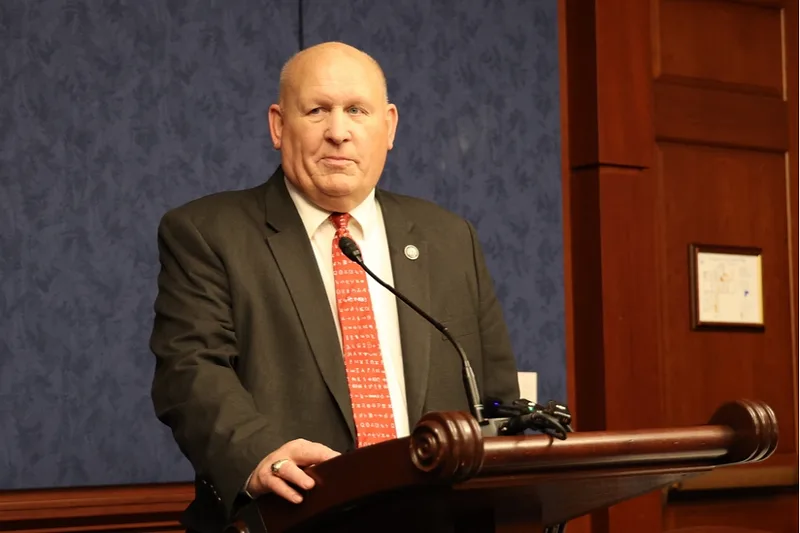
House Agriculture Committee Chairman Glenn "GT" Thompson, R-Pa., will formally introduce his Securing Agriculture's Workforce Act today, setting up what supporters hope will be the most significant opportunity for ag labor reform by Congress in years.
The proposal would make significant changes to the H-2A guest worker program by expanding eligibility for agricultural operations with year-round labor needs like the dairy sector, removing the requirement that agricultural work must be seasonal, revising wage calculations, and streamlining the application process. The bill reflects recommendations developed by the House Ag Committee's bipartisan Agricultural Labor Working Group.
The measure enters Congress with broad support from farm groups, including the American Farm Bureau Federation, Western Growers and the Florida Fruit & Vegetable Association, among hundreds of others. They argue the legislation would help address chronic labor shortages and provide greater certainty for employers.
At the same time, labor and farmworker advocates are pushing back. A letter circulated on Capitol Hill Monday by a coalition that includes the AFL-CIO, United Farm Workers, United Food and Commercial Workers and other worker groups warned the reforms would expand employers' reliance on guest workers while weakening wage and workplace protections.
Why it matters: Agricultural labor reform has repeatedly stalled despite years of complaints from producers that the current H-2A system is costly and restrictive. Supporters are calling Thompson's proposal the most significant opportunity in years to overhaul the program.
While it will be introduced by Thompson, the bill will ultimately be under the jurisdiction of the House Judiciary Committee.
Read more on Agri-Pulse.com today.
Trump can remove independent agency heads, Supreme Court rules
The Supreme Court on Monday affirmed the president’s ability to fire the leaders of several independent agencies at will, overturning a 91-year-old precedent that had shielded them from executive influence.
In a 6-3 ruling, the court’s majority found that President Donald Trump has the power to fire Rebecca Slaughter, a Democratic appointee to the Federal Trade Commission. Chief Justice John Roberts, writing for the majority, concluded that the FTC wields executive power, so its leadership must answer to the president.
“Our Constitution creates three branches, but only one President,” he wrote. “That President is not all powerful — not by any means. But he is not impotent either. He and he alone is vested with” executive power.
The case’s implications extend to an array of other independent boards and commissions, like the Surface Transportation Board, the Federal Communications Commission and the Securities and Exchange Commission.
Cut through the clutter! We deliver the news you need to stay informed about farm, food and rural issues. Sign up for a FREE month of Agri-Pulse here.
But, but, but: In a separate 5-4 ruling, with Roberts and Justice Brett Kavanaugh joining the liberals, the court held that the Federal Reserve's "for cause" protections are constitutional, and let Governor Lisa Cook, whom Trump attempted to fire, remain in office for now as litigation continues.
Grain and oilseed seeding report due amid questions on Iran impact
In one of the most watched ag reports of the year, USDA today will issue fresh estimates for this year’s grain and soybean plantings.
The big question: Did surging fertilizer and fuel prices during spring planting lead farmers to alter their original planting plans? The increase in already elevated costs for farm inputs may have been outweighed by mostly good planting conditions this spring.
Robust inventories: Also today, the department releases its quarterly report on crop stockpiles. That’s “expected to remind traders that we have ample supplies,” said Arlan Suderman, chief commodities economist for StoneX Group.
March estimates: The market will compare today’s estimates against USDA projections in March that called for corn acreage of 95.3 million, down 3% from last year’s record-big crop. Soybeans were seen at 84.7 million acres and cotton at 9.64 acres, both a rise of 4% if realized. All wheat was estimated at 43.8 million seedings, down 3% and the lowest since records began in 1919.
Bennet faces tough slog in Colorado Democratic primary for governorIt’s primary day in Colorado.
Sen. Michael Bennet, D-Colo., a member of the Senate Agriculture Committee, is facing off against Attorney General Phil Weiser to be the Democrats’ pick to run for governor in November’s open race.
The candidates are neck and neck. The winner will advance to the general election to compete against the Republican nominee in the race to succeed term-limited Democratic Gov. Jared Polis.
Bennet is pitching a message of “standing up” to Trump. But Weiser has come after the senator for supporting some of Trump’s Cabinet nominees, including Agriculture Secretary Brooke Rollins and Interior Secretary Doug Burgum.
“[Rollins] tried to pull SNAP food benefits from Colorado,” Weiser said in a gubernatorial debate a few weeks ago.
In response, Bennet has touted his pragmatic approach.
“The reality is that Colorado and the American West are going through an existential fire crisis, and we need the resources that the Forest Service is bringing to bear in Colorado,” Bennet said. “The easiest vote in America is to vote against one of Donald Trump's nominees, but when it's the right thing to do for Colorado, when it's the right thing to have the resources that we need and the attention that we need, I've done that.”
If he loses the race, Bennet is expected to stay in the Senate, where he’s not up for reelection until 2028.
WRDA markup on tap this week in House Transportation Committee
The House Transportation and Infrastructure Committee this week will consider a heavy-lifting water bill aimed at strengthening waterways across the country.
Committee Chairman Sam Graves, R-Mo., will oversee a markup Wednesday of the Water Resources Development Act, or WRDA, which authorizes U.S. Army Corps of Engineers civil works projects.
Missouri farmer asks judge to deny proposed settlement in Deere class action
A Missouri farmer is asking a federal judge to deny a proposed $99 million settlement in a class-action lawsuit over John Deere’s repair practices.
In a filing submitted to the federal court in Illinois' Northern District on Monday, Missouri farmer Jared Wilson alleged the settlement “would cause manifest injury to the interests of every farmer in America.”
He asserted that “by extinguishing farmers’ rights of action against Deere’s monopolization of repair markets for a slap-on-the-wrist in damages and ineffectual injunctive ‘relief,’” the settlement would "strengthen Deere’s repair monopoly instead of dismantling it.”
Wilson said the average member of the class will “get, at best, a $400 check, remain under Deere’s thumb, and see no meaningful change in their independence to repair their equipment.” He urged Iain Johnston, the judge overseeing the case, to reject the proposed settlement, which was filed in April.
Keep in mind: Beginning in 2022, several farmers filed lawsuits against John Deere, accusing it of monopolizing the repair market for Deere-branded machines with onboard central computers, and these cases were consolidated into one proceeding in Illinois' Northern District. Deere denies the allegations.
Under the proposed settlement, Deere agreed to pay $99 million and make repair resources available to every owner, lessor and independent repair shop "on a license or subscription basis on fair and reasonable terms,” according to a court filing. Once more than half of Deere dealer locations have access to those tools, the company will make future repair resources available to the same groups “on fair and reasonable terms,” it says.
Deere also agreed to let equipment owners, lessors and independent repair shops report possible defects to the company through its Customer Contact Center and give them the ability to perform reprogramming and diagnostics in offline mode through the John Deere Operations Center PRO Service by the end of the year.
Final Word
“Open-ended delegations of legislative power have not gone away; now they will just be exercised by agency officials who answer to the President. The power to write new regulatory crimes still exists, but now the pen ultimately rests in the President’s hand. The ability to judge disputes in-house remains, but now the house is white.” — Justice Neil Gorsuch, concurring with a majority opinion in a Supreme Court ruling that found the president can remove leaders of several independent agencies at will.
.webp?t=1762183428)


