
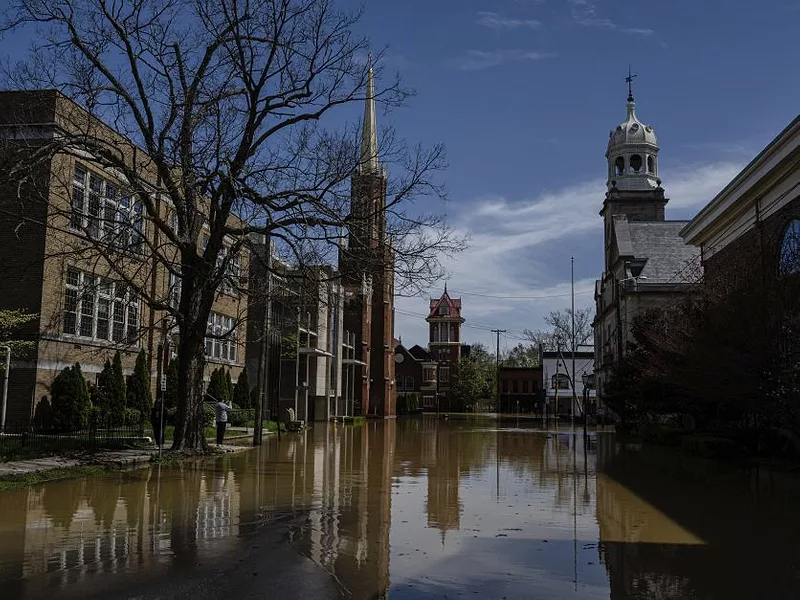
Intense rains that for days pummeled the Midwest and South have flooded farmers' fields, ruining some crops already in the ground and keeping producers off of acres that hadn’t yet been planted.
Roads have been submerged, and buildings have been damaged. At least 23 people are reported to have died.
Rainstorms that began last Tuesday and, in some cases, lasted through Sunday have devastated communities across the Mid-South whose residents are dealing with flooded homes and fields. Floodwaters, tornadoes and strong winds have flipped tractors over, crumpled grain bins and left trees lying across roads.
Farmers who had been inspired to plant corn and soybeans in the sunshine of previous weeks are now trying to figure out whether they should shoulder the cost of replanting their fields. At the same time, they must also weigh the low commodity prices and high input costs impacting the industry.
“We didn’t really, nor do we ever really, need a storm like this during planting,” said Tyler Oxner, a director of commodity activities and economics at the Arkansas Farm Bureau. "But this year it really, really hurts."
A strip of the U.S. stretching from the northeastern corner of Texas through the lower Ohio Valley has seen 8 to 16 inches of rain fall in the past week, according to USDA meteorologist Brad Rippey. Western Tennessee, southeastern Missouri, western and northern Kentucky and much of Arkansas saw heavy precipitation, which also extended into southern Illinois, Indiana and Ohio.
It’s easy to be “in the know” about agriculture news from coast to coast! Sign up for a FREE month of Agri-Pulse news. Simply click here.
Preliminary reports indicate over 100 tornadoes formed between April 1 and April 5, hitting much of that region, Rippey said. The most active tornado day was April 2, when “several dozen” tornadoes tore across the mid-South, causing some fatalities, he said.
Storms had also hit parts of the region back in February, causing some flooding. Rippey said that was likely an effect of La Niña, a weather phenomenon caused by changing ocean surface temperatures in the equatorial Pacific.
While planting had not yet gotten underway in the northern end of the impact zone, farmers in Arkansas, Mississippi and a small section of Kentucky and Tennessee had started planting corn and soybeans.
Arkansas farmers had planted 31% of their planned corn acreage as of Monday, while Mississippi farmers had planted 42%, according to USDA’s National Agricultural Statistics Service. Only 3% of Tennessee’s planned corn acreage and 1% of Kentucky’s had been planted by that date.
Additionally, Arkansas farmers had planted approximately 11% of the state’s planned soybean acreage as 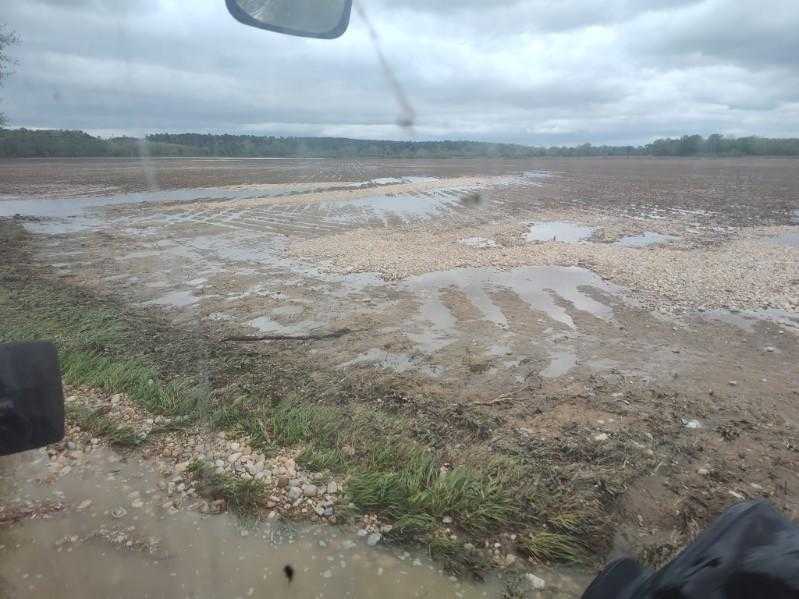 A flooded field in Arkansas. (Derek Helms photo)of Monday. Six percent of planned Mississippi soybean acreage had been planted by that day, along with 2% of Tennessee acreage and 1% percent in Kentucky.
Planting season for rice was also underway in Arkansas and Mississippi. Fifteen percent of expected rice acreage had been planted as of Monday in Arkansas, while 14% had been planted in Mississippi.
Farmer Derek Helms said he saw 14 inches of rain on his operation near Arkadephia, Arkansas. He had planted 350 acres of corn, some of which had already emerged. While he is unsure of how much of that has been ruined by flooding, he expects to have to replant some of it.
"It’s a pretty good cost to go in and replant all that,” he said. “We’re going to incur those costs and we’re watching some pretty unstable markets at this time, too. So it’s been a really nervous time.”
Drew Langley, who farms near Glendale, Kentucky, said he has received a little over 13 inches of rain. He planted 350 acres of beans, 50 to 60 acres of which was underwater as of Monday.
Other farmers question how soon they’ll be able to get into their fields following the flooding.
Tennessee farmer Ty McConnell said he has a field near the Obion River that is still mostly submerged. Surging water burst through a levee along the river, which he said had just been rebuilt following flooding in February.
“It’s as bad as we’ve ever seen it,” McConnell told Agri-Pulse. “When you have two major rain events within six weeks of each other … it’s just highly unusual.”
Jonathan Reynolds, president of the Kentucky Soybean Association, said he’s still got some standing water in low-lying parts of his fields, but only about 40 acres. He hopes to be able to begin planting soon.
“I’m not too worried yet,” Reynolds said of planting. “But the biggest thing is how long it’s going to take to dry out.”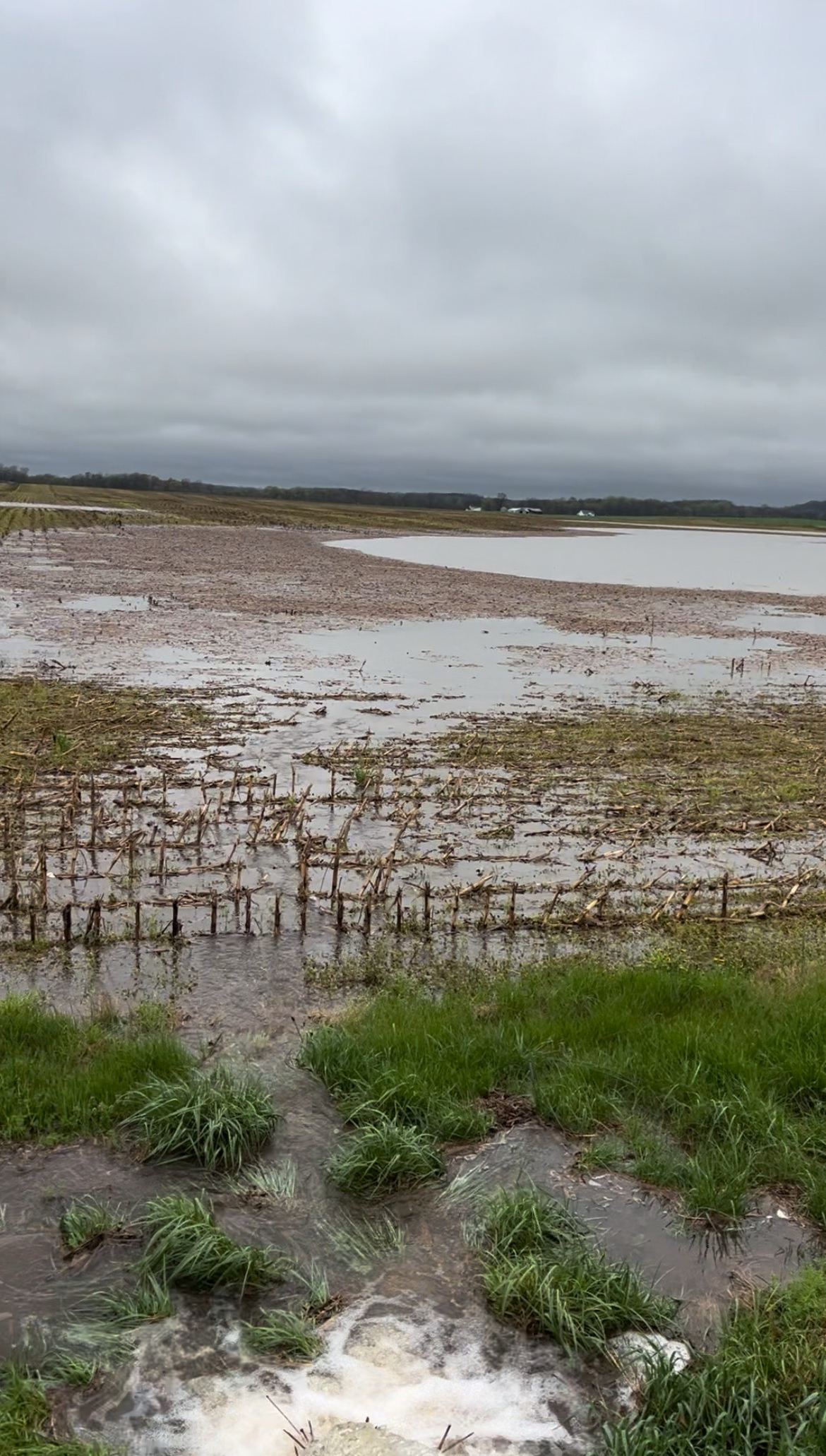 A flooded field where soybeans were recently planted. (Photo by Drew Langley)
Clay Brewer, who operates the Trenton Regional Stockyards in Trenton, Tennessee, said water flooded into the sale barn’s holding pens, ring, break room and office amid constant rain from Wednesday through Sunday. Much of the water has since receded, but the facility is "now a muddy mess,” he said. He’s trying to clean it up and repair the damage.
“It’s kind of a big headache, really,” he said.
The flooding has hit livestock producers, too. "I’ve heard firsthand accounts of producers rescuing calves from rising waters, and many now face the long, difficult task of repairing fences and clearing debris from hay fields and pastures," said Jake Cartwright, a director of commodity activities and economics at the Arkansas Farm Bureau Federation.
While the rains have subsided, the excess water will now make its way into the Ohio and Mississippi rivers, which means further flooding could occur along their banks in coming weeks. Mississippi Agriculture Commissioner Andy Gipson told Agri-Pulse at least 320,000 acres of land along the Mississippi could be underwater for most of April due to heightened water levels.
“It’s been a rough spring in terms of weather,” Gipson said. "All of these impacts are going to, unfortunately, adversely affect our farmers and that’s the last thing they need these days.”
For more news, go to agri-pulse.com.

