
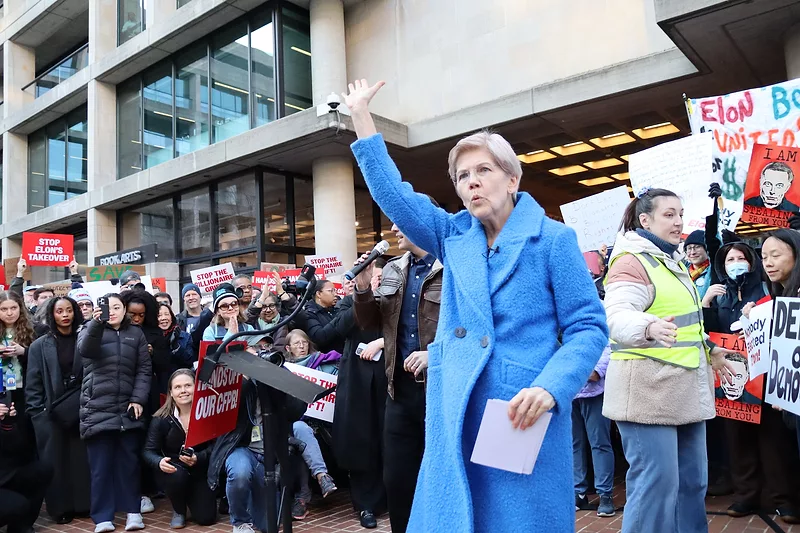
Democrats have blasted the Trump administration's new tariffs for potentially imposing steep costs on U.S. families, threatening to tip the economy into a recession, and what they say has been a haphazard rollout that fuels uncertainty for U.S. farmers, producers and businesses.
But the popularity of President Donald Trump’s underlying policy objectives and lack of predictability introduce challenges for opponents’ messaging, some analysts say. They argue critics have to proceed carefully to avoid dismissing the underlying arguments that resonate with voters.
Trump ran on a campaign that promised steep duties to re-shore American manufacturing, reduce the U.S. trade deficit and address unfair trade practices that have seen American exports, including many agricultural products, effectively locked out of foreign markets.
“You’ve got to be careful about just saying, like, ‘This is not for working people’… until you have an answer for this,” Sarah Bianchi, a deputy U.S. trade representative in the Biden administration, said during a recent panel discussion at the Brookings Institution. “If you dismiss all of that, you're going to be missing something that's very central to this presidency and to the appeal of this president.”
When Trump imposed duties on Canada and Mexico, Democrats lined up to denounce the duties as a tax that would be felt most keenly by the lowest earners and working Americans. But multiple union leaders, including those of the Teamsters and the United Automobile Workers, have since backed parts of the president’s tariff agenda, undermining this message.
“It's a huge problem,” a former Biden administration trade official told Agri-Pulse. “We really all have to take a step back as Democrats and think, like, what's not working here?”
A former aide at the Senate Finance Committee, the committee responsible for trade policy oversight, agreed that union support for the tariffs blunts the message.
“Unions drive voters, and I think it's a big deal,” the former aide said.
The Democratic messaging has shifted after Trump’s April 2 announcement of reciprocal duties and a temporary reprieve given to some trade partners. Lawmakers in recent days have been more focused on the cost the abrupt tariff announcements and policy whipsaws impose on business.
It’s easy to be “in the know” about agriculture news from coast to coast! Sign up for a FREE month of Agri-Pulse news. Simply click here.
“It's just all chaos and corruption,” Sen. Elizabeth Warren, D-Mass., said on ABC Sunday.
This line of opposition, analysts say, puts Democrats on firmer ground. Democratic lawmakers don’t want to be seen reflexively opposing everything Trump does, media consultant and political strategist Julian Mulvey told Agri-Pulse. They also don’t want to be seen defending policies of the trade liberalization era that contributed to the loss of manufacturing jobs and rising trade deficits.
“No one wants to defend the global order, but you can go about this recklessly, trying to bring back American jobs, or you can go about it more thoughtfully,” Mulvey said.
Last week, in a speech ahead of her meeting with the president in the Oval Office, Michigan Gov. Gretchen Whitmer signaled that she sympathized with the motivation behind Trump’s tariffs.
“I’m not against tariffs outright, but it is a blunt tool,” Whitmer said. “You can’t just pull out the tariff hammer to swing at every problem without a clear, defined end goal.” But Whitmer has been an outlier in a cacophony of Democratic voices issuing full-throated tariff denouncements.
Criticizing the rollout as Whitmer has – while acknowledging the problems that tariffs are trying to solve – is a “winning message,” the former aide said, particularly in swing states like Michigan.
It also protects Democrats in the event Trump signs a slate of deals with countries in exchange for lowering U.S. duties. Under such a scenario, the aide said, not only would the worst economic projections from the tariffs never materialize, but the tariffs could have secured some concessions from U.S. trade partners.
“If you speak too early, and then Trump holds back and you never see any of the impacts, then I guess they've been wrong and look like Trump was right,” the aide said. But they added that “the chaos makes it really hard to message.”
The longer the tariffs remain in place, however, the easier the opposition messaging is likely to become, multiple analysts said. If the U.S. tariffs and Chinese retaliatory tariffs are still in place at the end of the summer going into the fall, when many commodities have been harvested and exporters are looking for overseas buyers and when retailers have drawn down existing stocks as far as they can go, some of the larger impacts of the tariffs will begin to show.
"The consequences of Trump's policy will speak for itself," Mulvey said.
 Brendan Duke (LinkedIn photo)When tariff impacts start to show up in economic data and in the everyday prices consumers are paying, critics’ messages will land more cleanly, Brendan Duke, senior director of federal budget policy at the Center on Budget and Policy Priorities told Agri-Pulse. “More important than what any particular politician says is what ends up happening,” Duke said.
The backdrop of Republicans in Congress trying to assemble and pass a package of sweeping tax cuts as the tariffs bite could also give critics’ messaging more clout, Duke added.
“Republicans talking about rhetorically offsetting the cost of their tax cuts with these tax increases that are the tariffs,” Duke argued, “makes the whole thing much more politically toxic.”
Duke said there could be a situation where Republicans in Congress are talking about cutting food benefits through the Supplemental Nutrition Assistance Program, as Americans are noticing grocery prices going up from the new tariffs. “That's going to be a key part of the critique of tariffs,” Duke said.
For more news, go to www.Agri-Pulse.com.

