
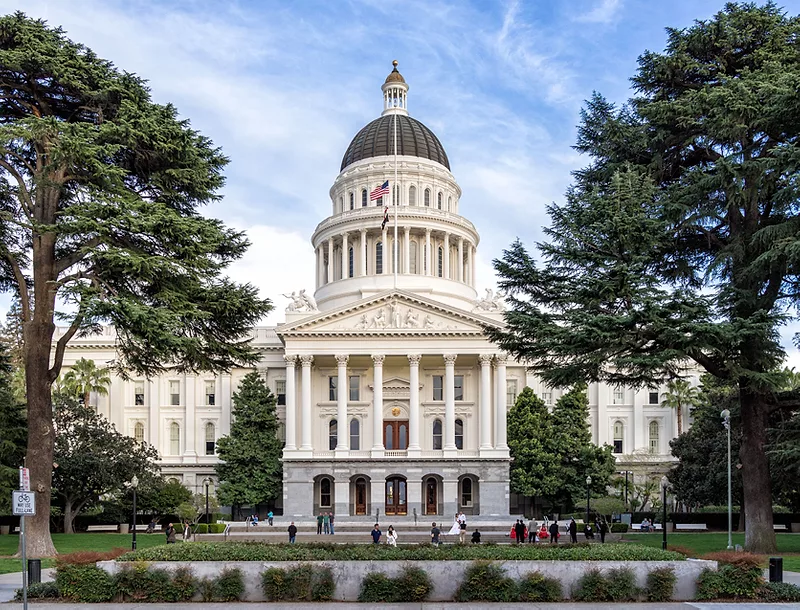
State and federal agencies broke ground on the Tenmile Slough project as part of a greater effort along the Lower San Joaquin River. The segment is considered the most inadequate across the Central Valley levee system.
The initiative is projected to protect 122,000 people and nearly $29 billion in property from future flooding. California Department of Water Resources Director Karla Nemeth said the project will pay for itself as shifts between wet to dry conditions increase.
State flood risk management in the Sacramento and San Joaquin river basins is informed by the 2022 Central Valley Flood Protection Plan update. The lower Delta region is considered roughly 75% rural and is locally governed by the San Joaquin Area Flood Control Agency.
Legal challenges mount, but tariffs likely aren’t going anywhere soon
California opened a fourth legal challenge to President Donald Trump’s use of emergency presidential powers to impose tariffs last week. But while the case may have merits and could inspire additional cases, those hoping the courts will provide swift relief from the duties will likely be disappointed, legal experts say.
Gov. Gavin Newsom and State Attorney General Rob Bonta are suing the administration in a district court in California, arguing that Congress, not the president, has purview over U.S. tariff policy and that nowhere in the powers delegated to the president does it state he may use tariffs in an economic emergency.
Read our full report at Agri-Pulse.com.
Industry: Port fee plan better – but not good enough
The Trump administration’s plan to boost domestic shipbuilding continues to raise concerns in some ag sectors despite the latest revisions.
Industry groups say revised new port fees on Chinese-built and operated ships are an improvement on earlier proposals but will still raise costs for many ag exporters. The final fees are “better, but not necessarily good enough,” Agriculture Transportation Coalition director Peter Friedmann tells Agri-Pulse.
It’s easy to be “in the know” about agriculture news from coast to coast! Sign up for a FREE month of Agri-Pulse news. Simply click here.
Keep in mind: The U.S. will impose new fees beginning in October, the Office of the U.S. Trade Representative said last week. USTR watered down earlier proposals by exempting vessels arriving empty and those on shorter routes, as well as capping the number of times a ship will have to pay the fee.
But Friedmann says shipping commodities such as soybeans and almonds via container will still cost more. The International Fresh Produce Association says the fees “may affect agricultural and perishable products.”
American Association of Port Authorities president and CEO Cary Davis says the fees will “still drive up the cost of shipping, reduce volume through our nation’s trade gateways, and make goods” more expensive.
Take note: China’s Ministry of Foreign Affairs on Friday responded by saying it would “take necessary measures to defend its lawful rights and interests.”
Don’t miss: Hoelscher being tapped ag negotiator
As we scooped on Friday, President Donald Trump will nominate Doug Hoelscher to serve as chief agricultural negotiator in the Office of the U.S. Trade Representative, according to sources. Hoelscher would join the administration from the America First Policy Institute – the Trump-aligned think tank founded by now Agriculture Secretary Brooke Rollins. The Iowa native led the organization’s American Leadership Initiative, which worked on a strategy to swiftly execute the president’s policy agenda upon taking office.
Luke Lindberg confirmation hearing slated for April 29
The Senate Agriculture Committee has scheduled a confirmation hearing April 29 for Trump’s pick for USDA undersecretary for trade and foreign agricultural affairs, Luke Lindberg.
Lindberg would join the administration from the America First Policy Institute – the Trump-aligned think tank founded by Agriculture Secretary Brooke Rollins.
Increased trade frictions could threaten ag innovation, economist warns
An ag economist says the Trump administration’s decision to reignite a global trade conflict with China could have implications for innovation and adoption of new ag technology.
Economists have been increasingly concerned in recent months over “how the global economy is fragmenting,” says Sandro Steinbach, who leads North Dakota State’s agricultural policy and trade studies.
During an event hosted by Virginia Tech, he argued China’s 2013 rejection of certain U.S. corn shipments demonstrated the threat regulatory divergence poses to ag innovation. Beijing blocked imports of U.S. corn bred with a new trait to control insects.
The incident led to U.S. corn growers successfully suing Syngenta, arguing the company should not have commercialized the seeds without Chinese approval.
But, but, but: Steinbach added that the U.S. “decoupling from China in terms of ag trade” could also provide opportunities for reassessing international regulatory frameworks. “There's an opportunity that comes with heavy change at the same time,” he said.
NWS warns of potential weather balloon launch suspensions
The National Weather Service may temporarily reduce or suspend weather balloon launches at offices across the U.S. due to staffing challenges.
In a normal year, the agency would launch weather balloons twice a day at its sites. Now, launches may be reduced to one per day or dropped entirely. A notice issued by the agency says it’s “actively pursuing alternative sources of upper-air data and adjusting internal staffing and procedures to maintain continuity of service."
Why it matters: Weather balloons are among the most reliable methods for collecting weather data.
By the way: The American Meteorological Society and the National Weather Association are warning in a statement that the proposed elimination of the National Oceanic and Atmospheric Association’s research arm could reduce observational data collection and cause weather models and products to “stagnate."
FDA: No shift in foodborne illness communication policy
FDA didn’t provide details or name companies responsible for growing and processing lettuce tied to an E. coli outbreak that sickened dozens and led to one death, according to a NBC News investigation.
Earlier this month, the agency closed the investigation without disclosing details to the public. An internal report obtained by NBC found that FDA did not name companies involved because no contaminated lettuce was left on shelves by the time investigators discovered the pathogen's source.
FDA’s take: A spokesperson for the FDA said this incident was not a shift in policy, and the agency names firms when there is enough evidence linking them to an outbreak and there is actionable advice for consumers.
Most of the FDA’s communications team was eliminated through the reductions in force at the Department of Health and Human Services. This team was often responsible for public and stakeholder engagement during outbreaks. In a statement, the FDA spokesperson says the human foods program continues to provide “critical communications” to consumers related to outbreaks.
Trump moves to make it easier to fire federal employees
The Trump administration is proposing to make it easier to fire federal workers by allowing them to be moved into what’s known as Schedule F employees.
The proposed rule from the Office of Personnel Management “lets policy-influencing positions be moved” into Schedule F. “These positions will remain career jobs filled on a nonpartisan basis,” the proposed rule states.
“Yet they will be at-will positions excepted from adverse action procedures or appeals,” the proposal says, allowing agencies “to quickly remove employees from critical positions who engage in misconduct, perform poorly, or undermine the democratic process by intentionally subverting presidential directives.”
Union’s take: The American Federation of Government Employees has already sued over the plan, announced in a Jan. 20 executive order. Under a briefing schedule set for that litigation, the government must respond to the complaint tomorrow.
About 50,000 civil servants would be affected by the change, according to OPM – or about 2% of the federal civilian workforce.
Final word
“The road to reviving California salmon will be long. But these successes give me hope and the drive to keep fighting for salmon.” — California Department of Fish and Wildlife Director Chuck Bonham, in an op-ed for CalMatters responding to the third closure in a row for commercial salmon fishing.


