
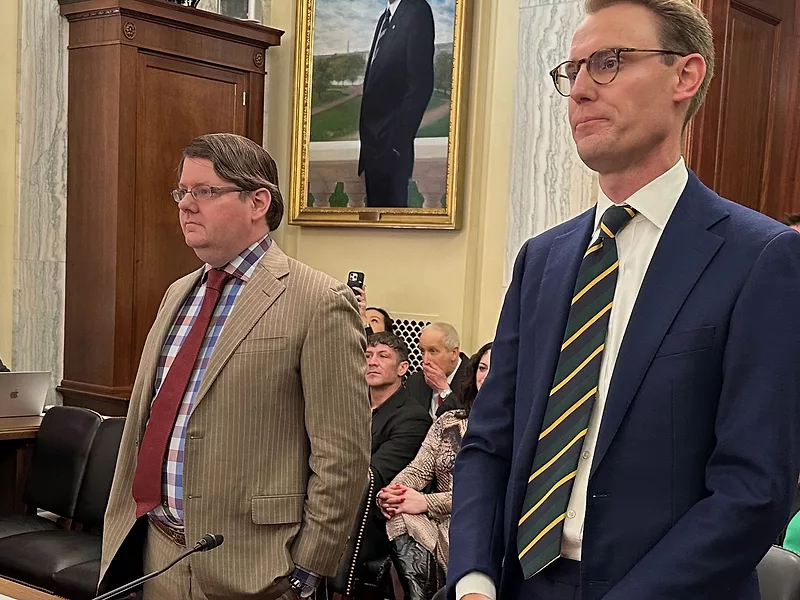
The Senate Agriculture Committee voted along party lines Monday evening to send two USDA nominations to the Senate floor: Stephen Vaden to be deputy ag secretary and Tyler Clarkson to be USDA’s general counsel.
The panel voted 12-11 to approve them. “We do have concerns about these nominees’ past records, so we will be not voting for them,” said the committee’s ranking Democrat, Amy Klobuchar of Minnesota.
Vaden served as general counsel during the first Trump administration, and Clarkson was deputy general counsel.
Keep in mind: Ag Secretary Brooke Rollins remains the lone official at USDA who’s been confirmed by the Senate.
SNAP advocates gear up for Capitol Hill fight
Anti-hunger groups see this week as their final chance to persuade Republicans to block steep cuts in the Supplemental Nutrition Assistance Program that some argue would be almost impossible to reverse.
The Food Research & Action Center hosted its National Anti-Hunger Policy Conference this week, which leads up to a lobby day and SNAP rally today.
A House Agriculture Committee markup on its portion of the budget reconciliation bill was originally scheduled for this week but is now expected next week. The panel’s Republicans remain split on how to find over $230 billion in spending reductions.
Anti-hunger groups are concerned by proposals to toughen SNAP work requirements, a potential state-cost share model for the program and restrictions on the Thrifty Food Plan.
Keep in mind: Some Republicans are not on board with the cost-share proposal. Rep. Derrick Van Orden, R-Wis., instead proposed basing state cost-share on each state’s error rates. For example, Wisconsin had a 4.74% SNAP error rate in 2023. Under his proposal, the state would be responsible for covering the same percentage of the program.
Other states, including many red states, have significantly higher error rates. Alaska in particular has drawn attention from lawmakers for a 60.37% error rate in 2023.
Shifting costs to the states would make a “bad thing worse” said Salaam Bhatti, SNAP director at FRAC. He said this would impact services, which Republicans could try to use as justification for additional cuts down the road.
Meanwhile: House Agriculture ranking member Angie Craig, D-Minn., echoed this sentiment in her address to the anti-hunger advocates Monday morning. She said she’s seen a disconnect between what Republican colleagues will say privately versus publicly on Medicaid and SNAP cuts, but more recently those members are starting to draw red lines.
Cut through the clutter! We deliver the news you need to stay informed about farm, food and rural issues. Sign up for a FREE month of Agri-Pulse here.
“I’ve seen a whole lot of my colleagues draw red lines and just jump in the red pool after … or get their arm twisted to support bad policy anyway,” Craig said. “So, I sure hope as my colleagues march up to these lines that they’re willing to hold the line.”
By the way: House Ag Republicans will be meeting this morning to talk about their plans for meeting their target spending cut.
Grocers’ report highlights SNAP’s impact on local economies
A new analysis from the National Grocers Association found that SNAP generated over $4.5 billion in federal, state and local tax receipts in 2024. The program supports about 388,000 jobs at grocery stores, warehouses, trucking companies, farms and more. This contributes over $20 billion in direct wages, according to NGA’s report, which came out this morning.
“SNAP is not just food assistance for families — it’s an economic engine that bolsters jobs on Main Street,” said Stephanie Johnson, NGA’s group vice president for government relations, in a statement.
NIOSH employees get RIF notices
The National Institute for Occupational Safety and Health saw another round of layoffs on Friday, affecting most of the staff who had not already been let go, two sources with knowledge of the cuts told Agri-Pulse.
Employees who research occupational hazards associated with fishing were among those in the second wave, as well as some who help distribute funding to external Agricultural Safety and Health Centers, according to one former NIOSH employee.
Trump and Carney to meet amid tense US-Canada relations
Canadian Prime Minister Mark Carney is in Washington today for his first in-person meeting with President Donald Trump since winning the Canadian election last week. Carney’s office said the two would discuss trade and the future of the countries’ economic and security relationship.
The meeting comes against a backdrop of 25% U.S. tariffs on imports from Canada not covered by a North American trade deal, reduced to 10% on energy products and potash. On the campaign trail, Carney, a former central banker, argued that the era of deepening U.S.-Canadian integration is over — a “tragedy,” he called it.
Take note: Trump set the tone for the discussion in his Sunday appearance on NBC’s Meet the Press. “We don’t need their cars, we don’t need their lumber, we don’t need their energy. We don’t need anything,” he said. “We do very little business with Canada.”
Canada “has consistently been one of the top two trading partners for the United States,” according to the Office of the U.S. Trade Representative. So far in 2025, it’s also been the top destination for U.S. exports, which have totaled $55.7 billion.
Lutnick’s take: On Monday, Commerce Secretary Howard Lutnick poured cold water over a possible deal to lift the Canada tariffs. "It is very complex," he told Fox Business. Lutnick added it would be a "fascinating" meeting between the two leaders, but said he doesn't see how "it works out so perfectly."
Tyson sees cattle production expanding
Tight cattle supplies and strong cattle prices continue to weigh on meatpacking giant Tyson Foods, but the company believes producers are starting to rebuild their herds.
Tyson’s beef and pork segments posted operating income losses of $258 million and $195 million, respectively, for the latest quarter.
Tyson President and CEO Donnie King said it was the “most challenging beef environment we’ve ever seen.”
But Brady Stewart, who oversees the company’s beef and pork business, sees signs that the cattle market is easing. “If we’re not at the bottom relative to cattle inventories, we can definitely see it from here,” he told analysts on the company’s quarterly earnings call. He noted that beef cow slaughter numbers have dropped sharply.
Final word
“I'm actually so excited, and I'm so encouraged and the conversations that I have had — which I obviously can't talk about here — have been incredibly encouraging with our partners around the world.” – Agriculture Secretary Brooke Rollins talking to reporters outside the White House Monday about trade deals. She said that when President Donald Trump says 100 countries are “coming to the table, he is absolutely right.”
Rebekah Alvey, Philip Brasher, Oliver Ward and Noah Wicks contributed to today’s Daybreak.
For more news, go to www.Agri-Pulse.com.


