
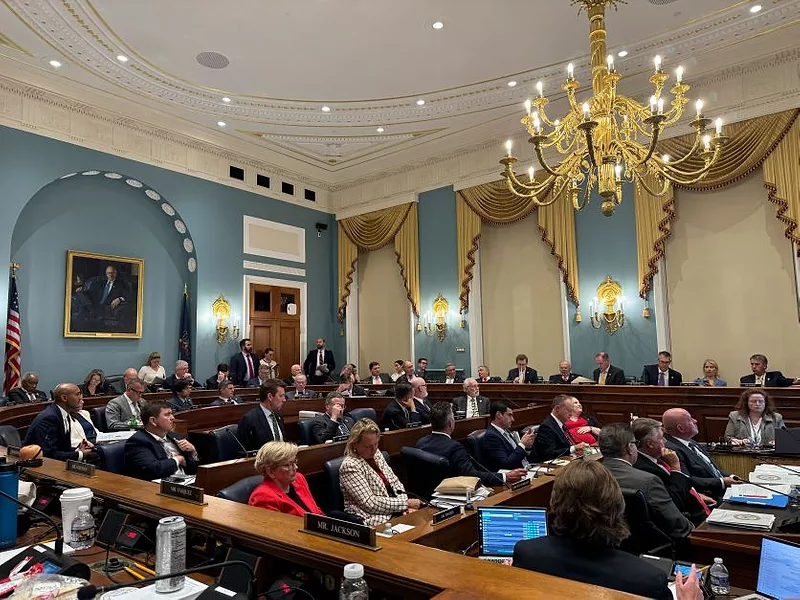
Democrats are making the process as painful as possible, but Republicans are pushing major pieces of their giant budget bill toward votes on the House floor.
After an all-night session, the House Ways and Means Committee approved the tax piece of the bill. It includes several valuable tax benefits for farmers and small businesses, including an increase in the Section 199A deduction for business income. Democrats used the long markup to highlight tax provisions that they say would benefit the ultrawealthy.
In the House Ag Committee, Democrats forced votes on amendments highlighting the cuts to projected nutrition assistance funding. But House Ag Chair Glenn “GT” Thompson, R-Pa., had made notable progress in winning moderates over to a state cost-share requirement for SNAP. Rep. Don Bacon, R-Neb., said his state’s cost-share is much lower than it would have been if moderates hadn’t spoken up. “I'll take that as a victory,” he said.
All Democratic amendments to the bill were ultimately defeated, and the Ag Committee approved the legislation on a party-line vote, 29-25, Wednesday night.
What’s next: The committee measures will be merged into a single bill for House floor consideration. Some major provisions, including the state cost-share for SNAP, will face Senate GOP opposition.
Dietary guidelines will be streamlined, Kennedy says
The next edition of the Dietary Guidelines for Americans will be only four pages long, Health and Human Services Secretary Robert F. Kennedy Jr. revealed to House and Senate committees Wednesday.
As he has previously, Kennedy criticized the scientific report prepared by the Dietary Guidelines Advisory Committee, describing it before the House Appropriations Committee as “incomprehensible” and “written by industry.”
The new guidelines, which he projected would be out by August, will tell people to “eat whole food. You eat the food that’s good for you.” The secretaries of USDA and HHS work together to develop the final guidelines from the scientific report.
NIOSH comes up: Kennedy conceded that some cuts at HHS have been “painful,” including those at the National Institute for Occupational Safety and Health, which lost 90% of its staff. He said he had restored staff at three sites, but none that focus on how to prevent injuries to farmers, farmworkers or firefighters.
USDA bringing back climate-related webpages
USDA expects to restore climate-related content and pages to its websites in about two weeks in response to a lawsuit by environmental and farm groups.
Early in the Trump administration, USDA began removing websites and information related to climate change. This included a summary of projects receiving funds through the Partnerships for Climate-Smart Commodities as well as Natural Resources Conservation Service sites.
Earthjustice and the Knight First Amendment Institute at Columbia University filed a lawsuit challenging the action on behalf of environmental groups and the Northeast Organic Farming Association of New York.
In a letter to the Southern District of New York Court, USDA said it has begun the process of restoring sites and expects to complete this in about two weeks.
Lawmakers and industry push for domestic screwworm facility
A bipartisan group of House and Senate lawmakers are launching an effort to open a U.S.-based facility to protect U.S. livestock from New World screwworm. The STOP Screwworms Act would allocate $300 million for the construction of a sterile fly rearing facility in an at-risk area of the country.
Cut through the clutter! We deliver the news you need to stay informed about farm, food and rural issues. Sign up for a FREE month of Agri-Pulse here.
Senate Agriculture Committee members Sens. Ben Ray Luján, D-N.M, and Cindy Hyde-Smith, R-Miss., are among the five senators who introduced the bill Wednesday. Texas GOP Rep. Tony Gonzales is introducing the House version.
USDA has revived import restrictions on Mexico but groups representing U.S. ranchers also are pushing for a U.S. fly facility. The National Cattlemen’s Beef Association and the Texas and Southwestern Cattle Raisers Association welcomed the legislation.
Take note: Agriculture Secretary Brooke Rollins reportedly expressed enthusiasm for the idea of a U.S.-based facility in a closed-door roundtable last month with members of the Texas group.
China opens market to more Brazilian ag products
Brazilian exporters of duck and turkey meat, chicken offal, peanut meal and corn ethanol byproducts like dried distillers grains will now be able to export to the Chinese market.
During a visit by Brazilian President Luiz Inácio Lula da Silva to Beijing this week, the two governments inked multiple cooperation agreements and bilateral deals to boost agricultural trade.
These developments, plus last month’s agreement to allow Brazilian wild-caught fish exports, give Brazilian producers access to markets worth around $20 billion, the Brazilian Agriculture Ministry says.
China also lifted suspensions on five Brazilian soybean exporters ahead of Lula’s visit, Reuters reported at the time.
Take note: At the end of his five-day China trip, Lula stressed Brazil is “not concerned about competing with the United States,” insisting only that trade is a net positive for everyone.
He said he hoped that “both Brazil and the U.S. can improve the welfare and quality of life of their citizens through international trade,” according to an informal translation.
FDA seeks information on nutrients in infant formula
The Food and Drug Administration is asking for public input on nutrients in infant formula as it embarks on a comprehensive ingredient review.
A request for information was issued May 13 and commenters will have 120 days to respond. FDA is seeking comments “to help determine whether existing nutrient requirements should be revised based on the latest scientific data, including international,” the agency said.
“The agency also welcomes data on potential adjustments to existing minimum or maximum levels, recommendations for additional nutrients to consider, and how such changes may improve health outcomes,” FDA said in its announcement.
Zeldin: EPA working on 2026 renewable volume obligations
EPA Administrator Lee Zeldin says the agency will be working over the next few months to set 2026 renewable volume obligations under the Renewable Fuels Standard.
The agency missed its deadline for issuing the RVOs last November. Zeldin, speaking to members of the Senate Appropriations Committee, said he is “looking to not only solve that deadline in setting RVOs, but also look to the future and operate going forward in a way where we don’t blow any deadlines.”
On another note: Zeldin also said the agency is working on a new definition of “waters of the United States” that aligns with the Supreme Court’s decision in the Sackett case. WOTUS defines what streams, wetlands and other features are subject to federal jurisdiction.
“I want every one of your ranchers and landowners to know whether or not there is a water of the U.S. on their property,” Zeldin told Sen. John Hoeven, R-N.D. “We owe it to them.”
Final word
“We're a long ways from completion on this. I think this is the opening part of a conversation between both the House, the Senate and then getting it to the White House.” — Rep. Zach Nunn, R-Iowa, on the budget reconciliation bill.
Rebekah Alvey, Oliver Ward and Noah Wicks contributed to today’s Daybreak.


