
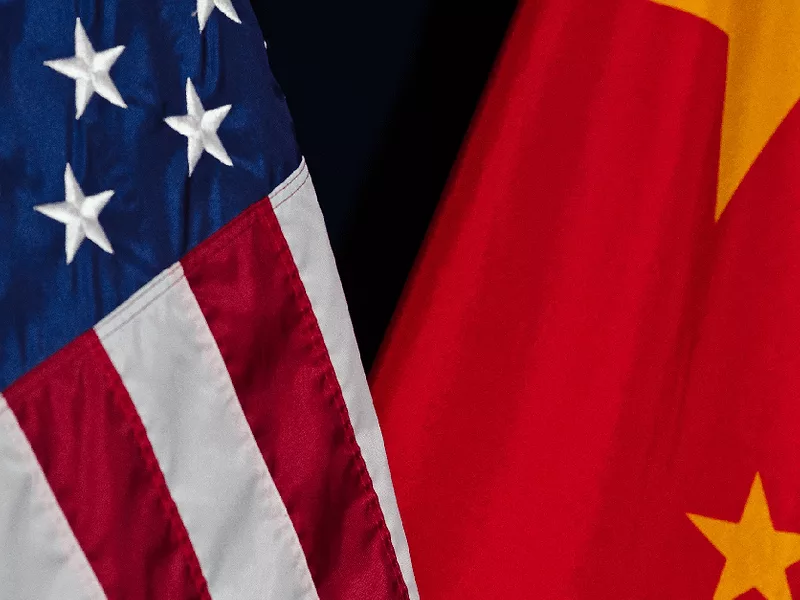
U.S. and Chinese officials are in Madrid today for the fourth round of discussions on tariff and other economic issues.
Why it matters: Last month, both countries extended a tariff truce until November. But trade tensions remain, and several ag commodities are already feeling the pinch from strained relations.
China had not made any bookings for the new soybean crop by the end of August – unprecedented for this late in the season, according to North Dakota State University (NDSU) researchers. Other buyers have not stepped in to offset the falling demand, the NDSU researchers find, and prices have fallen significantly below the price of production.
Chinese buyers are also holding off on booking U.S. corn, wheat and sorghum, and are only placing minimal orders for pork and cotton.
US calls on partners to use tariffs to end Ukraine war
President Donald Trump and senior administration officials are urging partners to use tariffs to help bring peace to Ukraine. In a post to his social media site over the weekend, Trump said he had written to NATO nations, criticizing their continued reliance on Russian oil.
“It greatly weakens your negotiating position, and bargaining power,” Trump said. He pushed for NATO countries to stop buying Russian oil and impose steep new duties on China over its continued purchases.
Treasury Secretary Scott Bessent and top trade official Jamieson Greer carried a similar message during an emergency call with G7 finance ministers on Friday. USTR said in a statement that the pair told ministers they should levy duties on countries buying Russian oil to squeeze revenues.
 U.S. Capitol (USDA Ken Hammond)
 GOP, Dems at loggerheads as spending deadline looms
The chances of a government shutdown in October are growing as Democrats and Republicans clash over the contents of a stopgap spending bill.
Republican leaders are expected to advance a relatively clean continuing resolution that would extend
government funding into November. But that CR can’t pass the Senate without 60 votes, and Senate Democrats are demanding that the measure also extend expiring health insurance subsidies.
Cut through the clutter! We deliver the news you need to stay informed about farm, food and rural issues. Sign up for a FREE month of Agri-Pulse here.
The new fiscal year starts Oct. 1.
Sen. James Lankford, R-Okla., said in an interview on CBS’ Face the Nation that Democrats are holding the CR hostage to get what amounts to $300 billion in additional health care spending.
But Sen. Chris Coons, D-Del., said extended heath care funding is critical because the Republican budget bill enacted in July is going to result in people losing health coverage. “I think there are ways we can reduce the harm to Americans' healthcare through the appropriations process,” he told Face the Nation.
For more on this week’s D.C. agenda, including an update on the Senate nominations process, read our Washington Week Ahead.
Health, not environmental concerns, driving organic demand
Matthew Dillon, Co-CEO of the Organic Trade Association, says there’s significant overlap between the Make America Healthy Again movement and organic consumers. Speaking on this week’s Agri-Pulse Open Mic,
Dillon says concern about health are the biggest reason people buy organic food, not environmental issues like climate change.
“The primary driver really is more aligned with the MAHA-movement type goals. That still is what's moving the sector forward,” he says.
Take note: OTA is holding its annual Organic Week, starting today in D.C. Dillon says there will be a major focus on increasing domestic production. The industry relies heavily on imported feed grains and beef. A bill called the Domestic Organic Market Expansion Act is being introduced to help fund on-farm infrastructure for organic crops.
County committees warn again of short staffing at FSA
County committee leaders continue to warn that short-staffed Farm Service Agency offices will be unable to quickly process farm program and disaster payments.
In a news release, the National Association of Farmer Elected Committees notes that USDA officials have said the speed with which disaster payments were recently distributed demonstrates that FSA offices can handle the workload.
But much of the groundwork for issuing those payments had been done in 2024 and 2025, NAFEC says. “A full year’s worth of work in FSA offices allowed the administration to quickly send out checks, based upon all of the work already performed in 2024 and 2025,” NAFEC says.
NAFEC says FSA leaders also have conceded in meetings with NAFEC that “staffing levels of county office employees are now under 6,000, as compared to several thousand more, just a few years ago.”
“NAFEC has county committee members in every county in the nation, and the word we are consistently hearing is our county office staffs are critically understaffed,” says NAFEC President Jim Zumbrink, a grain and turkey producer from Ohio.
Corteva considers splitting up seed, pesticide businesses
The Wall Street Journal is reporting that Corteva Agriscience is considering splitting up its seed and pesticide businesses. The Journal says the move could help protect the company’s seed business from liabilities associated with Corteva’s ag chemical side
The company is facing a lawsuit in federal court in Washington, D.C., from the Center for Food Safety and two other groups challenging registrations for Enlist One and Enlist Duo. The two herbicides are used as part of
Corteva’s Enlist soybean system. The plaintiffs contend EPA did not properly consider the environmental impacts of the herbicides.
Corteva stock was up 3.4% to $75.55 a share in regular and after-hours trading Friday on the news.
Litigants seek resumption of Snake River salmon lawsuit
Environmental groups, four tribal governments and the states of Washington and Oregon are seeking to restart litigation over a series of dams along the Snake and Columbia rivers after the Trump administration rolled back a federal plan meant to counter salmon declines.
The Biden administration in 2023 proposed the $1 billion Columbia Basin Restoration Initiative as it sought to end more than 20 years of litigation over the dams’ impact on native salmon. When the plan was introduced, a federal judge approved a five-year stay in the case to give participants time to see whether the initiative worked.
In June, Trump ordered the heads of four federal agencies to pull out of the agreement.
"The Trump administration’s recent actions leave us with no choice but to return to court,” Earthjustice Attorney Amanda Goodin said in a press release.
Final word
“Organic is still very much dependent on things we can grow here in the U.S.” – Matthew Dillon, Co-CEO of the Organic Trade Association, on Agri-Pulse Open Mic.
Oliver Ward and Noah Wicks contributed to today’s Daybreak


