
Fourteen House Republicans have come out against including language addressing California's Proposition 12 in the skinny farm bill, complicating a push by pork producers and other ag groups to overturn the 2018 law.
In the letter sent to to House Ag Committee Chair Glenn “GT” Thompson, R-Pa., and Ranking Member Angie Craig, D-Minn., the lawmakers said legislation such as the Save the Bacon Act would "erode states’ rights, undermine family farmers, and expand foreign influence over U.S. food production."
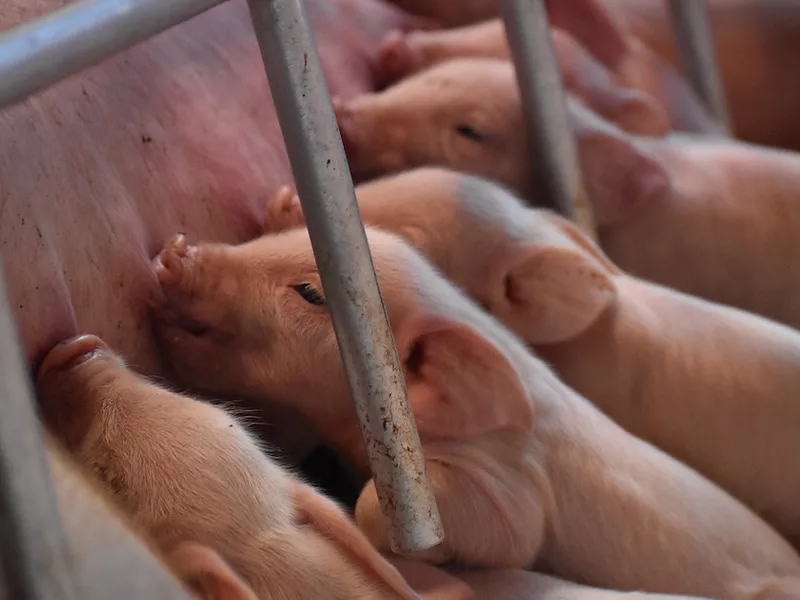
The ballot initiative was passed by California voters seven years ago and narrowly upheld by the Supreme Court in 2023. Prop 12 requires that pork sold in California come from the offspring of sows not raised in gestation crates. All swine farms in California and those selling into the California marketplace were required to comply with the rules as of January 2024.
Rep. Ashley Hinson, R-Iowa, introduced the Save the Bacon Act – a rebrand of the Ending Agricultural Trade Suppression Act – in July to prohibit state and local governments from interfering with livestock production in other states.
Reps. David Valadao of California, Anna Paulina Luna of Florida and Andrew Garbarino of New York led the letter.
Co-signers include Republican Reps. Gus Bilirakis, Vern Buchanan, Byron Donalds and Carlos Gimenez of Florida, Young Kim of California, Michael Lawler of New York, Nancy Mace of South Carolina and Brian Fitzpatrick of Pennsylvania. Reps. Tom Kean, Chris Smith and Jeff Van Drew of New Jersey also signed.
None of the signers are members of the House Ag Committee.
Cut through the clutter! We deliver the news you need to stay informed about farm, food and rural issues. Sign up for a FREE month of Agri-Pulse here.
Lawmakers specifically cited concerns with Chinese-owned Smithfield Foods, which is the largest pork producer in the U.S., controlling about a quarter of the market. The company returned to the U.S. stock market earlier this year.
“It is imperative to ensure that American farmers – not foreign governments – maintain control over U.S. domestic food production and supply chains to safeguard national interests,” the letter says.
"Enacting the EATS Act could further consolidate the influence of such foreign entities, granting them greater control over the U.S. agricultural sector and limiting the capacity of individual states to regulate their own food supplies," they said.
The National Pork Producers Council and American Farm Bureau Federation, among other industry groups, have cautioned that Proposition 12 and similar laws could create a patchwork of regulations dictating ag production practices across the country.
“The success of American agriculture has always depended on striking the right balance between federal and state responsibilities,” the letter says. “Congress must uphold this principle as it moves forward.”
“The Supreme Court has made it very clear that it's not something they were going to fix … a number of the opinions clearly stated that it's Congress' job and that we should do our job. So we are,” Thompson recently told Agri-Pulse. “We'll have the Save the Bacon Act, and we'll respect states’ rights to do internally whatever the states want to do."
Addressing concerns around industrial hemp and lawsuits against pesticide manufacturers are other examples of controversial provisions Thompson wants to include in “farm bill 2.0.”
Each vote – especially from his own party – will be critical to enact the legislation.
While Craig did not sign on to the Save the Bacon Act or similar legislation in the past, she recognized that it is “untenable for us to continue with 50 states having 50 different laws in this country.”
“I’m looking for how we can resolve the issue,” Craig told Agri-Pulse in August. “You’ve got a lot of people who have already invested in becoming Prop 12 compliant, so whatever we come up with I think it needs to be bipartisan and it needs to not punish the people who have made those investments already.”
A full House Ag Committee hearing was held in July where Republicans and one Democrat lawmaker – North Carolina Rep. Don Davis – said legislation is necessary to allow pork producers to raise their animals without the constraints of Prop 12.
For more news, go to Agri-Pulse.com.

