
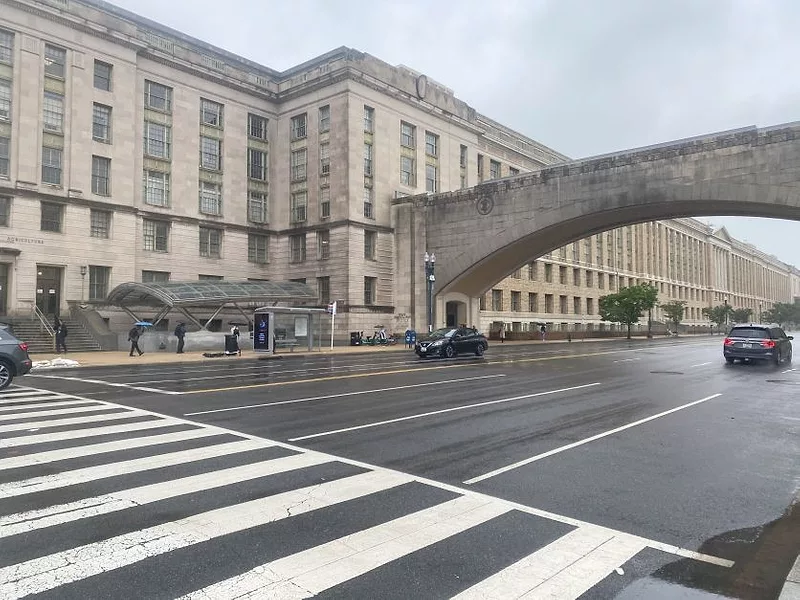
Half of USDA heads home for shutdown
About half of USDA employees will be furloughed under a shutdown plan released late Tuesday by the Agriculture Department.
Of the nearly 86,000 department employees, about 42,000 will go without pay during the shutdown due to Congress not agreeing on a spending plan.
No one knows how long the shutdown will last and Democrats and Republicans are each saying it’s the other side’s fault.
Majority Leader John Thune, R-S.D., accuses Democrats of abandoning the normal budget process.
“Instead of working with Republicans to extend government funding so that we can continue bipartisan appropriations work, Democrats are holding government funding hostage to a long list of partisan demands, totaling more than $1 trillion,” Thune said in an op-ed in The Washington Post Monday.
Meanwhile, House Minority Leader Hakeem Jeffries, D-N.Y., is touting poll numbers showing that more people will blame the GOP than the Democrats for a shutdown.
There’s always a lawsuit: Two unions on Tuesday claimed in a lawsuit that laying off federal employees during a shutdown is illegal.
“Carrying out RIFs is plainly not a permitted function that can lawfully continue during a shutdown," says the suit filed by the American Federation of Government Employees and the American Federation of State, County and Municipal Employees. It was filed in California’s Northern District.
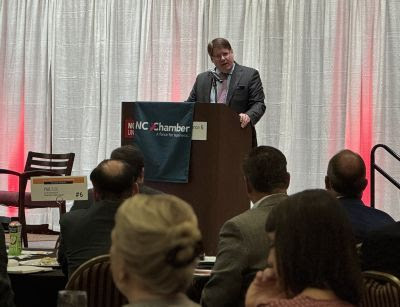 Stephen Vaden at the Ag Allies conference in North Carolina (Agri-Pulse photo)
Vaden questions why fertilizer prices are high
A spike in U.S. fertilizer prices isn’t adding up.
So says Deputy Secretary of Agriculture Stephen Vaden, as USDA and DOJ scrutinize the market for crop nutrients.
“We have so few domestic fertilizer companies, and one of those companies has an absolute majority market share,” Vaden told reporters Tuesday without elaborating. “You don't need to be a lawyer or an economist to realize that there are some questions that should be asked.”
The deputy secretary said he was meeting later with a fertilizer executive who wants to assure him nothing's wrong. Vaden said while he hopes so, it's important to look at pricing “so out of kilter.”
Some analysts say there's no mystery. It’s just demand outpacing supply and reliance on foreign producers.
"We can fix a lot of this by making more of our own," said Josh Linville, vice president of fertilizer at StoneX.
Cut through the clutter! We deliver the news you need to stay informed about farm, food and rural issues. Sign up for a FREE month of Agri-Pulse here.
Ag groups: U.S. needs enforceable trade agreements, stability
Representatives from across U.S. agriculture are calling for binding and enforceable trade agreements and stability in U.S. trade policy.
“Agreements have to be worth more than the paper they're written on,” Tracey Chow, government affairs director at Western Growers, said during a panel at the Congressional Hispanic Leadership Institute.
Chow says the U.S. needs to “get back to talking about, how do we establish rules, get detailed about reciprocal dispute resolutions processes to have that sort of reliability and certainty.”
“It just can't continue to be this, ‘we'll just see how we feel tomorrow.’ No one can plan for that,” she added.
The Meat Institute’s Michael Schumpp echoed that if the Trump administration’s recent trade deals don’t have binding commitments, it will be “very hard to hold trading partners accountable.”
Karis Gutter with Corteva said trade uncertainty is particularly challenging for their seed operations. Many of the company’s seeds require approvals from governments for import.
“We need stable trade partners and trade relationships,” said Gutter, who is vice president of Corteva’s government and industry affairs.

The CHLI agricultural trade panel. From left: John Weber, Monument Advocacy; Karis Gutter, Corteva; Tracey Chow, Western Growers; Michael Schumpp, Meat Institute. (Agri-Pulse photo)
Trump to hike tariffs on lumber
U.S. tariffs on lumber will rise starting Oct. 14 following a presidential proclamation issued this week.
Tariffs on all lumber imports will increase 10%, while derivative products, like furniture, will face even steeper hikes. The United Kingdom, European Union and Japan will see lower rates in line with their recent trade deals with the U.S.
The White House says the steps will protect U.S. national security, using legal powers known as Section 232. The increase will be on top of other duties, including antidumping duties on Canadian lumber.
“President Trump recognizes that an overreliance on foreign timber, lumber, and their derivative products could jeopardize the United States’ defense capabilities, construction industry, and economic strength,” a White House fact sheet reads. But the document adds that countries are free to negotiate an “alternative” to the hikes.
Lawsuit challenging disease traceability rule can continue, judge says
A lawsuit challenging a USDA rule requiring electronic eartags in certain cattle and bison transported across state lines is moving forward.
U.S. District Judge Eric Schulte in South Dakota rejected the federal government’s motion to dismiss claims made by cattle producer groups and ranchers alleging the rule is “arbitrary and capricious” under the Administrative Procedure Act. However, he did dismiss the groups’ claims that the rule went beyond USDA’s jurisdiction.
The lawsuit was brought by R-CALF USA, the South Dakota Stockgrowers Association, the Farm and Ranch Freedom Alliance, and South Dakota ranchers Kenny, Roxie, Rick and Theresa Fox.
New screwworm drug gets conditional approval from FDA
The Food and Drug Administration granted conditional approval for a drug meant to prevent New World screwworm infestations.
The agency has extended an initial green-light for cattle uses of Dectomax-CA1, an injectable drug produced by Zoetis that aims to treat New World screwworm larval infestations and prevent reinfestation for 21 days. It has the same active ingredient as Dectomax, which is already approved to treat certain parasites in cattle and swine.
"Under this conditional approval, the FDA has determined the drug is safe and has a reasonable expectation of effectiveness,” acting FDA Center for Veterinary Medicine director Timothy Schell said in a release. "We are making this treatment available to cattle producers immediately while the sponsor collects the data needed for a full approval."
Senators urge FDA to ensure egg integrity
Sen. Joni Ernst, R-Iowa, and Sen. John Fetterman, D-Pa., have introduced the Consistent Egg Labels Act to require FDA to set clear rules that only poultry-derived products can be labeled as “eggs.” The effort aims to support egg farmers and protect consumers from misleading plant-based labeling.
Reps. Chris Deluzio, D-Pa., and Elise Stefanik, R-N.Y., are leading the effort in the House.
“While Iowa farmers work hard to put healthy and affordable eggs on our tables, labeling plant-based products as ‘eggs’ undermines that work. That’s un-egg-cceptable,” Ernst said.
“The integrity of our eggs is no yolk, folks, which is why I’m taking a crack at ensuring there’s no question between the real deal and imitation.”
Final word
"Nobody likes government payments but my banker says it will make it easier to lend some of his clients money. At least we will have something coming in to keep us going." – Iowa soybean grower April Hemmes, who says any payments growers get will go straight to pay for things like fertilizer, seeds and rent. "Farmers are a hopeful bunch, but this has been a hard time to stay hopeful,” she says.
Kim Chipman, Oliver Ward and Noah Wicks contributed to today’s Daybreak
.webp?t=1762183428)


