
All 12 million tons of China’s soybean purchase target do not have to ship by the Dec. 31 deadline. So says Agriculture Secretary Brooke Rollins.
“It doesn’t mean we’ll move 12 million metric tons by the end of December,” Rollins told CNBC Monday. “But it means that those orders will come in according to their commitment.”
Chinese officials have yet to publicly confirm the commitment, but Rollins said the deal should be signed in the next two weeks.
“Every sign is their commitment remains true,” she said.
A critical two weeks: Rollins gave an update on internal deliberations around giving tariff assistance to farmers. She said that USDA is “looking at the aid” and there will likely be an announcement “in the next week or two.”
She added that the support package would have to reflect the latest trade conditions and ongoing negotiations.
“Every day that changes,” she said, adding, “We’re selling a lot more soybeans than we were … a couple of months ago when we first started talking about that.”
Europe won’t get more tariff relief until it cuts tariffs on U.S. ag
No tariff relief for the European Union until it makes tariff cuts on U.S. ag products that it agreed to in July, a top U.S. trade official says.
That’s according to U.S. Trade Representative Jamieson Greer who was with Commerce Secretary Howard Lutnick in Brussels to meet with European trade ministers and EU officials.
“It’s really hard to move on to other things or to a broader cross section of the economy before we fully implement the first part of the agreement,” Greer told reporters.
(Read more about the 2025 National Thanksgiving Turkeys at Agri-Pulse.com)
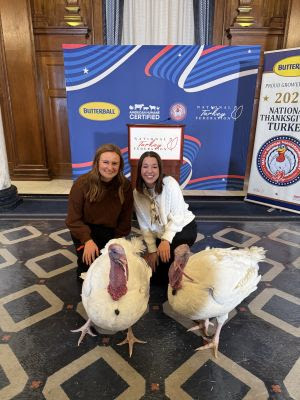 Agri-Pulse's Lydia Johnson and Parker Litterick with Gobble and Waddle.
 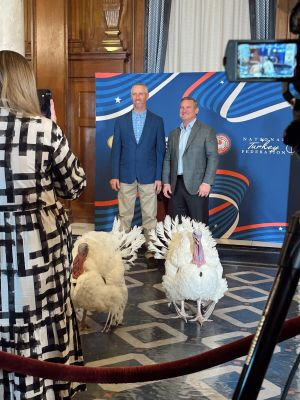 Travis Pittman, North Carolina turkey grower, and Jay Jandrain, president and CEO of Butterball and chairman of the National Turkey Federation. (Agri-Pulse photo/Parker Litterick).
New ‘assistant chiefs’ office announced at NRCS
USDA’s Natural Resources Conservation Service is launching an “Office of the Assistant Chiefs” to replace its current “Office of the Regional Conservationists,” Chief Aubrey Bettencourt announced on Monday.
A USDA press release said "assistant chiefs” will oversee regional operations and “work directly with state conservationists to ensure consistent, science-based and producer-driven program delivery.”
In the release, Bettencourt said the move puts leadership “in the field, side-by-side with the producers we serve,” and that NRCS is “streamlining operations, improving accountability, and ensuring that every NRCS employee has the tools, support, and leadership they need to deliver conservation results that matter."
Foreign Agricultural Service reports rescheduled following shutdown
The Agriculture Department’s Foreign Agricultural Service has rescheduled reports for livestock and poultry, sugar, grains, oilseeds, and cotton following the end of the government shutdown.
The agency will release its world markets and trade estimates for livestock, poultry, grains, oilseeds, and cotton on Dec. 9 at 12:15 p.m. Eastern Time. The reports were supposed to have been released in October and early November, according to a press release.
Don’t miss a beat! It’s easy to sign up for a FREE month of Agri-Pulse news! For the latest on what’s happening in Washington, D.C. and around the country in agriculture, just click here.
FAS’s world markets and trade report for sugar will now be released on Tuesday, Dec.16, at 3 p.m. Eastern Time.
World Bank report calls for countries to embed AI in ag policies
Global food systems are at an inflection point as farmers face a changing climate, higher input costs and ever-shifting supply chains. A new report from the World Bank and Microsoft says artificial intelligence can lift productivity, bolster climate resilience and support smallholder farmers in developing economies.
The bank is recommending countries develop agriculture-specific AI strategies and invest in data infrastructure and AI skills to scale up adoption and ensure poorer economies are not left behind.
“We believe that data needs to get converted into products and services at a much [more] efficient speed,” Parmesh Shah, one of the authors, tells Agri-Pulse. Shah leads the bank’s digital agriculture, data and innovation work.
Shah said ag AI investments are behind other industries because of lower returns and high data collection costs. There is a case for governments to implement policies to lessen those disadvantages and spur private sector investments, he added.
Take note: The World Bank recently launched its Agri-Connect initiative to lift smallholder farmer incomes – including by reforming policy in developing economies. Shah said he anticipates the report’s recommendations will help shape that initiative.
OSHA proposes fines for vegetable company in connection with worker’s death
A fresh-cut vegetable processing company has been hit with proposed penalties of more than $1 million for safety violations, following an investigation into a worker’s death.
The Labor Department’s Occupational Safety and Health Administration proposed the fines and cited the company, Taylor Farms New Jersey, with 16 safety violations.
Inspectors say the operation “failed to implement proper lockout/tagout procedures to protect workers from severe injuries during sanitation activities”.
Taylor Farms has 15 business days from receipt of the citations to comply, ask for an informal conference with OSHA, or contest the findings before the independent Occupational Safety and Health Review Commission.
Petition seeks ban on use of antibiotics as pesticides
EPA has received a petition asking the agency to ban medically important drugs being used as pesticides.
The petition says nearly 500 antibiotics and antifungals are now being used on fruits and vegetables. Filed by the Center for Biological Diversity on behalf of conservation, farmworkers and public health groups, the petition says the practice can lead to the development of “superbugs.”
The Centers of Disease Control and Prevention “has determined that the medically important antibiotics the EPA has approved for pesticide use on crops can facilitate antibiotic resistance in bacteria, causing increased risk of staph infections and MRSA,” the Center for Biological Diversity said in a press release.
Final Word:
“I just had a very good telephone call with President Xi, of China. We discussed many topics including Ukraine/Russia, Fentanyl, Soybeans and other Farm Products, etc. We have done a good, and very important, deal for our Great Farmers — and it will only get better.” – President Donald Trump in a Truth Social post following a phone call Monday with Chinese President Xi Jinping.
Oliver Ward and Noah Wicks contributed to today’s Daybreak


