
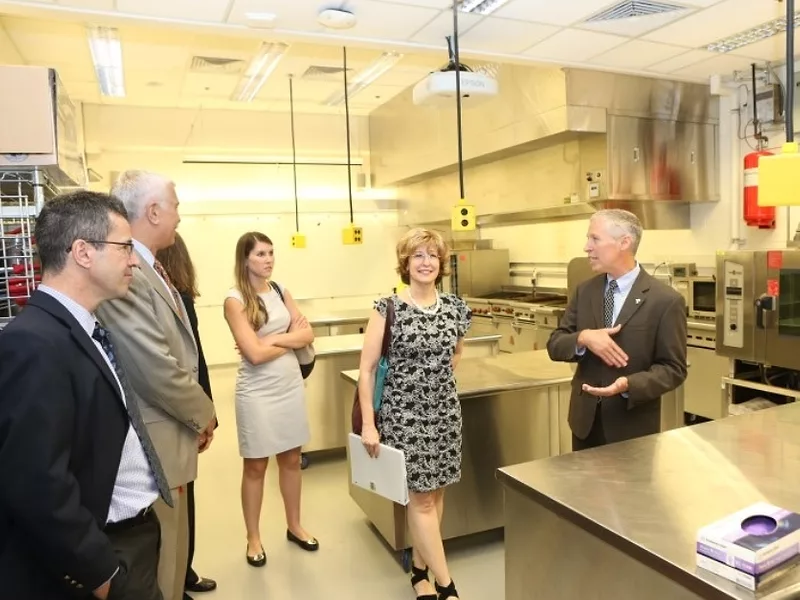
The State Department says it is developing new funding awards for Feed the Future labs, many of which have been in limbo since the administration froze funding earlier this year.
State is “in the process of developing plans for a new portfolio of awards to be issued, with the exact scope, number of awards, and partners to be determined,” a spokesperson told Agri-Pulse. The spokesperson neither provided a timeline nor said whether previously shuttered labs would reopen as part of the new awards.
Congress has appropriated $72 million for Feed the Future labs in this fiscal year.
Take note: A former USAID official tells Agri-Pulse that the department could struggle to spend all the money if it plans to run an open competition among universities for the new funding awards.
“We now have 10 months before that money expires, and it would be extremely difficult to run a competition that was acceptable,” the former official said. State doesn’t “have the staff right now.”
But the former official says the department can legally direct new awards to previously shuttered labs.
European Parliament to debate US deal
The European Parliament’s international trade committee today will debate proposed amendments on a bill to implement the U.S.- European Union trade framework.
Under the deal, agreed to in August, the EU will eliminate duties on a raft of U.S. ag products, including tomatoes, apples, cherries and other fruits. The EU also agreed to establish tariff-rate quotas to allow some duty-free imports of U.S. pork, bison, dairy products, animal feed and other goods.
Don’t miss a beat! It’s easy to sign up for a FREE month of Agri-Pulse news! For the latest on what’s happening in Washington, D.C. and around the country in agriculture, just click here.
Committee Chair Bernd Lange has proposed several amendments to the European Commission’s implementing legislation, which EU lawmakers will consider today. Among the amendments is a sunset provision scrapping the deal after 18 months if a more comprehensive arrangement cannot be reached.
Take note: The European Commission, Council and Parliament will enter trilogue negotiations on the implementing legislation once the parliament reaches a final position. Last week the European Council said it will push for a safeguard clause allowing the EU to protect domestic industries from any import surges triggered by the deal.
Former U.S. trade negotiator Dan Mullaney tells Agri-Pulse that adding the safeguard mechanism should be consistent with the negotiated deal.
“If there is a surge, and if the EU wants to take measures, then you'd have to have some discussions with the United States, but probably not until then,” he said.
 Geoff Cooper (RFA photo)
Biofuel group floats reciprocal tariffs on Chinese ag over Phase One shortfall
The Renewable Fuels Association wants the U.S. to use tariffs on Chinese ag imports to make up for missed purchases under the Phase One Agreement.
“China must be held to account for its failure and refusal to meet the terms of the Phase One Agreement,” RFA President and CEO Geoff Cooper says in a submission to the Office of the U.S. Trade Representative as part of a probe into the Phase One deal.
Cooper says China’s ag buys under the deal made during the first Trump administration fell $32 billion short of commitments. Accordingly, he says “reciprocal” tariffs “in the aggregate amount of $32 billion” should be imposed on Chinese ag exports to the U.S.
Take note: In recent weeks, the U.S. has lifted tariffs on many food and ag imports not produced in the U.S. Speaking about those reductions, U.S. Trade Representative Jamieson Greer said the time was right to offer some tariff relief after reaching a “critical mass” of trade deals.
Also, criticism of CARB: RFA also submitted comments to the California Air Resources Board criticizing CARB’s recent Biofuels and Land Use Change Public Forum for presenting “a biased and unbalanced view of the current state of research and understanding of indirect land use change (ILUC) analysis”. RFA Chief Economist Scott Richman says the amount of land needed to grow corn for ethanol use in California has fallen steadily.
Spain battles to contain African swine fever
The Spanish army is helping to contain an outbreak of African swine fever.
Two wild boars near Barcelona tested positive for the virus. More than 100 troops have joined about 300 Catalan officials to create a six-kilometer perimeter around the detection site, disinfect and search for animals, according to Agence France Press.
Spain is the EU’s leading pork producer and accounts for around a quarter of the bloc’s overall pork production. China stopped importing Spanish pork on Friday but has since resumed imports from unaffected regions.
Meeting to discuss future of Chesapeake Bay agreement
Governors and state officials from across the Chesapeake Bay region will meet today to revise an agreement laying out the goals and terms of a partnership to restore the bay.
During the meeting, members of the Chesapeake Executive Council are expected to formally adopt a revised Chesapeake Bay Watershed Agreement, which will likely chart a course for bay cleanup through 2040.
Attendees will include Governors Wes Moore of Maryland, Matthew Meyer of Delaware, Josh Shapiro of Pennsylvania and Glenn Youngkin of Virginia, as well as Washington, D.C. Mayor Muriel Bowser. Environmental Protection Agency Deputy Administrator David Fotouhi will also be in attendance, as will Chesapeake Bay Commission Chair Sara Love and state officials from New York and West Virginia.
Meat processing expansion grant listening session set for today
There will be a stakeholder listening session today to help shape USDA’s next meat processing expansion grant opportunity.
Flower Hill Institute is holding a two-hour event starting at noon Eastern Time.
The institute is the lead technical assistance coordinator for the meat and poultry processing capacity technical assistance program in USDA’s Agricultural Marketing Service.
“Flower Hill Regional Directors Chris Roper and Dave Carter will facilitate the input session, but representatives from USDA Rural Development will attend and provide information and answers as able,” the institute said.
Register for the listening session here.
Final word
“[T]he amount of land needed to produce ethanol used in California has steadily fallen. This is explained by two primary factors: 1) U.S. grain yield per acre has steadily increased, and 2) ethanol biorefineries are getting more ethanol out of each bushel of grain processed. Due to this combination of factors, RFA estimated that California ethanol demand was met with nearly 740,000 fewer acres in 2023 than in 2011 – a decline of approximately 20%.” Renewable Fuels Association Chief Economist Scott Richman, citing an RFA analysis in comments to the California Air Resources Board.
Oliver Ward and Noah Wicks contributed to today’s Daybreak.


