
The United Kingdom was an early dealmaker following President Donald Trump’s tariff blitz earlier this year, and U.S. ethanol producers welcomed expanded market access under the pact. More than seven months on, higher exports have yet to materialize, but the industry says they’re coming.
Under the terms of the U.S.-UK deal, Prime Minister Keir Starmer’s government agreed to allow 1.4 billion liters, or 369 million gallons, of U.S. ethanol into the country duty-free. The White House at the time estimated that the provision could be worth around $700 million in additional ethanol exports.
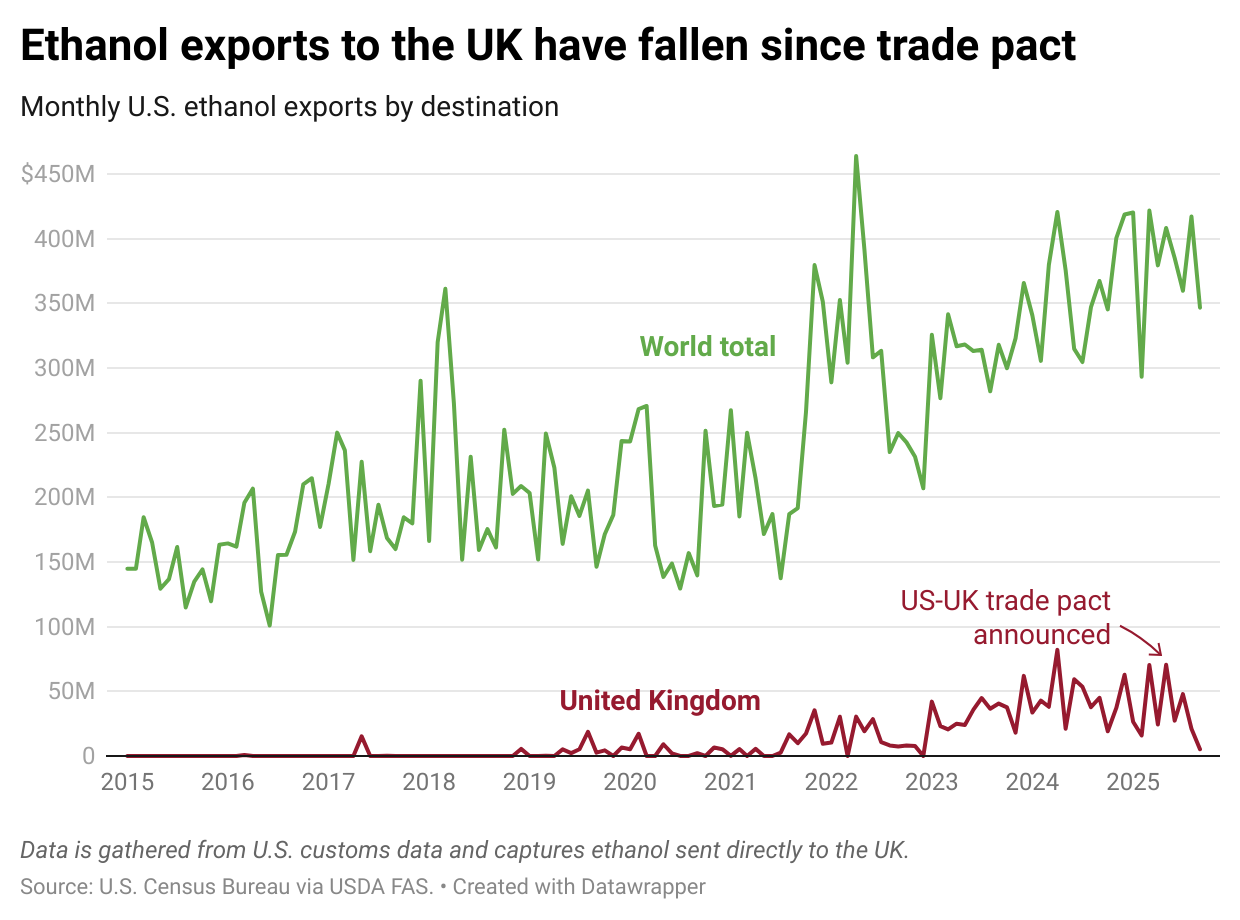
But seven months later, early trade data shows ethanol exports to the UK actually fell in the months following the trade pact’s announcement, even as exports elsewhere have been a bright spot for a U.S. industry grappling with the existential threat of electric vehicles.
The 1.4 billion-liter tariff-rate quota was prorated for the first year, Stephanie Larson, regional ethanol manager for the UK, European Union and Canada at the U.S. Grains & BioProducts Council, told Agri-Pulse in an email. Only 913 million liters, or 241 million gallons, were eligible for duty-free treatment in 2025.
Many traders, Larson said, have opted to wait for the full quota to go into effect before ramping up trade.
The prorated TRQ has “contributed to a lull in exports,” she noted. “However, export volumes are picking up again.”
Unlike with a similar tariff-rate quota applied to U.S. beef exports – which some analysts have questioned whether UK buyers will fill – Larson said that she expects U.S. ethanol exporters to reap the full benefit of the TRQ.
“The UK has emerged as a top export destination market for U.S. ethanol in recent years and the U.S. remains the principal supplier of ethanol to the UK market,” she said. “Our members are optimistic about being able to fill it” once the full quota becomes available in 2026.
Between 2021 and 2022, the country rolled out its mandate that gasoline must be blended with 10% ethanol, leading to a sharp uptick in imports and catapulting the UK from the ninth-largest buyer of U.S. ethanol in 2020 to the second-largest in 2023, according to USDA.
Filling the new quota under the UK agreement shouldn’t be a big lift, according to Ron Lamberty, chief marketing officer at the American Coalition for Ethanol in Sioux Falls, South Dakota. Lamberty also sits on an ethanol action team at the U.S. Grains & BioProducts Council.
“We’ve gone from around 1.5 billion gallons in exports to almost 2 billion over a couple of years, so I think there’s some flexibility there,” he said in an interview.
Export ‘bright spot’
After a surge in August, the U.S. saw a 21% decline in overall ethanol exports in September, the most recent monthly data available. It marks a seven-month low, though it's still the second strongest September on record, with Canada remaining the top buyer, according to the Renewable Fuels Association.
The U.S. had been on track for a second straight year of record-high ethanol exports, though that’s now uncertain. The murky outlook underscores the importance of the UK deal and future pacts.
Cut through the clutter! We deliver the news you need to stay informed about farm, food and rural issues. Sign up for a FREE month of Agri-Pulse here.
RFA CEO Geoff Cooper told Agri-Pulse in an interview last month that with domestic demand flat, exports had become a major driver of higher production volumes. “It’s the reason we are seeing the industry run at record production rates,” he said.
 Geoff Cooper (RFA photo)
The U.S. faces increased ethanol competition from Brazil, which traditionally has focused on a sugarcane-based version of the fuel but recently has started making more of the biofuel from corn. Also, enthusiasm over using ethanol as an ingredient in sustainable aviation fuel has died down for now as some plans for so-called ethanol-to-jet fuel production have stalled. Larson, Cooper and Lamberty also all see plenty more export opportunities on the horizon, however, as countries continue their push to reduce carbon emissions.
Canada, which currently accounts for more than a third of U.S. exports, should continue to see robust demand growth. Japan and Vietnam have also outlined plans to increase their petroleum blending rates, with Vietnam implementing E10 next year and Japan set to adopt an E10 policy by 2030.
“It’s roughly a billion gallons that Japan would need,” said Lamberty, who recently visited the Asian nation. “That’s like another California.” Mexico and all of Europe are attractive, as is the prospect of smaller Latin American countries banding together for volumes, he said.
Lamberty and Cooper are keenly watching the ongoing trade discussions with India. India is already the third-largest market for U.S. ethanol exports, even as Prime Minister Narendra Modi’s government retains a ban on fuel-grade ethanol for on-road uses.
“All of the ethanol going into India is industrial grade,” Cooper said. “One of the top goals for our industry as our government negotiates with India on a potential deal is repealing that ban.”
U.S. and Indian officials had appeared close to a deal in recent months, with Indian officials signaling that an outcome could be unveiled before the end of the year.
However, in recent days that timeline appears to have slipped. A senior Indian trade official told Bloomberg TV on Thursday that a deal before the end of the financial year in March is feasible.
.webp?t=1762183428)

