
Lawmakers are back in town this week to kick off the new year with government funding once more up in the air on Capitol Hill. But the biggest story in Washington, of course, is the future of Venezuela, and the U.S. role there.
Take note: Venezuela is an important market for U.S. farmers. As of last year, the United States was the second-largest exporter of farm products to the South American country with a 26% market share, according to USDA.
The main U.S. ag exports include soybean meal, corn, wheat, soybeans and rice.
For more on the coming week and month in D.C. read our Washington Week Ahead.
USDA releases bridge assistance payment rates
USDA made some important news during the holiday break, releasing payment rates for $11 billion in the Farmer Bridge Assistance Program, as well as the final annual Household Food Security survey.
Commodity groups welcomed the release of the payment rates but also stressed that they would not make farmers whole after several years of stagnant prices and rising input costs. The American Soybean Association, in particular, said the payments would not prevent many growers from leaving the business of farming altogether.
The administration has yet to release rates for $1 billion in payments targeted for specialty crop and sugar growers.
USDA issues last hunger numbers
USDA’s food security report, which is for 2024, shows food insecurity reached 13.7%, a 10-year high, during the last year of the Joe Biden administration. The Trump administration, as we know, has now cancelled the annual survey, so it will be years before the study can be reinstated, if it ever is.
Notable highlights: Some 18.4% of households with children were found to be food insecure in 2024. For married couples with children, the rate was 10.9%.
Six states have food insecurity rates that are statistically significantly above the national average, based on a three-year average: Arkansas, Kentucky, Louisiana, Mississippi, Oklahoma, and Texas. Sixteen states and the District of Columbia have food insecurity rates that are statistically significantly below the national average.
USDA inspectors to test retailer compliance with new SNAP restrictions
USDA will send inspectors to stores to test out new Supplemental Nutrition Assistance Program food restrictions being implemented in 18 states.
Investigators in the Food and Nutrition Service's Office of Retailer Operations and Compliance will go undercover to try to buy restricted items, according to an agency memo. If violations are found, retailers will receive a warning letter and will be subject to future investigations. If a second violation is found, the retailer may be barred from participating in SNAP.
China still short of soybean commitments as data trickles in
Chinese buyers are likely to have missed a Dec. 31 deadline for purchasing 12 million metric tons of U.S. soybeans.
USDA has published weekly export data through mid-December – with more numbers set to drop this morning. But daily sales data, which captures the largest sales, show China was behind schedule on its pledges.
China had almost 7 million tons of confirmed sales from late October to the end of 2025. The final destination for around 3 million tons of orders is still unknown. Even if all those are bound for China – which is unlikely – Beijing almost certainly missed the 12-million-ton target by the end of 2025.
But, but, but: Treasury Secretary Scott Bessent has suggested that the actual target for 12 million tons of Chinese purchases is Feb. 28. U.S. Trade Representative Jamieson Greer recently told senators that buys may extend into March.
Still, under the terms of the U.S.-China deal struck in October, the White House said China pledged to buy another 25 million tons in the 2026 calendar year. Stakeholders want to see both commitments met.
Take note: No text of the U.S.-China deal from October has been made public. Chinese officials have not yet acknowledged the soybean purchase commitments or deadlines in official communications.
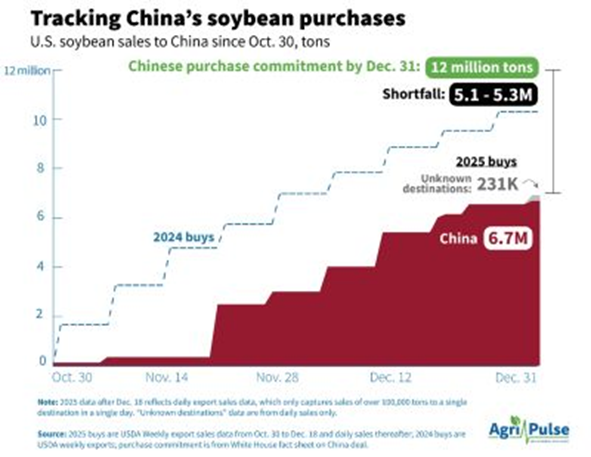
Check the Agri-Pulse home page today around 9:30 a.m. for an updated tracker.
Trump hits pause on tariff hikes on lumber products
The president has delayed increasing duties on furniture, kitchen cabinets and vanities by a year. The move is the latest tariff pivot following tariff reductions on ag products late last year.
The administration imposed 25% duties on certain wood products and cabinets in September over national security concerns, with the tariffs set to rise on Jan. 1. Those increases have been postponed for another year, the White House says, to let negotiations with partners play out.
A fact sheet notes that the administration still sees reliance on foreign timber and lumber products as a threat to U.S. national security and the domestic industry.
Take note: On Friday, Trump doubled down on the importance of tariffs in a post to social media.
“Losing our ability to Tariff other countries who treat us unfairly would be a terrible blow to the United States of America,” he wrote. He argued tariffs have been “incredible for our National Security and Prosperity.”
The post comes as the Supreme Court is expected to rule on the legality of Trump’s emergency tariffs early this year. The tariffs on wood products and cabinets would not be affected by the ruling, however, as they are based on a separate tariff authority.
Sheep industry looks to get focus on imports
The American Sheep Industry Association hopes an appeal from House members and senators will get the Trump administration to investigate the economic impact of lamb imports.
Sen. Steve Daines, R-Mont., and Rep. Doug LaMalfa, R-Calif., will lead the letters to the USTR’s office and are collecting signatures from colleagues this week, ASI says.
45Z credit on the way in 2026
The new year means a new look for the 45Z tax credit, a Biden-era biofuel production incentive revamped by Congress in July. Changes took effect Jan. 1, including no credit for renewable fuels made using ingredients from outside North America. The restriction is opposed by some fuel producers and end users.
Despite speculation the Trump administration would weigh in on how 45Z will work before the end of 2025, the White House was still reviewing proposed guidance from the Treasury Department as of Friday.
"We hope it doesn't slip much further," said Joe Jobe, CEO of the Sustainable Advanced Biofuel Refiners coalition. SABR and others are pushing for Congress to pass a temporary return of $1-a-gallon biodiesel credit that 45Z replaced last year.
Iowa Renewable Fuels Association Executive Director Monte Shaw said he's hopeful guidance will be out in January to "help the Midwest unleash American energy dominance."
Final Word:
Cartels are “running Mexico. I've asked [President Claudia Sheinbaum] numerous times would you like us to take out the cartels. 'No, no, no, Mr. President, no, no, no, please.' So we have to do something.” – President Donald Trump speaking on Fox News on Saturday after the capture of Venezuelan President Nicolás Maduro.
Kim Chipman, Oliver Ward and Noah Wicks contributed to today’s Daybreak.
.webp?t=1762183428)


