
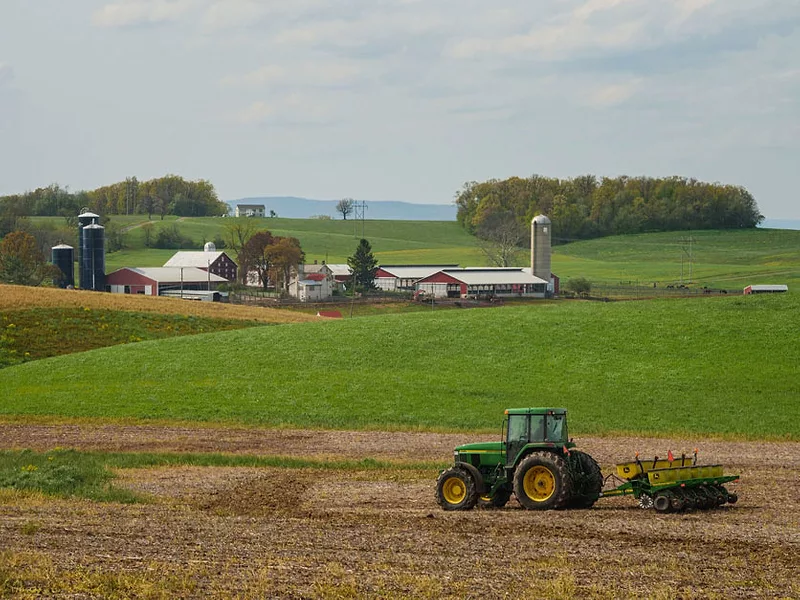
Key lawmakers are actively looking at injecting more money into the farm economy, possibly in an upcoming spending measure.
House Agriculture Committee Chairman Glenn "GT" Thompson, R-Pa., met this week with Senate Ag Chairman John Boozman, R-Ark., and Senate Ag Appropriations Subcommittee Chairman John Hoeven, R-N.D., to talk about the issue.
One source familiar with the Wednesday meeting confirmed that a figure of about $15 billion in additional aid was under discussion, a figure first reported by Politico. Another source described the meeting as "more an exchange of information on what everyone is hearing from stakeholders and how we ensure (administratively and potentially legislatively) that adequate support is delivered to farm country in a timely manner."
Take note: Farm groups sent a letter to House and Senate leaders appealing for more assistance. The letter doesn’t suggest a specific amount. “In addition to continuing to pursue federal policies to increase long-term domestic demand for U.S agricultural commodities, we urge Congress to provide immediate economic support to fill in the gap of remaining losses for both field and specialty crop farmers,” the letter says.
Democrat Craig warns GOP over farm bill ‘poison pills’
House Ag’s top Democrat, Angie Craig of Minnesota, says Republicans need to pursue a “clean” farm bill or risk problems moving the measure to the House floor. Craig said Thursday potential poison pills include any language saying that federal pesticides law preempts state law liability claims related to label warnings.
In addition to making it tough to get support from Democrats, such a provision would put Republicans under “tremendous pressure from the Make America Healthy Again movement if preemption for pesticides is included in their farm bill,” Craig told reporters Thursday at a news conference to unveil plans for legislation to provide $29 billion in addition economic aid to struggling farmers.
Don’t miss a beat! It’s easy to sign up for a FREE month of Agri-Pulse news! For the latest on what’s happening in Washington, D.C. and around the country in agriculture, just click here.
 (Agri-Pulse photo)
Keep in mind: Passing a farm bill will be very difficult to do this year, but the debate does give Democrats and Republicans a chance to position for the mid-terms.
Boozman: Farmers need to expand domestic markets
The Senate Ag chairman says his committee will focus on ways to expand markets for U.S. farmers and reduce the need for government assistance.
“We’re in a really serious problem right now,” Boozman says in a joint Agri-Pulse Newsmakers interview with the committee’s ranking member, Amy Klobuchar of Minnesota. “If you're planting something, you're probably losing money because of lack of demand for the product. We don't have the markets that we need. We need to increase our markets overseas, but we also need domestic markets, too.”
He goes on, “What we’d like to do is get some experts … (who) can give us some ideas and see if we can make it such that we’re not dependent on these government interventions.”
Klobuchar and Boozman both say farmers need additional aid to go with the $12 billion the Trump administration has already announced.
Craig and Thompson also are on Newsmakers this week from the American Farm Bureau Federation annual meeting in Anaheim, California.
Newsmakers will post later today at Agri-Pulse.com.
 L to R: Agri-Pulse Newsmakers host Lydia Johnson, Rep. Angie Craig, D-Minn., and Agri-Pulse's Sara Wyant at AFBF Annual Convention in Anaheim, Calif. (Agri-Pulse photo)
Former ERS administrator warns of impending data vacuum
USDA’s staffing cuts are compromising its ability to provide the high-quality data needed to shape policy and business decisions. So says former Economic Research Administrator Spiro Stefanou. In a new report, Stefanou says the Trump administration’s staffing cuts have complicated data collection – which was already facing challenges from falling budgets and inefficient processes.
Stefanou says ERS lost 27% of its staff in FY2025, while the National Agricultural Statistics Service lost 40%.
“The consequences will worsen data quality and the supply of many products,” Stefanou says. Stefanou was administrator from 2020 to 2025 and spent several months as acting deputy undersecretary for research, education and economics before leaving the post in September, according to this LinkedIn page.
Stefanou says without reliable data the vacuum will be filled with “incomplete databases that will be poor substitutes for federal sources they replace.”
Take note: Stefanou’s report comes on the heels of the American Statistical Association’s warning in December that the federal statistical system is facing “unprecedented strain.”
Soybean processing key for reducing trade vulnerabilities, says top WH aide
Increasing U.S. soybean crushing volumes would reduce the sector’s reliance on China as an ag export market and boost supply chain security, President Donald Trump’s top trade aide says.
In an op-ed for the Hill, White House Senior Counselor for Trade and Manufacturing Peter Navarro says U.S. agriculture has a structural vulnerability.
“We export whole beans — low-value bulk commodities — while foreign processors capture the higher-value soybean oil and meal,” he wrote Thursday. “That structure leaves U.S. farmers overly dependent on foreign buyers and allows Beijing to push the cancel button.”
Devin Mogler, president and CEO of National Oilseed Processors Association told Agri-Pulse in an email that he agrees that biofuel policies to prioritize domestic feedstocks can erode China’s leverage over the U.S. while benefiting livestock farmers.
“Since the first trade war with China, our industry has invested over $6 billion to expand crushing capacity by over 25%, providing strong and reliable markets for soybean farmers,” Mogler says. “Today, we have the capacity to process 3 out of every 5 rows of U.S. soybeans right here at home.”
Comer, hemp growers urge delay of provisions limiting THC
Kentucky Republican Rep. James Comer is rallying support for delaying new rules governing hemp growers. They say the new rules are making it difficult for them to sell their crop.
At an event on Capitol Hill Thursday, Comer told congressional staff and hemp growers that it’s essential to get a bill he introduced with Rep. James Baird, R-Ind., attached to a larger piece of legislation, such as a potential continuing resolution. The bill would extend by two years the effective date of the legislation included in the last CR, which would limit the amount of THC per container of hemp-derived products such as gummies.
“We've been grounded by that bill they just passed, and we just need some time to get some legislation together that'll give us guidelines to go by,” North Carolina hemp grower Randy Gray told Agri-Pulse. Gray said he now has about 90,000 pounds of hemp worth about $350,000 that he hasn’t been able to sell.
Final Word
"Farmers are hurting and people keep saying 'well there's great agriculture deals being made.' Yeah, I keep hearing about it, but nobody's buying it. You're not seeing soybeans being purchased. That's the number one issue right now." – Rep. Don Bacon, R -Neb.
Kim Chipman, Philp Brasher, Lydia Johnson, Steve Davies, Noah Wicks, and Oliver Ward contributed to today’s Daybreak.

.webp?t=1762183428)


