
The Trump administration is weighing temporarily suspending countervailing duties applied to Moroccan and Russian phosphate. That’s according to five people familiar with the discussions.
Senior administration officials have signaled that the administration could soon announce additional measures to ease high fertilizer prices following strikes on Iran. Agriculture Secretary Brooke Rollins said in a social media post Sunday that the administration is “keeping every option on the table.”
Multiple sources tell Agri-Pulse that includes pausing the countervailing duties.
Several people familiar with the discussions said U.S. fertilizer companies have had meetings with administration officials on the matter in recent weeks. One source said that the companies argued in those meetings that pausing the duties would not significantly affect fertilizer prices.
Take note: President Joe Biden paused similar countervailing duties on solar panels from four Southeast Asian countries in 2022 to ensure adequate domestic supply. The Court of International Trade later ruled that the decision was illegal, calling the order an “abuse of discretion.”
But, but, but: The duties are up for a five-year review, which offers another potential avenue for lifting the duties. If U.S. fertilizer companies determine the tariffs are no longer needed to prevent harm, the duties can be sunset.
Nutrien has already said the duties can come off. Ag groups are urging Simplot and Mosaic to follow suit.
The move would please many ag producers, however. A coalition of more than 60 ag groups wrote to Commerce Secretary Howard Lutnick on Friday called for the sunsetting of the duties.
Newton floats strategic fertilizer stockpile to address fertilizer access challenges
Should the U.S. think about a strategic stockpile of fertilizer? John Newton, American Farm Bureau Federation vice president of public policy and economic analysis, thinks the idea could have merit.
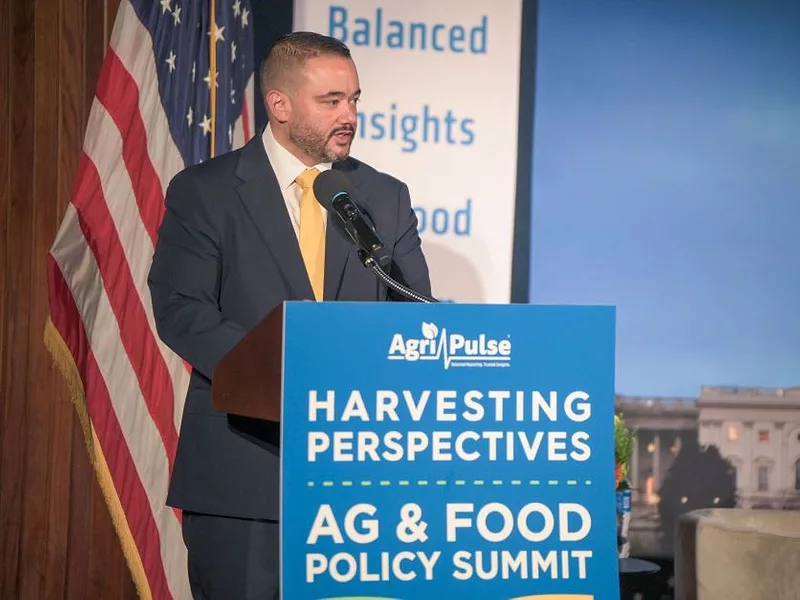
Speaking at the 2026 Agri-Pulse Food and Ag Summit, Newton said other countries like China have established such programs and it may be an idea worth exploring to help with fertilizer access challenges. On the sidelines of the summit, Senate Ag Committee Chairman John Boozman, R-Ark., also said the idea was worth exploring.
“I think, just on the surface, that things like that are a good idea,” Boozman said. “We have to start thinking outside the box so that we don’t have these shocks like we’re going through now.”
Take note: The administration has already launched an effort to establish a U.S. Strategic Critical Minerals Reserve. Called “Project Vault,” the program uses a $10 billion loan from the Export-Import Bank of the United States and around $2 billion in private-sector investment.
Thompson talks ag workforce legislation, farm bill
House Ag Committee Chair Glenn “GT” Thompson hopes to have a discussion draft of ag workforce legislation ready relatively soon, he said at the Agri-Pulse summit.
“I think we will have a great … tri-partisan bill built by Republicans, Democrats and people in agriculture, production and processing,” he said in a conversation with Agri-Pulse Founder Sara Wyant. The House Judiciary Committee would have jurisdiction, but Thompson said Jordan “has embraced the idea of coupling that with what he's working on going forward.”
Thompson also said he wants the farm bill that made it through committee earlier this month to pass the House with “strong bipartisan support” to help its chances in the Senate.
More on the farm bill: Boozman said he’d be happy to put an authorization provision for year-round E15 in the farm bill – if another Senate committee goes along with the idea – but he closed the door on including a delay for a SNAP cost-share requirement. Senate Ag’s top Democrat, Amy Klobuchar of Minnesota, told the summit the farm bill must address the SNAP issue. For more on Boozman’s and Klobuchar’s remarks at the summit, go to Agri-Pulse.com.
Callahan: US-China work plan includes measure to grow ag exports
A top Trump administration trade official says additional agriculture provisions are included in a work plan for a meeting between Presidents Donald Trump and Xi Jinping slated for later this spring. Treasury Secretary Scott Bessent and USTR Jamieson Greer were in Paris last week for meetings with Chinese officials to prepare the work plan.
“This work plan includes expanding U.S. exports of agricultural goods to China,” Julie Callahan, chief agricultural trade negotiator at the Office of the U.S. Trade Representative, said during the Agri-Pulse summit.
Callahan was in Beijing last week laying “the groundwork” for that work to come, she said.
“I raised some concern regarding some specific commodities. We've had some challenges with beef exports – as you all know – with poultry HPAI issues, with biotechnology,” she added.
Take note: A slate of U.S. beef export facilities have not had their export licenses renewed after they expired last year. Further, Beijing maintains bans on poultry products from some U.S. states over avian flu concerns, despite the states being free of the disease.
Analysis details NRCS staff losses
More than 1,300 counties lost NRCS staff in 2025, with 144 losing all of their staff by the end of the year, according to a new analysis conducted by Prospect Partners.
Using Office of Personnel Management data, the firm found 694 counties lost soil conservation staff, 380 counties lost general natural resources management staff, and 286 counties lost soil conservation technician staff, according to a summary by senior consultant and founding partner Bernie Kluger.
Only 167 counties saw net gains of staff and 949 saw no net change, according to the analysis.
Final word
“I think this is the most important thing we have to talk about in agriculture right now, folks. We had a hell of a 25-year run with China, but it’s kind of run its course.” – Gregg Doud, president and CEO of the National Milk Producers Federation and chief ag trade negotiator during the first Trump administrator. He was speaking during the Agri-Pulse summit.


