
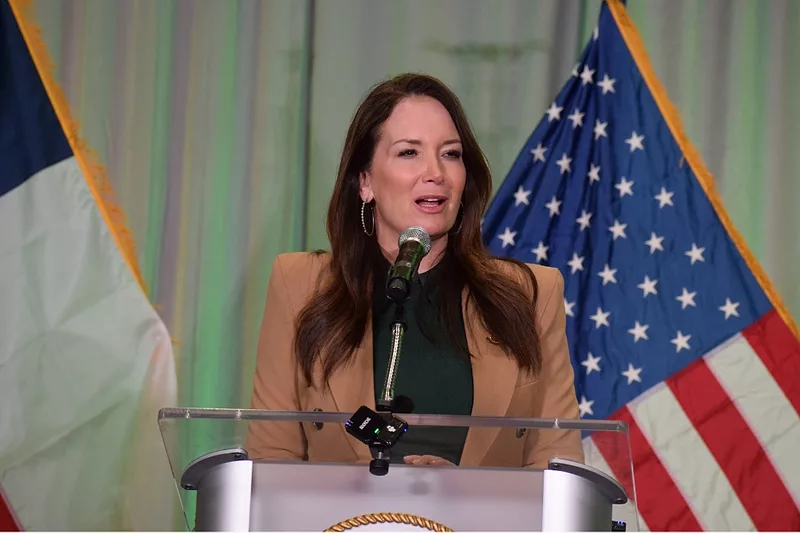
Agriculture Secretary Brooke Rollins says she is working directly with ag input companies to address rising prices amid mounting warnings over fertilizer supply and ongoing disruptions.
“We want real relief for our farmers,” Rollins told Fox News on Saturday. The president, she said, has tasked her with holding discussions with business leaders “to make sure that the farmers are seeing that relief.”
The administration is grappling with high diesel and fertilizer prices, which shot up since the onset of the Iran war. Price and supply concerns are looming over planting season and dimming financial outlooks.
“We're now talking about this likely being not just a spring problem, but a fall problem,” a fertilizer industry source told Agri-Pulse Friday.
Adding to the challenge is that while U.S. prices have climbed, they have not jumped as high as other countries, creating supply worries.
If fertilizer companies can make more in other markets, the source said, “product is not going to flow here,” the source said.
Take note: The administration has already pulled some trade policy levers to try and ease fertilizer price pressures, including waiving some domestic transportation requirements and lifting restrictions on purchases from Venezuela.
People familiar with the situation say officials have also looked into other tools and could still take further trade actions. The administration has weighed lifting countervailing duties on phosphate fertilizer as well as exempting fertilizer inputs from a 10% global tariff – including ammonia, sulfur and sulfuric acid.
Ontario business leaders in Washington for USMCA meetings
A group of business leaders from Ontario will be in Washington this week for the latest Canadian lobbying offensive on preserving the U.S.-Mexico-Canada Agreement.
Representatives from a raft of Canadian industries, including forestry and agriculture, will meet with policymakers and U.S. industries for discussions on the forthcoming USMCA review and tariffs.
“Ontario businesses seek trade certainty in North America – as do our American partners,” Daniel Tisch, the Ontario Chamber of Commerce president, said in a statement. “The key ideas are ‘review’ and ‘renew’ – not ‘re-do,’” he added.
With new RVOs out, the fight over the next batch can finally start
The wait for EPA biofuel blending targets for this year and next is over – and lobbying battles for 2028 and beyond can now begin.
The latest renewable volume obligations, or RVOs, issued Friday are the highest ever under the 21-year-old Renewable Fuel Standard program. This includes a record high for soybean-heavy fuels like renewable diesel and biodiesel.
But, but, but: The Trump administration delayed until 2028 a proposed financial disincentive, known as a “half-RIN,” for foreign production and making biofuels with non-U.S. ingredients, like Chinese used cooking oil or Brazilian tallow.
It’s easy to be “in the know” about what’s happening in Washington, D.C. Sign up for a FREE month of Agri-Pulse news! Simply click here
Biomass-based diesel credits used to track RFS compliance rose to around $1.70 on Friday, up from around $1.57 at the start of last week. That general range means foreign fuel producers can get robust value per gallon, says independent global biofuel analyst Henri-Jean Bardon.
Time will tell how this plays out in the global and domestic markets for renewable fuels.
For farmers and oilseed crushers: “Overall, this should be very strong for feedstock demand,” says Arlan Suderman, chief commodities economist for StoneX Group.
Also keep an eye on: EPA also announced a 70% reallocation of certain exempted RVOs for small refineries. The American Petroleum Institute says the move “distorts the marketplace.”
What does this have to do with 2028? The blowback from API and others amps up debate over not just the next RVOs, but the future of the RFS itself.
It’s also sure to come into play as other matters are considered, including efforts in Congress to pass E15 legislation.
Bottom line: Bumpy policy roads lie ahead.
Zeldin to tout DEF regulation changes in North Carolina visit
Environmental Protection Agency Administrator Lee Zeldin will be in North Carolina today to tout changes to Diesel Exhaust Fluid sensor regulations announced by the administration last week.
Zeldin will be in Rocky Mount, N.C., to discuss guidance issued to diesel equipment manufacturers on Friday stating that they no longer need to use urea quality sensors to meet emissions control requirements. Instead, the guidance states they can use nitrogen oxides sensors and other alternative methods in the hope of reducing DEF system failures.
According to a press advisory, EPA will also be issuing “a new deregulatory proposal that will completely remove all DEF deratements for new vehicles and engines.” That proposal will come “in the near future,” the advisory says.
Mahindra seeks to grow market in the U.S.
The world’s largest tractor manufacturer by volume is looking to expand sales in the U.S. after absorbing hits to its bottom line from wildly fluctuating U.S. tariffs.
Viren Popli, president and CEO of Mahindra North America, says U.S. tariffs, which at one point were as high as 50% in the past year, did deliver a blow.
“But we were very careful,” he tells Jeff Nalley on Agri-Pulse Open Mic. “We had hoped and believed that eventually the U.S. and India would work out a working relationship. … We did take an impact on the bottom line, but I think we're past that, and I'm hoping to grow from here."
The U.S. and India reached an agreement last month setting U.S. tariffs at 18% and lowering Indian tariffs on agricultural products such as dried distillers’ grains, red sorghum, tree nuts, fruit, soybean oil, and wine and spirits.
Mahindra has a commanding share in the Indian tractor market and is ranked fourth in the U.S., according to market research firm Mordor Intelligence.
Ag sounds alarm on rail mandates
Ag groups are warning lawmakers that proposed U.S. rail mandates could disrupt supply chains, boost costs and strain an already challenged farm economy.
Concern centers around the bipartisan Railway Safety Act bill reintroduced by senators last month.
The National Grain and Feed Association, Renewable Fuels Association, Pet Food Institute, National Corn Growers Association and 14 other members of the Agricultural Transportation Working Group write lawmakers to say they support “common-sense steps” to improve rail safety, but the bill calls for potentially burdensome new laws despite lack of evidence they would improve safety.
Provisions of concern include train length limits and expanded manual inspection requirements, the groups tell members of Congress.
Final word
“There are many things we are doing that make it easier to use a tractor without going to full autonomy. And obviously, you know, I feel that even now, we are all very comfortable sitting in an autonomous product, but we want that big red button which says, ‘Stop, I'll take over,’ you know, because we still don't trust the machines 100%. … We are on a journey, but I think there's plenty of opportunity for small farmers and large farmers, to be able to give them products and services that allow them to do driver-assist kind of stuff.” – Viren Popli, president and CEO of Mahindra North America, on Agri-Pulse Open Mic with Jeff Nalley.
.webp?t=1762183428)


