
|
President Donald Trump and senior officials are projecting continuity in U.S. trade policy despite the Supreme Court's decision last month striking down many of the administration’s tariffs. The new tariff instruments are beginning to take shape, offering clues as to how the administration plans to wield tariffs in the second year of Trump’s term.
Just hours after the Supreme Court ruled that the president had overstepped when he used emergency powers to impose tariffs, Trump unveiled a new 10% global tariff to replace some of the felled duties.
The statute underpinning the new tariff, however, only allows duties for up to 150 days. Accordingly, earlier this month, the administration announced two new investigations into unfair trade practices – which U.S. Trade Representative Jamieson Greer says could be used to justify tariffs after the global tariff expires – and has signaled that more are on the way.
Completing the investigations by the 150-day deadline would be “pretty fast,” former USTR General Counsel Greta Peisch told Agri-Pulse.
In probes into unfair trade practices, dubbed Section 301 investigations after the section of the 1974 law that created them, the administration has to gather public input before issuing its recommendations for a course of action. It then has to collect public input on the recommended actions.
The timeline “is potentially doable,” Peisch, who is now a partner at the Wiley Rein law firm, added, however. “It's a heavy lift, but certainly possible.”
Tariff instrument and enforcement mechanism?
The first Section 301 investigations will examine 16 economies’ manufacturing production and determine if countries are “producing more goods than they can consume domestically” in a way that harms U.S. producers.
Meanwhile, the second probe will look into efforts the 60 largest U.S. trading partners are taking to curb imports of products made with forced labor.
Analysts told Agri-Pulse they were struck at how sweeping the investigations are in scope, saying they appeared designed to cast a wide net.
The investigation on forced labor, for example, didn’t deal with efforts countries are taking to clamp down on forced labor in their domestic market, focusing instead on measures to tackle imports made with forced labor.
It’s easy to be “in the know” about what’s happening in Washington, D.C. Sign up for a FREE month of Agri-Pulse news! Simply click here
“That enabled them to address many more countries,” Peisch said. Many economies have laws on the books to address forced labor within their borders, but far fewer have statutes designed to eradicate forced labor in overseas supply chains.
 Greta Peisch (Wiley Rain photo)
Wendy Cutler, a former U.S. trade negotiator who is now senior vice president at the Asia Society Policy Institute, said that by casting a broad net, the administration is likely planning on using the Section 301 probes as an enforcement mechanism to ensure countries live up to their commitments in recent trade negotiations.
Just because a country is named, she said, doesn’t mean they will necessarily face tariffs. USTR could recommend a tariff but keep it suspended and use it as a stick to enforce concluded trade pacts.
With a completed Section 301 investigation in its back pocket, “if there are concerns about enforcement of the commitments, then the U.S. would have the legal authority to raise tariffs,” Cutler said.
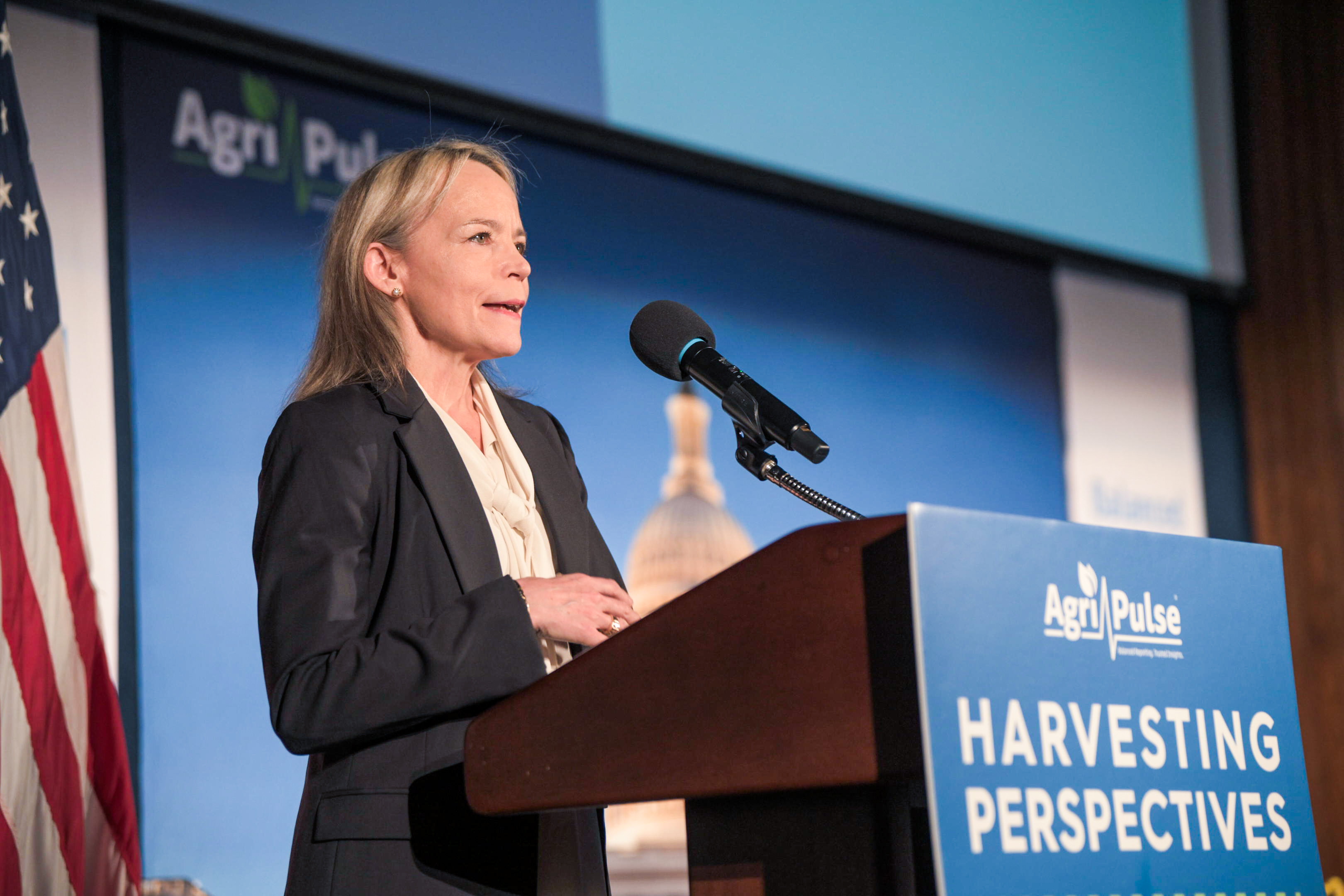
During remarks at Agri-Pulse’s Ag and Food Policy Summit on Monday, USTR Chief Agricultural Negotiator Julie Callahan suggested that the outcomes of the 301 probes would reflect whether countries have struck deals with the U.S. She stressed that trading partners with completed deals will be in a “better position.”
“They've already committed to address some of the issues that are likely to come,” Callahan said. “We intend that they will continue to come through and deliver on those commitments that we have secured on paper.”
Selected issues limit potential responses
In addition to choosing trade practices that cover a broad array of trading partners, Cutler argued that the administration also appears to be selecting practices that will be difficult for countries to address.
In a statement following the Supreme Court ruling, USTR identified several areas of concern that could be subject to Section 301 probes. In addition to excess industrial capacity and forced labor, USTR singled out pharmaceutical pricing, digital services taxes, discriminatory practices against U.S. tech firms, ocean pollution, rice and seafood.
Several of these issues, including rice subsidies, are politically charged, and the U.S. may be banking on foreign governments being unable to address the issue so it can impose tariffs.
“If, indeed, USTR is looking to replicate the IEEPA tariff structure,” Cutler said, referring to the axed duties imposed under the International Emergency Economic Powers Act, “they'll need to identify unfair trade practices where countries don't have the bandwidth or the political backing to move on.”
Rice, she said, would fit the bill. Modifying or removing subsidies "is going to be so politically difficult” for some countries to do that they would rather accept a tariff, she said.
The same applies to forced labor, Felicia Pullam, former executive director in the U.S. Customs and Border Protection’s Office of Trade Relations, told Agri-Pulse.
“Forced labor has been around for as long as humanity has existed, and these bans are difficult to put into place,” she said. That is not to say that the issue is solely a trade tool, Pullam added.
“There are people within the administration who genuinely care about forced labor as an issue, and this is a way to keep the conversation around forced labor going, and to keep encouraging countries to take action,” she said. Pullam now leads the trade, investment and market access division at APCO, a global advisory and advocacy firm.
Using inaction over forced labor as a justification for duties could also take some of the sting out of the political attacks from tariff critics, Pullam said.
“It's very hard to be against tariffs that are encouraging other countries to join the fight against forced labor,” she noted. Similarly, companies might be put off filing any lawsuits challenging the tariffs.
“Who is going to sue over this?” she asked, and risk being branded as an opponent to stamping out forced labor.
Use of Section 301 carries new risks
The administration is signaling to trading partners that they should expect continuity in their tariff rates.
“The tools are changing. The policy is not changing,” Callahan said Monday.
 Julie Callahan (Agri-Pulse photo)
But Cutler argued that the new policy tools run the risk of rankling allies more than the emergency powers Trump used previously. It is one thing for governments to face higher tariff rates, but quite another to be publicly accused of not taking a firm-enough stance on forced labor in their supply chains.
“I think this is going to complicate things,” Cutler said. Cutler said she has spoken with foreign governments that are already expressing concerns about being branded an unfair trader, even if officials haven’t been openly critical in public.
“There is a definite gap between the public and private reactions,” she noted.
Reuters in New Delhi reported earlier this month that Indian officials could hold off on finalizing an interim trade deal until they have a better understanding of what the tariff landscape will be following the Section 301 probes.
Cutler said she will also be watching Vietnam closely for any sign that it might delay its own negotiations until the Section 301s have played out.
The administration also needs to be wary of making these investigations look “pre-cooked,” Cutler said. The Section 301 statute requires USTR to weigh public input as part of the investigations and ensure that any action is proportionate to the burden of the unfair trade practice on U.S. businesses.
“USTR is going to bend over backwards to make this look as objective as possible,” Cutler said. If the 301 process concludes by recommending tariff rates that are identical to the IEEPA duties, it may look “too cute by half,” Cutler said.
“Then I think we can expect legal challenges,” she added.
It wouldn’t be the first time the Trump administration has faced a legal challenge over its use of Section 301. In 2022, the Court of International Trade found that USTR had failed to demonstrate it had adequately considered public input when it imposed Section 301 tariffs on Chinese exports in 2018 and 2019. The court upheld the tariffs and denied the plaintiff’s request to lift the duties but remanded the decision to USTR for further explanation – which it provided.
But Alan Sykes, a law professor at Stanford University, told Agri-Pulse that even if the 301 probes face legal challenges, plaintiffs will have a much harder time convincing the courts of wrongdoing than they did under IEEPA.
“It’s a much harder statute to mount a successful legal challenge, as long as the USTR goes through the procedural steps that the statute requires,” he said. “The president has a lot of discretion.”
For more news, go to Agri-Pulse.com.

