
.webp?height=700&t=1775581252&width=800)
|
Wheat simply isn’t penciling out for many U.S. farmers this year, pushing plantings toward the lowest level in more than a century as growers shift to more profitable crops.
“From our view, the decline in wheat acres is primarily cyclical and is being driven first and foremost by profitability,” Anthony Peña, vice president of policy and communications at the National Association of Wheat Growers, told Agri-Pulse.
In its most recent Prospective Plantings report, USDA estimates U.S. wheat plantings at 43.8 million acres, down 3% from 2025 and the lowest since records began in 1919, if realized. Winter wheat acres are projected to fall 2% from last year, while spring wheat, excluding durum, is pegged at 9.42 million acres, a 6% decline. Durum wheat, used in premium pastas, is forecast at 1.95 million acres, down 11% from 2025.
Low prices for spring wheat are a major factor behind the decline, confirmed Erica Olson, director of marketing and research at the North Dakota Wheat Commission. In the nation’s top spring wheat state, more acres are expected to shift to soybeans and hay.
Soybean acres are expected to rise 4% nationwide this season. Futures tied to the oilseed are up about 15% from a year ago, compared with a 7.5% drop for hard red spring wheat.
Wheat stockpiles also remain high. As of March 1, the U.S. held 1.3 billion bushels, up 5% from a year earlier.
“The American consumer has nothing to worry about because we have grain bins full of wheat that we weren't able to sell last year,” said Walter Schweitzer, president of the Montana Farmers Union.
Peña noted that global wheat production reached record highs last year, so “even with export demand in the current marketing year remaining relatively strong, that … has not translated into the kind of price support at the farm gate that growers would typically expect,” he said.
Soybeans, which require fewer nutrients than wheat or corn, also have an advantage as fertilizer prices continue to rise amid conflict in the Middle East.
Fertilizer makes up about 38% of wheat operating costs, NAWG says, and the U.S. relies heavily on imports to meet phosphate needs, with domestic production falling short by roughly 3 million metric tons a year.
“Low prices, coupled with persistently high input costs, are making it increasingly difficult for wheat to remain a profitable commodity,” Peña said.
NAWG is among the farm groups urging the Commerce Department and the International Trade Commission to lift countervailing duties on phosphate fertilizers from Morocco and Russia. The tariffs have imposed “an unsustainable financial burden on America’s farmers who raise wheat,” NAWG CEO Sam Kieffer said in a letter to ITC, estimating $1 billion in added costs to wheat farmers between 2021 and 2025.
“Inputs remain one of the clearest domestic policy areas where action could help improve the economic outlook on the farm,” Peña said.
Schweitzer said tariffs are central to the challenges facing wheat and agriculture more broadly.
Interested in more news on farm programs, trade and rural issues? Sign up for a four-week free trial to Agri-Pulse. You’ll receive our content - absolutely free - during the trial period.
“Stop the trade war. That's had the biggest impact on all things agriculture,” he told Agri-Pulse. Referring to President Donald Trump’s tariff policies, he added, “We just scared away all our customers, and they have developed relationships and infrastructure with our competitors.”
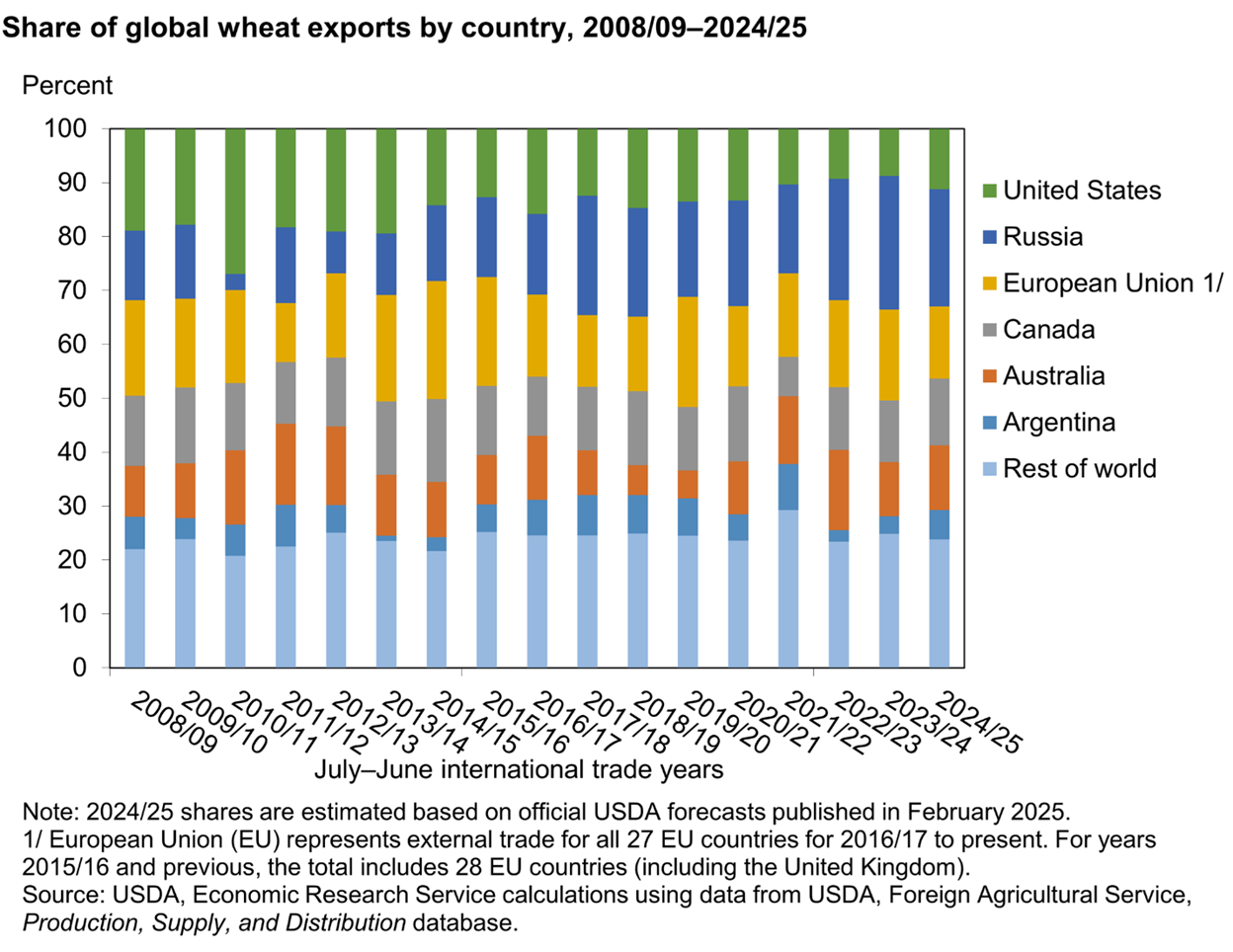
Although Russia and the European Union are the world’s top wheat exporters, the United States routinely ranks among the top five, according to USDA data. But the U.S. share of global wheat trade has fallen to about 11%, down from an average of 25% in the early 2000s.
Dalton Henry, vice president of policy at U.S. Wheat Associates, said wheat still plays an important role in crop rotations. “Including wheat in a rotation with soybeans can help manage herbicide-resistant weeds,” he said. The grain allows farmers to use different herbicide modes of action, “improving overall system performance — even if wheat isn’t the most profitable crop in a given year.”
Jenny Dewey Rohrich, who runs the Prairie Californian website, writes about her family’s experience growing wheat, corn, soybeans and sunflowers on their North Dakota farm. She says wheat remains a key part of the farm’s crop rotation because it allows them to change herbicide modes of action “so that we aren’t putting the same herbicides on the field time and time again.”
“But even outside of agronomy reasons, wheat has an important legacy on our farm,” she writes. “It is one of the only crops we continue to grow today that was grown on the farm when it was started.”
Peña noted that wheat often has important rotational and agronomic benefits, “but when margins are compressed, immediate financial realities understandably drive planting decisions.”
Consumption trends
Consumer preferences for high-protein, low-carb diets may also be contributing to long-term declines in wheat acreage. U.S. per capita wheat use has fallen from nearly 147 pounds in 1997 to under 129 pounds in 2024.
“Domestic wheat consumption has seen challenges over time as consumer perceptions around wheat and carbohydrates more broadly have increasingly been shaped by narratives that characterize them as unhealthy,” Peña said.
Christina Hagerty, an associate professor of plant pathology at Oregon State University, said average bread wheat protein content is 14% to 15%, making it a viable option for people trying to meet protein goals without excess calories. But she noted the geopolitical environment is making it increasingly difficult to grow high-protein wheat, which requires significant fertilizer inputs.
Interest in artisanal wheat and regenerative practices is growing, especially in the Pacific Northwest, she noted. Cairnspring Mills in Washington’s Skagit Valley, for example, now offers premiums for wheat grown under its regenerative organic certification standards.
Long-term trends and investment
The near-term pressures sit atop a decades-long trend. U.S. wheat acreage has fallen about 1.5% a year since the 1990s, said Romulo Lollato, a professor of wheat production at Kansas State University.
Henry said wheat’s challenges extend beyond markets or weather. “Wheat has clearly lagged behind other major commodities, particularly in private-sector investment,” he said.
About half of U.S. wheat acres are still planted with publicly developed varieties, he said.
“That’s not to diminish the progress made by public institutions and state wheat commissions,” Henry said. For example, the U.S. produces more than double the wheat on nearly 40% less land today compared to 1919, due to massive increases in yield per acre.
“However, those gains still haven’t kept pace with the yield increases seen in corn and soybeans, largely because the scale of investment is different.”
Wheat’s quality demands add a unique challenge, Henry added. “As yields increase, U.S. millers and end users still expect consistent or improved milling and baking performance. That adds another layer of difficulty for breeders.”
At the same time, wheat is increasingly grown on more marginal land. As corn and soybeans expand in the Midwest and Northern Plains, wheat has been pushed into more arid regions. About 65% of U.S. winter wheat areas are experiencing drought, according to the latest U.S. Drought Monitor.
Looking ahead, Henry said the focus is not on boosting yields or acres but on improving returns.
“Yield gains alone aren’t enough — what matters most is profitability. That means identifying technologies and traits that can make wheat production more efficient and economically viable.”
Kim Chipman contributed to this report.
