
India is weighing a U.S. request to include increased market access for U.S. apple exports in a U.S.-India trade pact under negotiation, the administration’s top trade official told lawmakers on Thursday.
During a hearing before the House Appropriations Committee's commerce, justice and science subcommittee, Virginia GOP Rep. Ben Cline pressed U.S. Trade Representative Jamieson Greer for details on what he has been doing to improve Indian market access for U.S. apples.
“I personally raised it with my counterpart,” Greer said, adding that the U.S. side has made it a “priority” in negotiations.
“This is something that they're considering,” Greer said of the Indian government. He stressed that negotiations have not been finalized.
The U.S. and India have been working on the deal since last year and published an initial list of agricultural products that could see tariff reductions in a February joint statement. Apples, however, did not make the cut.
India maintains a 50% tariff on apples to protect a substantial domestic industry. Indian producers grow 2.5 million metric tons annually, concentrated in the north of the country, according to the Global Trade Research Initiative – an Indian think tank.
Under the terms of a recent free trade agreement with the European Union, however, New Delhi agreed to allow some volumes to enter at a reduced 20% rate. A deal with New Zealand will also establish a similar tariff-rate quota.
The developments could “further chisel away the market” for U.S. growers, Cline warned.
“We want to be able to play in that space,” Greer stressed. “If they're going to import it, they should be importing from America too.”
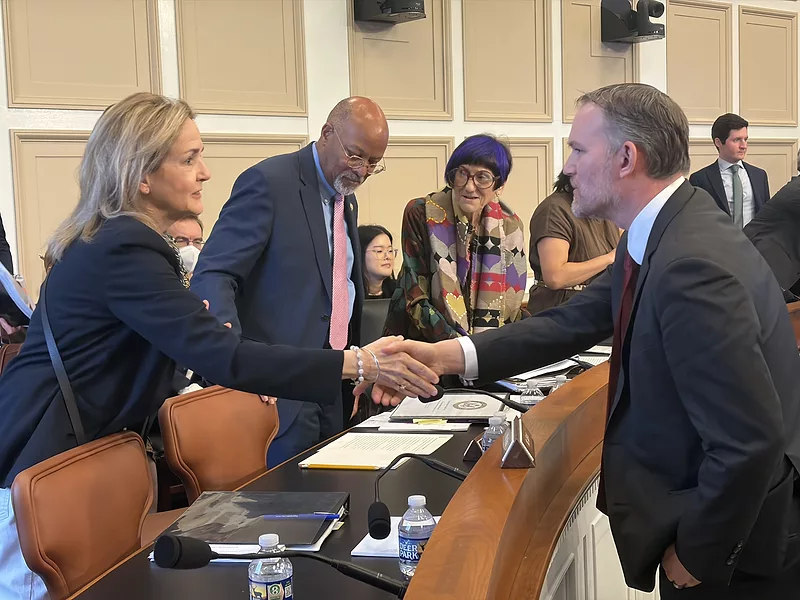
Greer was on Capitol Hill to make the case to lawmakers for why his office needs additional funding for the 2027 fiscal year. The proposed White House budget includes a $7 million increase to bring USTR’s total budget to $95 million.
The bulk of that $7 million increase, Greer said, would go to hiring additional staff to help enforce the new trade deals the administration has inked. He said some would also go to securing more trade agreements.
The administration has indicated that it intends to pivot to alternative tariff statutes in the wake of the Supreme Court’s February ruling to strike down President Donald Trump’s emergency tariffs.
These alternate authorities, like Section 301 of the 1974 Trade Act, which is designed to combat unfair trade practices, are more resource-intensive, Greer told the panel.
“Every time I say Section 301, you have to think, that's a policy person, that's one or two lawyers, that's a political person in the front office,” Greer said.
Interested in more news on farm programs, trade and rural issues? Sign up for a four-week free trial to Agri-Pulse. You’ll receive our content - absolutely free - during the trial period.
When lawmakers raised unfair trade barriers affecting industries in their districts and appealed for further action, Greer made clear what they were asking for.
“I'm happy to do it, but I do have to have the resources to hire,” he told Cline in response to a question about digital trade policies.
At times, Greer and the Democrats on the panel found themselves aligned on trade matters. Rep. Rosa DeLauro, D-Conn., ranking member of the House Appropriations Committee, complained that the U.S. lost industries to Mexico and Canada after Trump retooled a North American trade pact into what became the U.S.-Mexico-Canada Agreement.
“I agree with you,” Greer said, adding, “I think you and I are aligned on so many of these issues.”
But Greer sparred with other Democrats on the subcommittee, including over whether the administration would take any steps to ensure consumers see some benefits from the tariff refund process and its approach to tariff exemptions.
The administration did not open a formal tariff exclusion process for the emergency tariffs, preferring to allocate exemptions based on “analyses done by economists within the administration,” Greer said. The same exclusions granted to the emergency tariffs have been replicated for the 10% global tariff that the administration imposed in February.
But subcommittee ranking member Grace Meng, D-N.Y., argued that in reality, companies and industries with access to lobbyists could push for carveouts, while smaller businesses could not.
“If someone wants to make the case to the government, that a product that is critical to their business should be excluded, what process would a small business or manufacturer in our district undergo?”
Greer noted that although the global tariff and emergency tariffs were imposed without public input, stakeholders have been able to weigh in on the Section 301 investigations and the Section 232 investigations used by the Commerce Department to put tariffs on products with national security value.
“I've been encouraging people who have a view on product coverage for tariffs to comment,” Greer said.
For more news, go to Agri-Pulse.com.

