

A proposed E15 amendment to a House farm bill is drawing widespread cheers from farm and biofuel groups.
Optimism that the measure can move through the House and ultimately be signed into law by President Donald Trump persists despite opposition from some small and mid-sized oil refiners.
Their opposition is focused on what they call an attempt to “eliminate” biofuel-blending law exemptions for refiners heavily burdened by regulatory compliance costs. Supporters say the measure was written to ensure refiners can seek a waiver under extreme financial stress, such as imminent shutdowns.
“Let’s just let the market work. That’s important," Rep. Tracey Mann, R-Kan., tells Agri-Pulse. "Much of the oil industry to my understanding is for year-round E15. They want the certainty. They want to be able to do the blends. So I think the time is now to get it done.”
Greer: Administration looking at trade options to protect sugar growers
U.S. Trade Representative Jamieson Greer says the administration is weighing its trade options to give sugar producers additional import protections.
“We’re looking at different authorities that could be used,” he told Rep. Greg Steube, R-Fla., during a House Ways and Means Committee hearing Wednesday.
Agri-Pulse first reported earlier this month that the administration was considering using Section 301, which allows tariffs to address unfair trade practices, as a potential vehicle for higher duties. Since then, Agriculture Secretary Brooke Rollins and Greer have commented on the need for additional protection.
“We want to maintain our industry,” Greer said. But he also stressed that there are other stakeholders that need to be considered.
“We have a broader industry that uses sugar as an input,” he added. “We need to be able to account for that as well.”
Take note: Greer is back on Capitol Hill this morning when he will appear before Senate Finance Committee lawmakers.
Read more from the hearing at Agri-Pulse.com
Lawmakers, ag community mourn David Scott, former House Ag Committee Chair
Rep. David Scott of Georgia, a staunch advocate of nutrition assistance programs and the USDA 1890 National Scholars Program, died Tuesday. He was 80.
Scott was the first Black lawmaker and the first Georgian to chair the House Ag Committee.
The farm bill the House is set to vote on as early as next week includes a provision renaming the 1890 National Scholarships Program after Scott. The 1890 institutions are the 19 historically black land-grant universities.
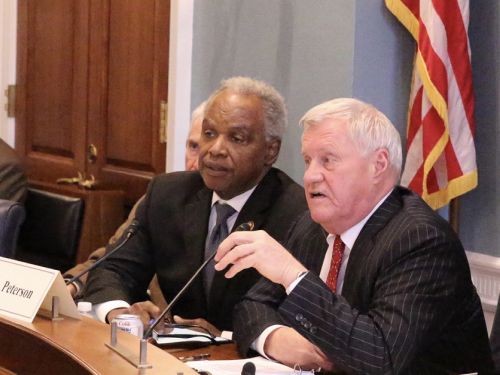
David Scott, left, with Collin Peterson, right. Peterson was Scott’s predecessor as the top Democrat on the House Ag Committee. (Agri-Pulse photo)
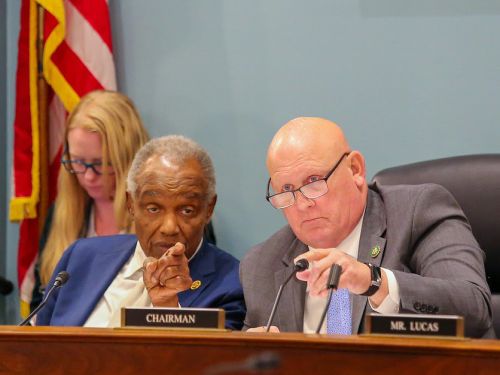
Scott as House Ag Committee Ranking Member in 2024 at a committee hearing with the panel’s chairman, Glenn “GT” Thompson. (House Ag Committee Democrats photo)
Agriculture wish list season hits Congress
A flood of ag policy proposals is hitting Capitol Hill as lawmakers prepare to take a first crack at writing a USDA budget bill.
There’s a push on everything from adding hot food to SNAP to barring duties on phosphate imports as House members get ready to vote on a farm bill as soon as next week.
A USDA spending measure is set for a markup by the House Appropriations ag subcommittee starting Thursday morning.
Read more about it here.
Interested in more news on farm programs, trade and rural issues? Sign up for a four-week free trial to Agri-Pulse. You’ll receive our content - absolutely free - during the trial period.
Missouri bound: Ag Secretary Brooke Rollins said she’ll be in the Show-Me state on Friday to announce “tweaks” to USDA’s Supplemental Disaster Relief Program.
The changes are aimed at helping specialty crop growers tap emergency relief when needed. “If you're a blueberry grower, you don't have the same paperwork that, you know, a corn or wheat farmer does,” she said. “They don't fit into the box of applying for these programs.”
About that farm bill: House Agriculture Committee Chair Glenn "GT" Thompson, R-Pa., told Agri-Pulse Wednesday that he anticipates the Rules Committee will consider the farm bill Monday, with a floor vote coming before lawmakers leave Washington on Thursday.
The Rules Committee did not immediately respond to Agri-Pulse's request to confirm Monday's meeting.
Ex-EPA’ers urge agency to ban paraquat
Eight former EPA officials are urging the agency to ban paraquat due to the herbicide’s risk of accidental exposure and its connection to Parkinson’s disease, which it called a “growing concern.”
“A substantial body of scientific research — including studies supported by the National Institutes of Health — has found that exposure to paraquat is associated with a higher risk of developing Parkinson’s disease,” the officials said in a statement released by the Environmental Working Group.
Syngenta, a major manufacturer of paraquat, said earlier this year it was ceasing production and recently said it was canceling its registration of the paraquat herbicide Gramoxone SL 3.0 in California. Paraquat is still registered for use in the U.S., despite being unauthorized for use in 70 countries.
The ex-EPA employees are “former senior officials in EPA’s Office of Chemical Safety and Pollution Prevention, which is responsible for federal pesticide regulation, as well as senior scientists who worked on chemical issues in EPA’s Office of Water and the Office of Research and Development,” according to the statement.
Broadband group asks USDA, Interior for faster permitting on public lands
Broadband group USTelecom is asking Agriculture and Interior Department leaders to enable faster broadband permitting on federal lands.
In letters to Ag Secretary Rollins and Interior Secretary Doug Burgum, USTelecom President and CEO Jonathan Spalter urged the agencies to formally adopt categorical exclusions under the National Environmental Policy Act to “further streamline reviews, reduce duplication, and improve coordination across federal agencies” for broadband deployment.
In his letters, Spalter also pointed to recent Council on Environmental Quality guidance encouraging agencies to expand their use of categorical exclusions.
Final word
“At one point, we had very, very high tariffs on China. Now we just have high tariffs on China. So, the president has tools like that, and other things, as an enforcement mechanism. The Chinese know this. They want to have stability as much as we do. And so we feel very strongly that they will deliver on this.” – USTR Jamieson Greer on what the administration will do if China fails to meet its soybean purchase commitments.
For more news, go to www.Agri-Pulse.com.
.webp?t=1762183428)


