

|
For the two U.S. companies that make life-saving ready-to-use therapeutic food – the dense paste most widely recognized as Plumpy’Nut – the first year of the second Trump administration has been a turbulent ride. Industry players are hoping a provision in the House-passed farm bill can inject some much-needed certainty into the industry.
The bill, which passed the House 224-200 last week, would set a minimum Food for Peace spending requirement on RUTF through 2031. If global child malnutrition rates are above 5%, and the program has at least $1.2 billion in annual appropriations, USDA would have to spend at least $200 million on procurement and distribution of RUTF. This is consistent with what the Biden administration spent on the products in 2024.
“Any time you can carve out unknowns, that's really helpful,” Jon McDowell, chief of staff at Mana Nutrition, a Georgia-based RUTF producer, told Agri-Pulse.
Both Mana and its competitor, Rhode Island-based Edesia, have been grappling with uncertainty since President Donald Trump took office last January. The administration froze spending on foreign assistance in January while it set about dismantling the U.S. Agency for International Development, which housed the Food for Peace program.
The administration moved the program to the State Department, which resumed RUTF purchases in August after what had become an 11-month hiatus. But then in December, the program was temporarily moved to the Agriculture Department via an interagency agreement.
The department has taken several months to stand up the program but issued its first tender late last month.
For Edesia, which was forced to make layoffs last year during the procurement freeze and explore alternative financing sources, the spending floor “creates more consistency. And it also clearly meets a very critical time-sensitive need for children,” Maria Kasparian, Edesia’s chief of staff, told Agri-Pulse.
 Maria Kasparian (LinkedIn photo)
If current conditions persist, the provision's triggers are highly likely to be met. UNICEF, the World Health Organization and the World Bank Group estimate that more than 6% of children under five globally suffered from malnutrition in 2024, down from 7.4% in 2012 – but still well above the 5% trigger level in the House farm bill proposal. A House proposal for the 2027 USDA budget would also allocate $1.2 billion for Food for Peace next year, hitting the minimum appropriation levels.
Crafting consistency
The RUTF measure ultimately included in the latest House farm bill also featured in the 2024 farm bill. The House Agriculture Committee marked up that bill, but it never advanced to the floor. The provision was conceived several years before that.
It’s easy to be “in the know” about what’s happening in Washington, D.C. Sign up for a FREE month of Agri-Pulse news! Simply click here
A 2019 study changed the way international organizations approached malnutrition treatment, recommending combined protocols for treating both moderate and severe malnutrition. Accordingly, demand for RUTF grew in the years following.
The Biden administration committed to spending more of the Food for Peace budget on RUTF to meet new needs, but the effort was never codified into law.
“The idea of codifying it in the farm bill as part of Food for Peace was to say, ‘You know what? This is helpful to have some kind of consistency in terms of what we're doing with RUTF, because we know there's high need,’” Kasparian said.
The proposal has the backing of groups representing the commodities used as ingredients in RUTF, including peanuts, soybeans and dairy, a House Agriculture Committee aide told Agri-Pulse.
Kasparian said that there had been some concern about earmarking some Food for Peace spending for a specific commodity, but added that the triggers helped ease concerns by demonstrating global need.
It served to “make others comfortable,” Kasparian said – “to say, ‘Alright, we’re not taking over the whole budget. As long as the budget remains at least flat from the year before, and as long as this need is clearly indicated, then that will trigger this amount to be spent.”
Pushing predictability
The farm bill still has to clear the Senate before it can be signed into law – which will be no small feat. Republicans will need to garner support from at least seven Democrats to clear the Senate's 60-vote threshold and lawmakers are already gearing up for fights over cuts to food assistance, pesticide labelling and California’s Proposition 12 animal-welfare law.
Republicans’ decision to move legislation addressing many of the issues typically dealt with in a farm bill as part of their One Big Beautiful Bill Act last year has also fractured the bill’s traditional coalition and taken some of the opportunities for negotiations off the table.
But Eric Muñoz, a senior fellow at the Food Security Leadership Council, said that getting the bill signed into law will only be “half the battle.”
“The other half is getting the administration to do what it’s legally obligated and legally required to do,” he said. That has been “not an easy thing to achieve,” he added.
The administration last year signed a rescission package into law canceling aro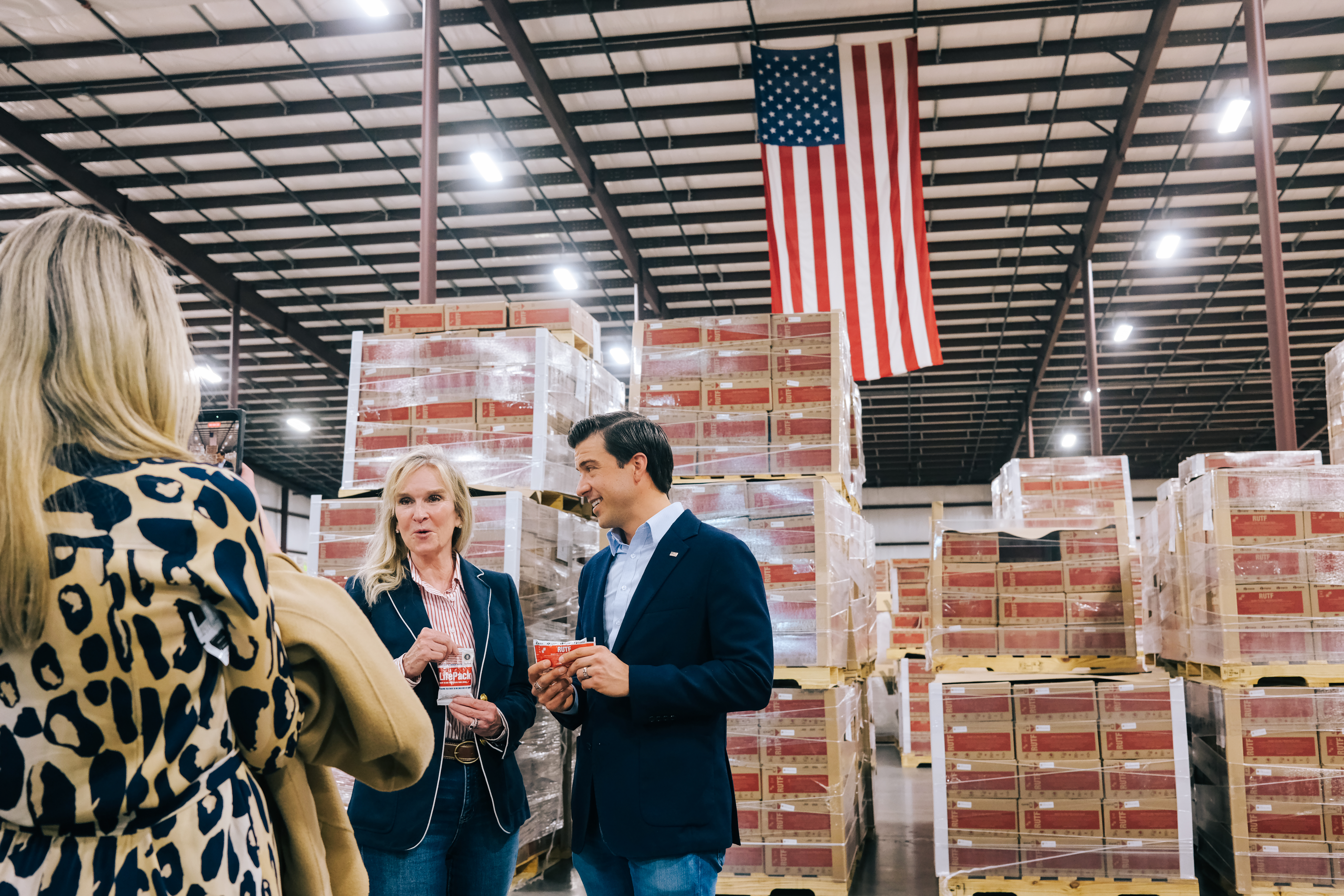 Luke Lindberg and U.S. Representative to the UN Agencies for Food and Agriculture Lynda Blanchard at Mana Nutrition on Monday, May 4, 2026. (Photo by 1504 for Mana Nutrition)2und $9 billion in spending that Congress had previously authorized, including $7.9 billion in foreign assistance.
The White House has also suggested scrapping Food for Peace and the McGovern-Dole assistance program in both of its last two budget proposals.
The minimum spending levels for RUTF are “possibly a very good thing” for the industry, Muñoz said. “But there will still be an effort required to make sure that the administration follows through – actually procures the goods and then distributes them.”
During a roundtable discussion hosted by Mana in Georgia on Monday, however, USDA Undersecretary of Trade and Foreign Agricultural Affairs Luke Lindberg gave a full-throated endorsement of the RUTF sector and the role the products play in combating global malnutrition.
“Right now, there's a sense about the world that the U.S. is retreating from our role in international affairs. And I want to say today that that could not be more incorrect,” Lindberg said. “The United States is stepping up in new and, admittedly, different ways, and the administration is seeking to align with where the American people are at.”
He told attendees that the administration is more closely aligning its trade and humanitarian objectives, but stressed that “we're going to need food assistance and we're going to need places like Mana to step up and meet the need of those folks around the world.”

