
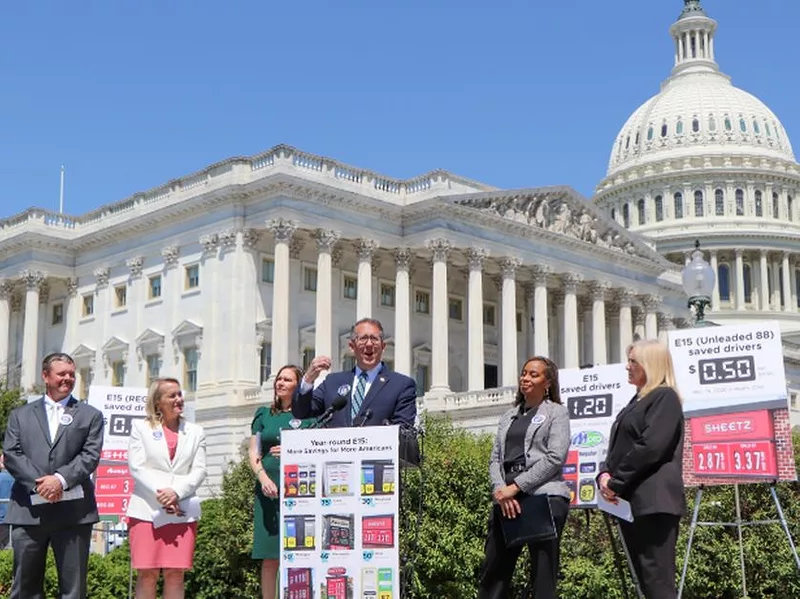
A standalone bill to allow year-round, voluntary sales of 15% ethanol fuel blends, up from the standard 10% now, is set for a vote in the House today as champions and critics of the legislation go into a final stretch of frenzied lobbying.
Obstacles to passage include a formal Congressional Budget Office projection that the bill, H.R. 1346, would lead to a net increase in the federal deficit of $2.3 billion from 2026-36.
The estimate stems from a provision in the legislation to revamp part of the Renewable Fuel Standard.
“Taken by itself, allowing year-round sales of E15 would tend to reduce the deficit,” CBO said.
Separately, Republicans on the House Rules Committee advanced a rule on Tuesday to de-link the E15 measure from the House-passed farm bill. The move should give lawmakers in the Senate more options on how to handle the E15 legislation if it clears the House.
Trump kicks off China visit
President Donald Trump will arrive in Beijing today for a state visit in which the president is likely to address a laundry list of economic and foreign policy issues in bilateral meetings with his Chinese counterpart.
While there, the president will participate in a state banquet and hold two bilateral meetings with Chinese President Xi Jinping.
The administration has said that it is aiming to secure commitments from Beijing for commodities other than soybeans. The two leaders hashed out an agreement on soybean purchase commitments that run through 2028 at their last meeting in October.
Bloomberg reported this week that the two sides could come to an agreement on corn, as well as sorghum and dried distillers’ grains.
StoneX’s Arlan Suderman said a deal on corn could present a win for both sides but added he expects outcomes on “a basket of commodities.”
The administration’s decision to invite Cargill executive Brian Sikes on the trip “suggest that there is some ag in there somewhere,” Suderman said.
China’s corn and wheat stocks are at multiyear lows, Suderman said in his market outlook Tuesday. “Could that be an indication that perhaps corn and wheat might be a part of the deal?” he asked.
He doubted that soybeans would receive much attention in the talks, however, particularly when Chinese soybean stocks are high and crush is falling.
Beef, beef, beef: A bipartisan group of farm-state senators returned from Beijing last week. When Agri-Pulse asked two of them Monday what they would most like to see from Trump’s visit, GOP Sens. Steve Daines of Montana Deb Fischer of Nebraska both pointed to beef exports.
China made market opening commitments as part of the Phase One deal, but a slate of U.S. export facility registrations were allowed to expire last year and have not been renewed.
“I hope we can get the beef flowing back to China, second largest beef market in the world,” Daines said.
USDA bars 10 lenders from Rural Development loan programs
The Agriculture Department is barring 10 lenders from participating in four Rural Development loan guarantee programs, Secretary Brooke Rollins said Tuesday.
It’s easy to be “in the know” about what’s happening in Washington, D.C. Sign up for a FREE month of Agri-Pulse news! Simply click here
The agency is restricting 10 banks and credit unions from the OneRD guaranteed loan umbrella, which includes the Rural Development's Business and Industry, Community Facilities, Water and Waste Disposal, and Rural Energy for America programs. According to a press release, they collectively have around $620 million in delinquent loans.
The organizations include Bank of Montgomery, Byline Bank, Celtic Bank, Community Bank and Trust of West Georgia, Genisys Credit Union, Greater Nevada Credit Union, North Avenue Capital, Optus Bank, U.S. Eagle Federal Credit Union, and ReadyCap Commercial.
Corteva’s seed business finds a home in Iowa, crop protection in Indiana
Johnston, Iowa, will be the new home of Corteva's future independent seed and genetics company, Vylor, and Indianapolis, Indiana, will be the home of “New Corteva,” the future crop protection company.
The business separation is scheduled for the fourth quarter of this year.
“Our roots stretch back 100 years to a farm in Johnston, which we call home,” said future Vylor CEO Chuck Magro, referencing the home of the company’s flagship Pioneer brand in the Des Moines suburb. “Vylor is proud to build on our long history of innovation in Iowa, and continue to work alongside farmers to help feed and fuel our growing world.”
“The Hoosier state is an established leader in global biosciences innovation and the Corteva headquarters will serve as the company’s core research and development hub, driving its impressive pipeline of synthetic, biological, and natural product innovation, while also anchoring Corteva Catalyst, its investment and collaboration platform,” said Corteva Chair Greg Page, who will also chair “New Corteva” after the separation.
Bayer reports solid earnings for first quarter
Shares of Bayer were up about 3.3% after the company posted quarterly earnings above Wall Street expectations Tuesday.
The Crop Science division saw sales increase about 6.8%, the company reported, driven by an agreement with Corteva that resolved a licensing rights dispute and “price recovery following the return of the dicamba label in the United States,” the company said in a news release.
Herbicide sales were down 10.2%, with glyphosate-based products declining 15.1%. Sales of fungicides decreased 10.7%.
Final word
“I had the chance to [have a phone] call w[ith] trade ambassador Greer b[efore] he takes off for China w[ith] Pres[ident] Trump[.] I emphasized the importance of agriculture trade/soybeans in the talks,” Iowa GOP Sen. Chuck Grassley posted to X. “Greer understands that importance.”
For more news, go to Agri-Pulse.com.
.webp?t=1762183428)


