
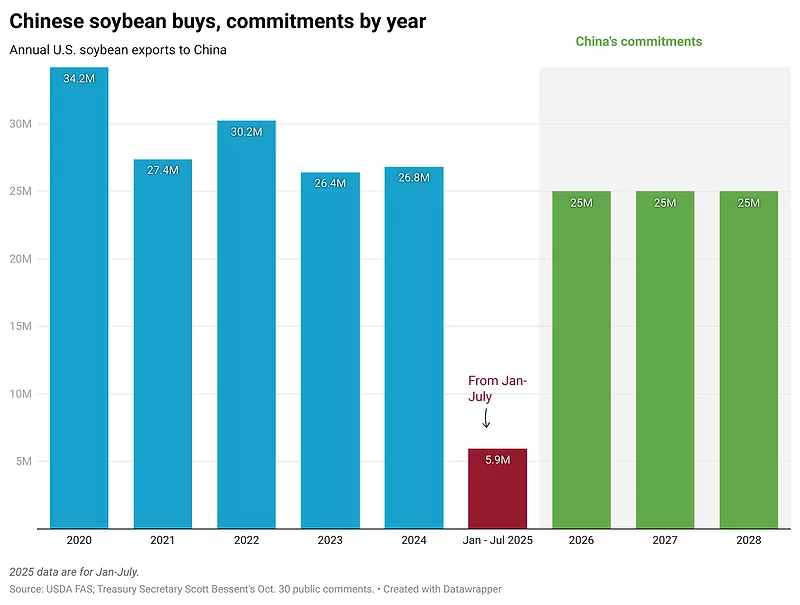
Treasury Secretary Scott Bessent said Thursday that under the terms of a new U.S.-China deal, Beijing has pledged to continue buying soybeans in similar volumes to recent years. Meanwhile, Agriculture Secretary Brooke Rollins touted tariff reductions on U.S. commodities and opportunities for sorghum and hardwood.
Speaking with Fox Business’ Maria Bartiromo just hours after President Donald Trump met with Chinese President Xi Jinping in South Korea, Bessent said China had committed to buying 12 million metric tons of soybeans this season, which Bessent said would end in January, and to keep import volumes to at least 25 million tons per year for the next three years.
China bought around 26 million tons of soybeans in both 2023 and 2024, according to USDA’s Foreign Agricultural Service.
A White House official told Agri-Pulse that the 12 million-ton target refers to "the 2025 growing season," while the 25 million-ton figures are for 2026, 2027, and 2028.
Bessent told Bartiromo that “the massive amount of agriculture purchases” are a central component of the deal.
The treasury secretary also stressed that the 26 million tons is a floor, not a ceiling.
Bessent noted that China is just one of the export destinations the administration has been working on to protect and expand U.S. soybean exports. He touted recent agreements that the U.S. has signed with Southeast Asian nations and others that, he argued, could be worth another 19 million tons in soybean purchases.
“Our great soybean farmers, who the Chinese used as political pawns,” Bessent said, “should prosper in the years to come.”
Negotiations on the deal, Bessent said, concluded overnight. Accordingly, he said that both parties could sign the deal as soon as next week.
U.S. soybean farmers “backed President Trump, and they knew that he had their back. And this deal is the culmination of that,” Bessent said.
Cut through the clutter! We deliver the news you need to stay informed about farm, food and rural issues. Sign up for a FREE month of Agri-Pulse here.
Rollins said in a post to X on Thursday that China would buy U.S. sorghum and hardwood under the deal, as well as remove tariffs on a slate of commodities, including soybeans, sorghum, beef and corn. Sen. Roger Marshall, R-Kan., told Agri-Pulse that the sorghum sales could be worth around $2 billion annually.
"That's huge news, especially for Kansas," Marshall said, adding that his state accounts for around half of total U.S. sorghum production. "This is going to save some farms," he added.
U.S. soybean growers also applauded the administration's work to restore Chinese purchases.
"Today’s announcement is great news for American agriculture," American Soybean Association President Caleb Ragland said in a statement Thursday. "This is a meaningful step forward to reestablishing a stable, long-term trading relationship that delivers results for farm families and future generations."
It is not clear, however, that China will be able to fill 12 million tons in orders before January. And whether it can live up to its annual targets will depend on the final tariff rate applied to U.S. soybeans, according to one analyst.
“The most confusing number is 12 million tons [this season],” said Eduardo Vanin, a senior agriculture strategist at Marex Group, a financial services company. Vanin said there just isn’t enough time to scale up transportation and freight before the end of the season.
China bought its first shipments of U.S. soybeans for the season on Wednesday. Those had transportation dates of December and into January.
“They have no logistics for December,” Vanin said.
Over the longer term, Vanin said, whether China lives up to its pledge to buy 25 million tons annually will depend on the tariff rate applied to U.S. soybeans. Heading into the Trump-Xi meeting, U.S. soybeans faced a 23% tariff in the Chinese market, compared to Brazil’s 3%.
The U.S. agreed to cut its fentanyl tariffs on China by 10%, and a Chinese Ministry of Commerce spokesperson told its state-run media that China will “make corresponding adjustments to its countermeasures.” But Vanin points out that if China only reduces tariffs by 10%, Brazil will still have a competitive advantage.
“Brazil will increase production,” Vanin said, and could have up to 115 million tons available to export, of which, if recent trends hold, around 90 million would likely go to China. Argentina could have a further five million tons for export. Twenty-five million tons on top of that would be more soybeans than the Chinese need, Vanin said.
Under such a scenario, prices would likely fall, and private Chinese buyers would flock to the most competitive beans. With a 13% tariff rate, those may not be from the U.S.
State buyers, which are unaffected by the tariffs, could continue to purchase U.S. beans. But Vanin doubts demand from state buyers alone would be enough to reach the 25 million-ton target.
Angie Setzer, a partner at Consus Ag Consulting, told Agri-Pulse earlier this week that demand from state-owned companies in China could be around 8-10 million tons.
“To have a good volume, for sure, they need the private companies also,” Vanin said.
For more news, go to Agri-Pulse.com.

