

|
Lower Colorado River water leaders are pitching a new plan to stave off the threat of low water levels at key Colorado River reservoirs for the next two years while state officials continue negotiations over the best way to manage the river’s supplies beyond 2026.
Negotiators from Arizona, California and Nevada are proposing to use 3.2 million acre-feet less Colorado River water in 2027 and 2028 to “stabilize the system in the face of deteriorating hydrology,” according to a plan sent on May 1 to leaders of the Bureau of Reclamation, the federal agency in charge of the river’s reservoirs. On top of these cuts, they have also suggested conserving an additional 700,000 acre-feet of water over the two-year period.
Under the proposal, Arizona would take 760,000 acre-feet of cuts each year for the next two years, while California would take 440,000 acre-feet and Nevada would take 50,000 acre-feet. In the near term, it would help to keep water levels in Lakes Powell and Mead from reaching “dead pool,” or dropping so low that water physically could not be released downstream.
 Tom Buschatzke (Arizona Water Banking Authority photo)
“It is a really proactive proposal in the lower basin that protects that Colorado River system total,” Tom Buschatzke, Arizona’s Colorado River negotiator, told reporters on a press call Thursday. He said it would create “robust protection” over the next two years for the basin’s two major reservoirs — Lake Powell and Lake Mead. However, he added that in the longer term, he expects all seven basin states will need to continue meeting to discuss “whether or not we could find a seven-state path forward after 2028.”
Officials from all seven Colorado River states have spent the last few years locked in tense negotiations over the river’s future, but failed to meet their February negotiating deadline. In the absence of consensus, Reclamation is conducting environmental reviews of its own proposals for managing operations at Lakes Powell and Mead after this year and will need to make a final decision before Oct. 1.
“It’s sort of like a plan to help us barely scrape by as we continue to negotiate,” University of Nevada, Reno, professor Elizabeth Koebele said of the lower basin proposal.
Lower Basin seeks funding assistance from Reclamation for conservation
The lower basin plan is contingent on the prospect of federal funding. Buschatzke said he expects Reclamation to provide $354 million to lower basin water users to compensate for reductions, pulling from $4 billion in Inflation Reduction Act dollars earmarked to the agency for bolstering water-saving efforts in drought-stricken parts of the West.
“We need the federal government’s funding to help make this happen,” Buschatzke said.
David Palumbo, Reclamation's Deputy Commissioner of Operations, told the Senate Energy and Natural Resources Committee in March that around $1 billion of the IRA drought funding remains unobligated.
“Our intention is to get that money out the door, put it to work, and have it obligated before the end of this fiscal year,” Palumbo said at the hearing.
The Agribusiness and Water Council of Arizona, the Association of California Water Agencies, the Colorado Water Congress, and other western farm groups on Friday urged Congress to provide $2 billion each year over the next five years to help finance water conservation efforts, warning that many river basins are “recording the worst hydrologic conditions in history” this year.
"Without immediate federal action, and should dry conditions return next winter, the consequences will be catastrophic for farms, communities, and ecosystems across the region,” their letter said.
It’s easy to be “in the know” about what’s happening in Washington, D.C. Sign up for a FREE month of Agri-Pulse news! Simply click here
The agency has used past agreements to pay producers to scale back their water use in places like California’s Imperial Valley, a major crop growing region with powerful water rights. One agreement from 2024 to 2026 compensates users in the Imperial Irrigation District to conserve up to 700,000 acre-feet of water.
Over the past two years, IID users have conserved some 250,000 acre-feet each year, leaving around 190,000 acre-feet of space left in the program this year, said Tina Shields, IID’s executive director. She said Reclamation is looking at another agreement with IID to compensate an additional 100,000 acre-feet of savings, bringing total conservation up to around 800,000 acre-feet, though these new payments will likely be 50% less than they were previously, Shields said.
“It’s a drought — we’re willing to do this to preserve our future water supply reliability,” Shields said. While she isn’t sure if the district will see a full 100,000 acres enrolled, she added that she thinks it can get to 65,000 or 70,000 “pretty easily."
Buschatzke said that in Arizona, the cuts in the lower basin proposal will need to be applied under the state’s existing priority system absent consensus from its water users over a different method for assigning them. Under a system called prior appropriations, the earliest Arizona users to put water to a “beneficial” use acquired “senior" rights to it, while those who did so later had more “junior” rights. Junior users take cuts sooner under this “first in time, first in right” system.
Absent concessions from other Arizona water users, cuts under the Lower Basin Plan could significantly hit the Central Arizona Project, a 336-mile aqueduct system that delivers Colorado River water to counties in central and southern Arizona. Congressional approval of the aqueduct in 1968 required Arizona’s lawmakers to make one concession: In times of drought, the CAP would be the first lower basin user to take cuts. Farmers who use CAP water have already lost their access under existing restrictions, though further cutbacks could hit the fast-growing metropolitan regions of Phoenix and Tucson and tribes in the region.
Some farmers in southern Arizona share the same priority as the Central Arizona Project under state law, which means they’ll likely be forced to take some cuts under the plan. However, most producers in Yuma, a major produce-growing region, have high priority rights and “will not be taking any cuts unless they come to us and say, ‘we’d like to contribute,'” Buschatzke said.
Upper basin states call for mediation
Meanwhile, officials from the upper basin states are calling for negotiations to resume — and include mediation. In a statement last month, negotiators from Colorado, New Mexico, Utah, and Wyoming suggested a mediation process focus on “operations", "federal funding" and "creative and flexible programs.”
A point of contention in recent discussions is whether the upper basin states should face mandatory cuts during times of drought like Arizona, California, and Nevada do. While the lower basin states want to see mandatory restrictions imposed on the upper basin, lower basin negotiators argue they already face their own version of cuts due to “hydrologic shortage,” or an overall lack of water caused by dry conditions. The upper basin states instead argue that the lower basin should bear the brunt of future cuts.
The Colorado River is governed by complex, long-standing agreements, federal laws and court decisions collectively called the “Law of the River.” The Colorado River Compact, one of the foundational governing documents, formally split apart the upper and lower basins and allocated 7.5 million acre-feet of water to each.
The four upper basin states — Colorado, New Mexico, Utah and Wyoming — have historically used less water each year than their lower basin counterparts. In 2024, states in the upper basin collectively used around 4.4 million acre-feet, while lower basin states used around 6 million, according to Reclamation data.
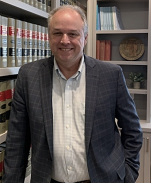 Chuck Cullom (Upper Colorado River Commission photo)Chuck Cullom, executive director of the Upper Colorado River Commission, told Agri-Pulse that some upper basin water users already have their water access cut off under prior appropriations processes as a result of an overall lack of water. He said the upper basin instead believes operations at Lake Powell and Mead should operate in a similar way, adding “when the water isn’t available, we reduce uses rather than putting the infrastructure and the entire system at risk delivering more water than we have out of those reservoirs."
"The lower basin is focused on operations that reflect their legal theories more than joining the upper basin in addressing the math problem,” Cullom said in an interview. “And we, the upper basin, believe that the way forward is through some structured, neutral mediation.”
Meanwhile, Buschatzke, Colorado River Board of California Chair JB Hamby, and Southern Nevada Water Authority General Manager John Entsminger publicly bemoaned the upper basin states' "refusal to commit to water use reductions to protect the system" and asked them to join with "verifiable water contributions of their own for 2027 and 2028."
"Achieving sustainable operations will require net reductions in use across all basin states," they wrote.

