
It’s another big week as Agriculture Secretary Brooke Rollins grapples with a threat to livestock, senators work on a farm bill, and President Donald Trump says he’s focused on ending war with Iran and lowering costs for ag producers and other Americans.
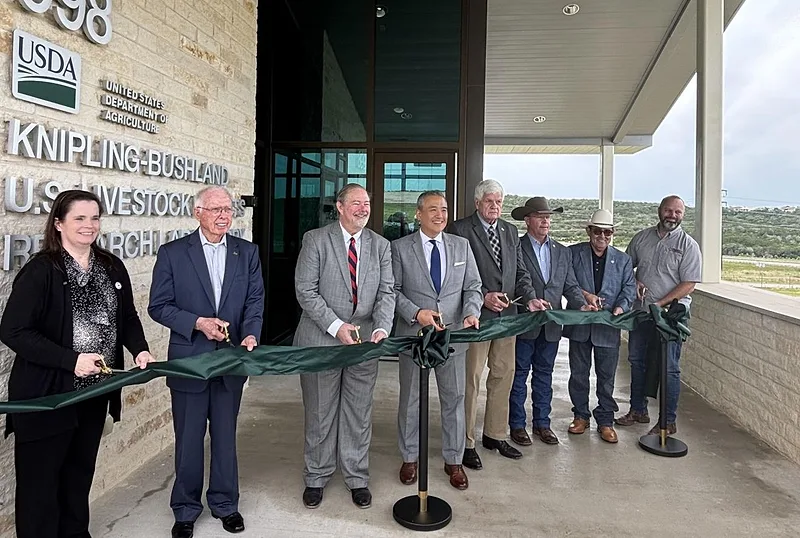
Rollins will travel to Kerrville, Texas, to visit the new Knipling-Bushland U.S. Livestock Insects Research Laboratory, which works to control livestock arthropod pests.
With a second case of New World screwworm found in a Texas calf on Friday, Canada said it would temporarily bar certain U.S. imports of livestock, including horses, from entering the country.
“Animals that originate from or were present in the state of Texas within 21 days prior to border crossing will not be accepted into Canada,” the Canadian Food Inspection Agency said.
In Congress, farm bill talks continue as the Senate Agriculture Committee works to finish draft legislation within the next few weeks.
“We're working with Congress to quickly pass the new farm bill,” Trump said during an event at a Wisconsin farm on Friday. “We're very well on our way to getting the farm bill finished and approved.”
Trump also said the U.S. is going to be out of the Iran war “very quickly,” either by negotiation or force, and then fertilizer and fuel prices “are going to go way down.”
Judge temporarily bars USDA from enforcing funding conditions on 21 states
A federal judge has issued a temporary injunction barring the Agriculture Department from withholding funding from a group of states through a terms and conditions framework that seeks to comply with Trump administration policies on gender, immigration and diversity.
Judge Myong Joun of the U.S. District Court of Massachusetts granted a request to enjoin USDA from enforcing a set of general funding award terms and conditions challenged by 21 Democratic state attorneys general. While Joun did not offer details behind his decision-making, he said USDA does not need to issue new terms and conditions documents and that he would publish an opinion later that explains his decision.
Cut through the clutter! We deliver the news you need to stay informed about farm, food and rural issues. Sign up for a FREE month of Agri-Pulse here.
The dispute stems from a standard set of general terms and conditions the agency issued in December at the request of Secretary Brooke Rollins. In their brief supporting a motion for a preliminary injunction, the AGs argued the agency “has threatened harsh penalties” if states do not comply with certain requirements relating to DEI, gender and immigration.
They said the new requirements imperil more than $74 billion their states receive annually.
The funding would affect “food and nutrition programming (including Child Nutrition Programs, the Supplemental Nutrition Assistance Program, and the Special Supplemental Nutrition Program for Women, Infants, and Children, agricultural, forestry and rural support programming, and programs to support academic research and programming in agricultural sciences,” according to the states’ brief.
But, but, but: Shiela Corley, the Food and Nutrition Service administrator’s chief of staff, wrote in a declaration that many nutrition assistance programs are administered through federal-state agreements, which have historically operated through a different set of terms and conditions than the one being challenged.
USMCA helps lower U.S. food costs, Purdue study finds
The trade accord among the U.S., Mexico and Canada has helped keep food prices in check for U.S. families, a Purdue University study finds.
Lower tariffs under the U.S.-Mexico-Canada Agreement established in 2020 have led to savings of about $700 a year for U.S. households in today’s dollars, equal to roughly 7% of a home’s total spending on food, according to the report being released today.
“Food affordability remains one of the top concerns for American families, and this study makes clear that USMCA is part of the solution,” says John Bode, president and CEO of the Corn Refiners Association, which commissioned the study in partnership with the Agricultural Coalition for USMCA.
But, but, but: The U.S., Mexico and Canada are set to miss a July 1 milestone to renew the trade deal, raising the prospect of months or years of wrangling over the rules and tariffs for agriculture and other industries, Bloomberg News reported Friday, citing unidentified people familiar with the matter.
Trump’s remaining USDA nominee to get Senate Ag Committee vote
After a string of scheduling delays, Trump’s nominee to lead USDA’s Rural Development mission area is set for a vote by the Senate Agriculture Committee on Monday.
Glen Smith is the sole unconfirmed nominee for the Agriculture Department. The job of undersecretary for rural development has been vacant since January.
If confirmed by the Senate, Smith would oversee billions of dollars in federal lending and grant programs. USDA is planning a sweeping overhaul of its technology systems to improve financing access for rural communities.
Four states sent subpoenas for SNAP data by USDA inspector general
USDA’s inspector general has sent subpoenas for Supplemental Nutrition Assistance Program participant information to state agencies in California, Illinois, Michigan and New York, saying they’ve refused to provide it for more than a year.
In a press release, USDA’s office of the inspector general cited the request as part of a “series of inspections to assess the quality and integrity of SNAP participant data for 10 states,” which focuses on “key information states used to validate an individual’s eligibility for food assistance.
The release said the agency has so far received data from Ohio, Georgia, North Carolina, Pennsylvania, Texas and Florida.
Hutchins discusses USDA proving grounds, Beltsville closure on Open Mic
USDA’s undersecretary for research, education and economics touts the department’s new National Proving Grounds Network for AgTech and defends the closure of the Beltsville Agricultural Research Center on this week’s Agri-Pulse Open Mic.
Scott Hutchins tells Jeff Nalley that the newly announced but not yet operating NPG-Ag in North Dakota will test precision ag technology.
“The vision that we have long term is that we're able to very precisely measure, and almost simultaneously — I mean during the same pass of the tractor or the implement — to be able to apply just the right amount of fertilizer or nutrient, depending on what the mix is, to the plant and to the soil,” he says.
“We believe that when we reduce that, we will not hinder at all any of the yield productivity or capability of the plants or the crops, but we'll use a significantly less amount of actual product, which will reduce the input costs,” he says. Using less fertilizer could also protect sensitive areas, he adds.
Regarding BARC in Beltsville, Maryland, Hutchins says research being conducted there will continue to be conducted elsewhere, “at least the research that has been funded by Congress.”
Agricultural Research Service Administrator Joon Park has told staff that nine research projects would be terminated as part of the department’s reorganization.
Listen to Agri-Pulse Open Mic on our website.
Final Word
“We issued a historic $12 billion in farm relief, so it's $12 billion, but it was $28 billion in my first [term], so we're looking at that right now, about increasing it.” – President Donald Trump at a White House event in Chippewa Falls, Wisconsin, Friday.
.webp?t=1762183428)

