
|
California regulators are moving faster to approve biological crop protection products, but growers and industry leaders are warning that quicker registration alone will not persuade farmers to risk valuable crops on tools that have not demonstrated consistent performance in the field.
That tension — between agriculture’s urgent need for alternatives and lingering doubts about product claims — ran through discussions at the fourth Salinas Biological Summit last week.
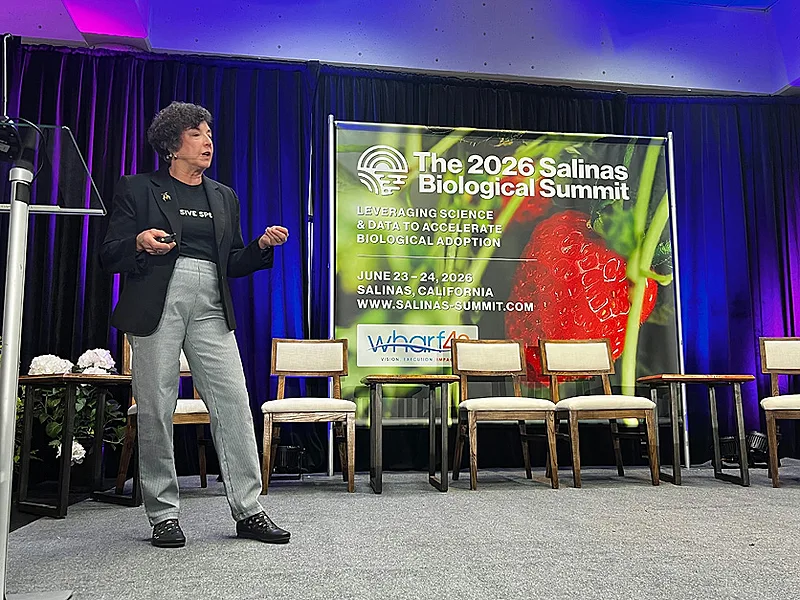
The conference brought together growers, researchers, regulators, investors and biological companies from California and several countries. Along with presentations, the summit included research and regulatory workshops, a farm visit and discussions of commercial field trials intended to move promising products out of laboratories and into production agriculture.
Organizers described collaboration as the central theme, with particular attention on Platform10, a program conducting biological trials on commercial California farms. The initiative is intended to keep growers at the center of product testing and connect companies with researchers, advisers and farmers who can determine whether products work under real production conditions.
California Department of Food and Agriculture Secretary Karen Ross framed the challenge around rising invasive species pressure, longer pest seasons and the need to provide farmers with more tools as conventional options become less available.
The broader discussions made clear that availability is only one hurdle. Biological companies must find investment, navigate multiple regulatory environments, generate credible field data and prove they can deliver enough value to earn repeat purchases.
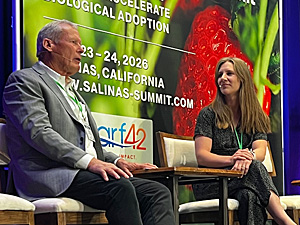 Farmer Don Cameron and DPR Chief Deputy Director Leia Bailey (Brad Hooker/Agri-Pulse)
Biological firms compete for scarce capital
Pam Marrone, founder and chair of the Invasive Species Corp., explained that several parts of the biological sector continue to grow at double-digit rates even as startups confront one of the most difficult investment environments in years.
Cut through the clutter! We deliver the news you need to stay informed about farm, food and rural issues. Sign up for a FREE month of Agri-Pulse here.
Venture capital funding has pulled back following high valuations in 2021 and 2022, she said. Investors who lost money during that period are more cautious, while artificial intelligence, gene editing and other technologies compete for capital.
“AI is sucking up all the oxygen in the room,” Marrone said.
European investors have remained more active in biologicals, while private equity firms are primarily seeking profitable or break-even companies, she said. Merger and acquisition activity continues, but businesses still years away from significant revenue face a difficult path.
Companies must also become more sophisticated in describing what makes their products different, Marrone said. Telling investors that a startup discovered better microbes is no longer enough.
Developers need to explain the specific problem they solve, how their products compare with competing tools and what return farmers can expect. A modest yield claim by itself may no longer attract investors or growers.
Marrone pointed to Brazil as a model for faster biological adoption. Brazilian farmers commonly integrate biological and conventional tools rather than treating each biological as a stand-alone substitute, she said.
Brazilian companies at the conference contrasted California’s system with a country that has moved biological products into commercial agriculture more rapidly.
Marrone highlighted a CDFA-led climate and trade trip to Brazil last July, describing how the delegation of regulators and agricultural leaders visited an avocado operation that used drones to release beneficial insects. The farm had moved from spraying weekly for an avocado pest to controlling it without those applications.
The lesson for California is that biologicals need to be evaluated within complete production systems. Developers also need to shorten product development timelines that can stretch from seven to 14 years.
Artificial intelligence, machine learning and advances in formulation and fermentation could help companies move more quickly and use investment dollars more efficiently, Marrone said.
Growers wary of lofty promises
Despite the growth in biologicals, Marrone said the industry’s greatest obstacle remains a lack of confidence among farmers.
“Lack of trust in product performance — that is number one,” she said.
Marrone lamented that growers routinely hear sales representatives promise higher yields, healthier plants and lower input costs. Yet they often lack the information needed to distinguish products backed by reliable evidence from those supported by limited or selective trials.
She urged farmers to ask about the science behind a product, the number and consistency of field trials and the company’s quality control procedures. For products containing multiple microbial strains, developers should be able to explain the purpose of each strain and how the combination performs.
Don Cameron, vice president and general manager of Terranova Ranch, offered a blunt assessment of the sales pitches reaching farms.
Cameron said growers are “bombarded” by products promising to increase yields and save money, but “nine out of 10 times, it usually doesn’t work.”
His farm is conducting a 25-acre trial of a root stimulant in processing tomatoes. The treated plants appeared smaller, Cameron said, raising concerns that the product could delay harvest despite promises that it would produce stronger plants and higher yields.
“Jury’s out, we’re going to wait till harvest,” Cameron said.
Growers are interested in products that can ease plant stress, control emerging pests and replace aging chemistries, he said. But they cannot afford repeated failures or independently evaluate every product entering the market.
Terranova Ranch lost several hundred acres of processing tomatoes last year to consperse stink bug, Cameron explained, illustrating the need for new tools. Neither conventional pesticides nor biologicals have provided a strong solution.
Pest control advisers could help farmers evaluate products, though Cameron said some may hesitate to recommend biologicals because growers expect the same speed and degree of control associated with conventional chemistry.
Platform10 is aimed at addressing that credibility problem by testing products on commercial farms and involving growers in trial design and evaluation. The summit highlighted trials underway on sizable California operations in an effort to keep farmers central to the program.
Those trials could help companies understand why a product succeeds in one setting and fails in another.
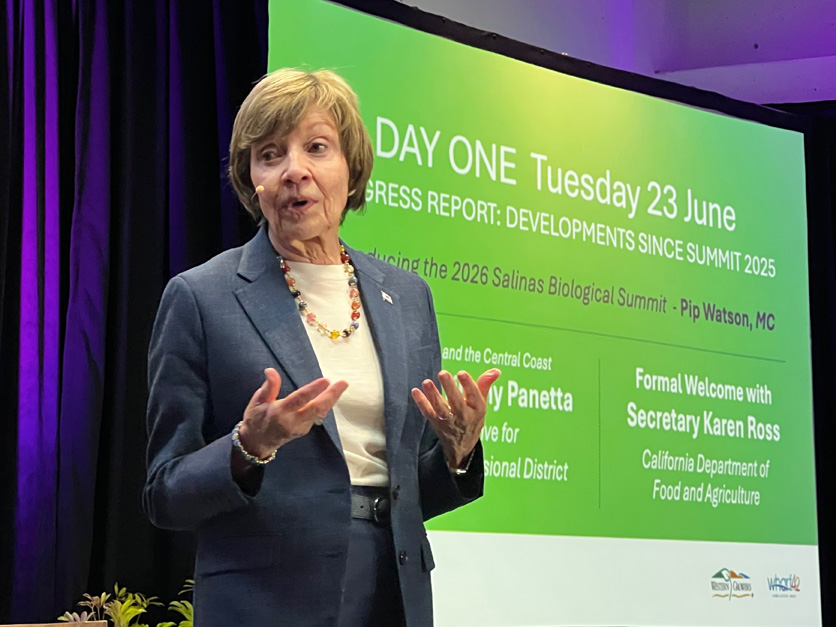
CDFA Secretary Karen Ross opens the 2026 Salinas Biological Summit. (Brad Hooker/Agri-Pulse)
DPR shortens registration timelines
Department of Pesticide Regulation Chief Deputy Director Leia Bailey said the agency has significantly reduced the time needed to review new products, including many biological active ingredients.
The department replaced 20 paper-based legacy systems with the electronic CalPest platform, allowing scientists in different units to review registration materials concurrently instead of passing physical packets from one station to another.
DPR is adding about 100 positions over three years after lawmakers raised pesticide fees through AB 2113. Bailey said the additional staffing and technology have helped DPR process new products about twice as fast and new active ingredients about four times as fast, based on 2025 data.
The most complex registration category previously took three to four years, Bailey said. DPR has dropped that to about a year.
Bailey encouraged companies seeking federal and California approval to submit applications to U.S. EPA and DPR at the same time and to tell both agencies that concurrent reviews are underway so regulators can communicate and avoid unnecessary delays.
She also urged developers to consult DPR about efficacy evidence before submitting a complete package.
DPR has expanded its sustainable pest management research and adoption grants to about $5 million annually, though demand greatly exceeds available funding. Bailey said the program has received $40 million in requests.
The state must also look beyond registration and consider what happens after a product reaches the market, she said. Gaps in training, education and incentives can prevent the adoption of products that may otherwise be useful.
DPR-funded research into alternatives to fumigants found few direct replacements. In many cases, growers will need combinations of products and practices, along with additional field research, to achieve comparable control.
The collaboration begun in Salinas promises to extend beyond California. Wharf42 is working toward a joint Platform10 roadmap linking California with Australia and New Zealand, with the goal of aligning specialty crop research and sharing lessons across regions.
That international approach reflected the conference’s larger message that no agency, university, company or country can manage the biological transition alone.

