
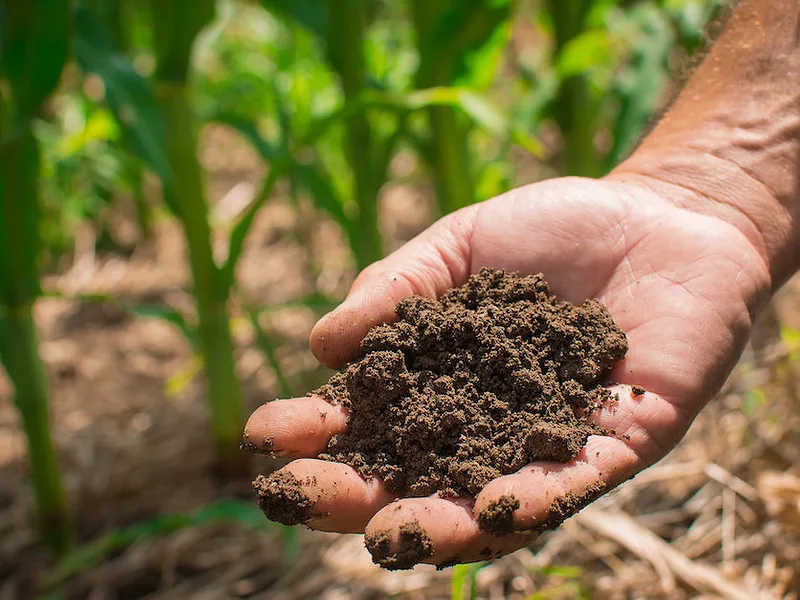
The Agriculture Department has agreed to enroll 2.2 million acres in the Conservation Reserve Program this year out of the 2.5 million acres offered by landowners under all three program signups.
According to a USDA press release, this year’s signup was “highly competitive” due to only 2.2 million acres being available for enrollment this year. Under a cap set in statute, a maximum of 27 million acres can be enrolled in the program, which pays farmers to remove environmentally sensitive land from production.
Take note: Conservation policy experts told Agri-Pulse in February that CRP would likely see increased interest this year from farmers seeking a consistent source of income from less productive acres amid a tough commodity market.
NCGA study says US farmers pay more for inputs than Brazilian rivals
The National Corn Growers Association is calling for heightened transparency from agricultural input companies as it releases a new study that shows U.S. farmers paying substantially more for seeds and pesticides than their counterparts in Brazil. The higher costs are in some cases double those of South American producers.
NCGA is singling out Brazil — this country’s biggest global ag rival — over trade barriers on U.S. ethanol while “enjoying lower input prices.”
The corn group also said it is seeking legislative reform to the countervailing duty process so that the public interest must be weighed before levies on farm products are imposed by the Commerce Department and the International Trade Commission.
The study was done by NCGA along with the data firm Kynetec and didn’t include fertilizer costs.
The group said in a statement Tuesday that prices need to better reflect existing economic realities.
“The price gouging that is happening for U.S. farmers is even worse than many of us suspected,” said Matt Frostic, a Michigan farmer and NCGA’s first vice president. The higher costs paid by producers versus their largest rivals in Brazil is occurring as U.S. corn farmers are on track to lose money for a fourth consecutive year, he said.
Read more on the study here.
Growth Energy urges US to end RFS credits for Brazilian ethanol
Growth Energy is calling on the Trump administration to eliminate the ability of Brazilian ethanol to generate credits under the Renewable Fuel Standard.
The nation’s biggest biofuel trade group says the Office of the U.S. Trade Representative needs to work with EPA on the issue. Brazil’s renewable fuel program is blocking U.S. biofuels despite the South American nation getting favorable treatment under the RFS, Growth Energy testified before USTR, which has proposed imposing tariffs of 25% on all goods from Brazil.
“Brazil has been systematically working to undermine the U.S. bioeconomy since 2017, all while enjoying complete and unfettered access to American markets,” Growth Energy’s Chris Bliley, senior vice president of regulatory affairs, said in written testimony.
“We’re encouraging USTR to go beyond the proposed tariff and take additional actions to end deceptive practices designed to disguise illegal deforestation by Brazilian producers and block U.S. products from participating in clean fuel markets,” he said.
$1.25 billion biosafety lab wasn't properly configured for animal disease research, USDA watchdog says
The Agriculture Department accepted a $1.25 billion biosafety lab from the Department of Homeland Security that wasn't properly configured to house animals for high-level disease research, USDA's Inspector General says.
According to a new report published by USDA’s OIG, the agency has seen $78.4 million in added remediation, commissioning and operational costs for high biosafety laboratory spaces since inheriting the National Bio and Agro-Defense Facility in Manhattan, Kansas, in 2024.
USDA agreed with the report's recommendations.
Exhibits attached to the report say issues in the lab include problems with air supply continuity, room seals, air pressure and monitoring, alarms, condensation issues and fan replacements. Animal handling issues include missing gates, problems with drain design and a need to retrofit some animal holding rooms.
EPA Inspector General to release report on regulation of Ohio CAFOs
EPA’s Inspector General will release an evaluation today looking at whether Ohio’s pollutant discharge permit program is properly regulating concentrated animal feeding operations in the state.
EPA launched the examination in September, saying it was “the result of OIG Hotline complaints alleging that animal waste from [CAFOs] may be entering Lake Erie through Ohio’s Maumee River Watershed.”
The goal of the probe was to see whether the state’s National Pollutant Discharge Elimination System permitting program “implements all federal regulatory requirements related to nutrient management plans for concentrated animal feeding operations,” the agency said last fall.
Landfills drive US renewable natural gas growth, group says
Landfills are the biggest source of captured biogas in the U.S., propelling record investment in renewable natural gas production, according to the American Biogas Council.
The country’s 598 landfill gas capture systems provide about three-quarters of all biogas captured in the U.S. and produce 64% of the nation's RNG, according to data from ABC.
Biogas is produced when organic material — like food waste, manure and wastewater sludge — breaks down without oxygen. At landfills, that gas can be captured instead of being released or flared and used to generate electricity and heat or converted into RNG that can be delivered through existing pipelines.
Landfill gas facilities typically capture far larger volumes of biogas than systems in the agriculture, wastewater or food waste sectors, leading to a disproportionate share of total biogas capture, the group said in a report released Monday.
"Landfill gas projects are proof that America can produce more energy by using resources we already have," said ABC Executive Director Patrick Serfass. "By capturing biogas that would otherwise be released or flared, these facilities create fuel and electricity while delivering economic value to communities across the country.”
Developers brought 20 new landfill gas projects online in 2025, all of which capture additional biogas and convert it into RNG that displaces conventional natural gas, ABC said. Together, these facilities added about 75% of all new U.S. biogas capture capacity added last year across all biogas sectors.
Final word
“The rule would impose new, burdensome requirements on award recipients that would harm small and rural communities, undermine scientific and biomedical research, and conflict with Congress’ control over the federal funding process.” — Senate Appropriations Committee Chair Susan Collins, R-Maine, in a letter to the Office of Management and Budget seeking an additional 90 days to comment on a proposed rule that she said “would make extensive changes to the Guidance for Federal Financial Assistance, the government-wide framework for administering grants, cooperative agreements, and other forms of assistance.”
.webp?t=1762183428)

