
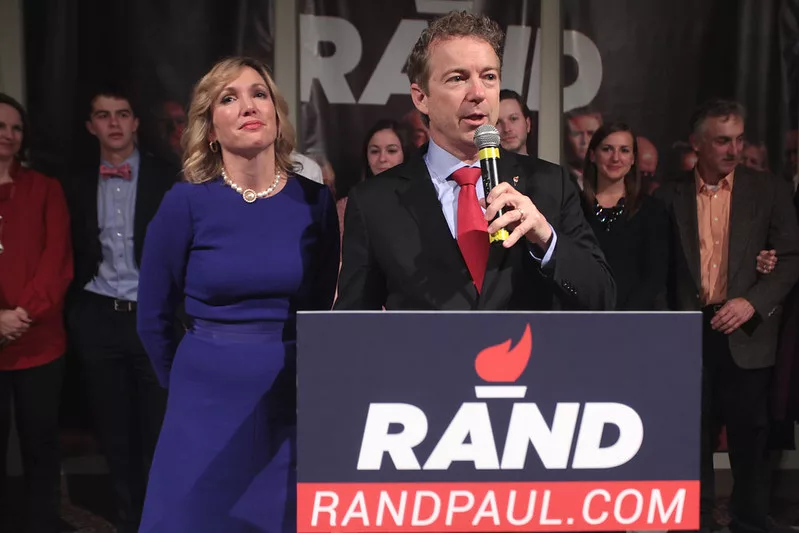
Republican Sen. Rand Paul of Kentucky told reporters Wednesday that farm-state GOP lawmakers should start being much louder in pushing back against the administration’s trade policy.
“Farm-state senators, who are still quietly pro-free trade – pro-trade – are unwilling to step forward and vote,” Paul said.
Paul joined with Democrats in forcing votes in the Senate on Trump’s tariffs targeting Canadian exports, as well as the “reciprocal” tariffs unveiled in an April 2 executive order.
The first effort challenging the administration’s tariffs on Canada passed, with Kentucky’s other GOP Sen. Mitch McConnell, Maine’s Susan Collins and Alaska’s Lisa Murkowski all crossing the aisle to vote with Democrats. The second failed after a tied vote, but McConnell was absent and did not vote.
Tariff critics can force another vote on the tariff emergencies after six months, and senators have indicated they intend to do so. Paul and Democratic Sens. Ron Wyden, Ore., Tim Kaine, Va., Jeanne Shaheen, N.H., and Senate Minority Leader Chuck Schumer have also introduced a bill to force a vote on the new Brazil tariffs.
Meanwhile, the Trump administration is expected to announce any day an aid package worth more than $12 billion for farmers hurt by the trade tensions with China. The chairman of the Senate Agriculture Appropriations Subcommittee, John Hoeven, R-N.D., stressed to Agri-Pulse that the aid package would be one of two provided to producers.
USDA is preparing the first package based on a $13 billion transfer from the department's Commodity Credit Corporation spending authority. Congress would enable the second package by loosening restrictions on USDA's Section 32 spending authority.
Hoeven describes the aid packages will serve as a "bridge" until increased farm bill payments kick in next year and exports increase.
"We've got to keep fighting on the trade front until we win. We produce more food, fuel and fiber from agriculture, crops and livestock, by far, than we consume. We have to export," Hoeven said.
Paul told reporters that he knows of at least a “half a dozen” more Republicans that quietly oppose the tariffs.
“If they voted to end the emergencies, I think all of a sudden the White House would have to sit up and take notice,” he said.
Paul also argued that farm groups could be more vocal in articulating the pain inflicted by trade tensions and lost export markets.
Cut through the clutter! We deliver the news you need to stay informed about farm, food and rural issues. Sign up for a FREE month of Agri-Pulse here.
“We’ve started to see some pushback from the soybeans,” Paul said, but added that the “the farmers need to be louder.”
“The Farm Bureaus need to speak up and say the tariffs are killing them,” Paul continued. “Some of this is going to be a long-term hit to farmers. The idea that China no longer buys any soybean from us is a long-term problem. They've found other sources for it… those markets may never come back.”
The U.S. spirits sector, including Kentucky’s bourbon industry, has been outspoken in its opposition to tariffs and renewed trade tensions with Europe, in particular. But Paul said that he’s hearing plenty of opposition from other Kentucky-based industries.
“Every significant business sector in my state is opposed to the tariffs,” Paul said. “The bourbon industry is opposed to the tariffs. The cargo industry, you know, UPS, DHL are opposed to the tariffs, home builders – you name it. I don't have any significant business interest telling me they want to keep doing tariffs.”
A Democratic staffer told Agri-Pulse Tuesday that they are expecting a vote on the Brazil tariffs soon, but the Senate majority leader’s office did not immediately respond to a question on when a vote might happen.
Challenges to presidential economic emergency declarations are considered under expedited rules in the Senate.
For more agriculture news, go to Agri-Pulse.com

