
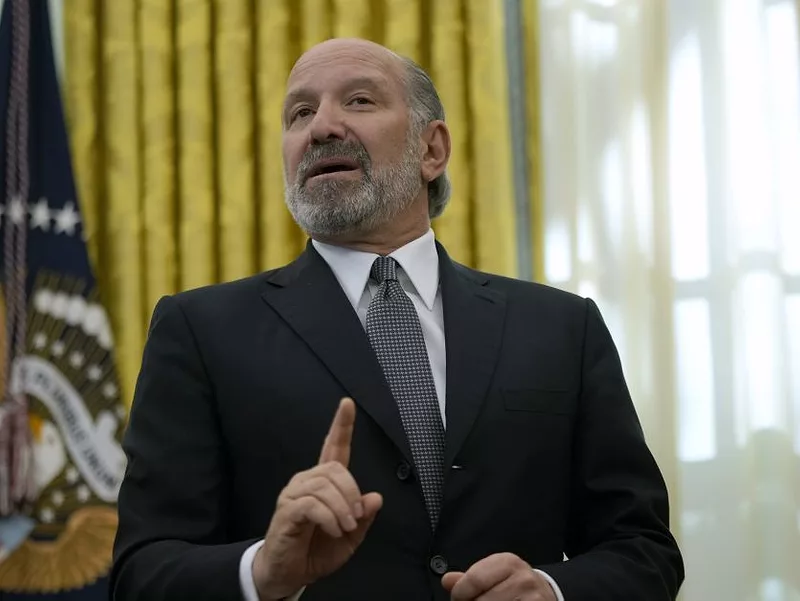
President Donald Trump and senior administration officials are reinforcing the administration’s arguments for why the U.S. needs emergency tariffs, after a bruising hearing at the Supreme Court. Legal analysts, however, say the justices appear broadly skeptical of Trump's case.
U.S. Trade Representative Jamieson Greer told Fox Business host Maria Bartiromo on Thursday the U.S. is facing a clear economic emergency, and the president is acting accordingly.
"You need emergency powers," Greer, who was among the officials in the courtroom and heard the justices probe the administration's solicitor general on whether emergency powers grant the president broad tariffing authorities. "If you look at what's gone on with China over the past several months, anyone who thinks we don't have an economic emergency with respect to our trade relations, I think they're living under a rock."
Multiple conservative justices, including several Trump appointees, however, pursued lines of questioning during Wednesday's hearing that suggested deep skepticism that the 1977 International Emergency Economic Powers Act justifies sweeping duties of the kind President Donald Trump has adopted.
Commerce Secretary Howard Lutnick told Fox News’ Sean Hannity that Wednesday’s oral arguments were “the Super Bowl of trade.” Lutnick and Treasury Secretary Scott Bessent also made the trek across Washington to attend the hearing. But Lutnick’s confidence was not dented by what he saw, he said.
“The justices were on the president’s side,” Lutnick said on Fox News. “President Trump is going to win this case.”
Similarly, Bessent took to X on Wednesday evening to rebut some of the arguments advanced by the plaintiffs’ attorneys.
The justices spent some time on Wednesday deliberating whether IEEPA could be used to impose measures that are revenue-raising, and whether the tariffs were primarily a revenue-raising measure, or a national security tool – as the president claims.
“The goal of his agenda is bringing back manufacturing and balancing the crisis-level deficits and trade barriers with our global trading partners,” Bessent said in social media post. “The tariff income is incidental to these urgent goals – not the underlying reason for their application.”
In an interview with Fox News’ Brett Baier that aired Wednesday, Trump also defended his tariffs in hyperbolic language.
“If I didn’t have tariffs, the entire world would be in a depression,” Trump said, arguing that the “threat” of lost manufacturing was a global threat. “I did this for the world,” Trump said.
Although the justices pressed Solicitor General D. John Sauer rigorously on the administration’s legal justifications for tariffs, they also probed at weaknesses in the plaintiffs’ arguments. Lutnick highlighted an exchange between Justice Brett Kavanaugh and Oregon Solicitor General Benjamin Gutman in which Gutman argued that IEEPA allows a president to embargo every country in the world and completely sever U.S. trade, but not levy a 1% tariff.
Cut through the clutter! We deliver the news you need to stay informed about farm, food and rural issues. Sign up for a FREE month of Agri-Pulse here.
“That doesn’t seem to have a lot of common sense behind it,” Kavanaugh remarked.
Greer on Thursday conceded that the justices had been "tough on the government," but also noted that they were equally dubious of the plaintiffs' claims.
"The justices were quite difficult and quite tough on the plaintiffs here," Greer said, arguing that their argument "has some absurdity to it."
But other advocates for Trump’s trade approach didn’t walk away from the hearing reassured that the conservative justices were swayed by the administration’s arguments – including Kavanaugh.
One trade lawyer working for a pro-tariff organization granted anonymity to speak frankly about the case told Agri-Pulse they wouldn’t be surprised if the ruling ends up 9-0 or 8-1 against the tariffs.
“I'm not sure that we'll get a neat majority opinion with five justices on it. I can see various concurring opinions, but the overall effect – they can't sustain the IEEPA tariffs,” the lawyer said.
The lawyer pointed out that the conservative judges all seemed to raise concerns with different facets of the administration’s argument.
Justices Neil Gorsuch, Samuel Alito and Clarence Thomas appeared to wrestle with whether Congress could delegate all of its tariff-setting powers in the event of an emergency, the lawyer pointed out. Chief Justice John Roberts seemed to be more concerned by the “major questions” doctrine – the idea that Congress must be very clear and explicit when it is delegating powers that are used to make major economic policy decisions.
Trump appointee Justice Amy Coney Barrett seemed to have concerns with whether the term “regulate importation,” as it appears in the IEEPA text, encompasses the right to tariff.
Only Kavanaugh, the trade lawyer said, is “a wild card.”
During the hearing, Kavanaugh noted that tariffs can be a valuable foreign policy tool – singling out Trump’s use of IEEPA to apply duties to India over its purchases of Russian oil.
Jason Kenner, a trade lawyer at Sandler, Travis and Rosenberg – a law firm – also identified Kavanaugh as the justice most aligned with the government’s arguments. But overall, Kenner said after Wednesday’s hearing, it seemed clear that there are enough skeptical justices to overturn the tariffs.
“I can easily see five to strike the tariffs. It's not as easy to find five to uphold them,” Kenner said.
The decision, Kenner said, could come swiftly as well. He noted that the administration’s argument that issuing tariff refunds could be a bureaucratic mess has the potential to spur the justices to issue a decision more quickly.
Both Barrett and Alito addressed the issue of refunds during Wednesday’s hearing and the potential challenges it could entail. Senior administration officials have been arguing in recent weeks that forcing the government to issue refunds could be calamitous.
“I think they're going to act quickly to stop the collection of monies that would have to be refunded, which would compound the problems the government has identified,” Kenner said.
But Kenner and others also warned that the administration is unlikely to let the tariffs wither away without an attempt to use other statutes to reimpose duties. Other statures, however, could require the administration to adjust the tariff rates applied to specific countries and set clear expiration deadlines, Kenner pointed out.
The administration can use a statute known as Section 122, which allows tariffs of up to 15% for 150 days to deal with short-term balance-of-payment issues. Similarly, it could roll out more investigations of countries’ unfair trade practices, under a statute known as Section 301, or of industries that could benefit from tariffs to protect national security, known as a Section 232 investigation.
All of these mechanisms have more guardrails than IEEPA, however.
It’s “why I think the administration chose [IEEPA],” Kenner said. “It is unfettered – ultimate discretion to do what you want, where you want, for however long you want.”
Peter Harrell, a trade attorney and scholar at Georgetown Law, also pointed out that Congress could vote to codify the tariffs – but lawmakers would likely be reluctant to be seen openly endorsing a cost-raising measure ahead of next year’s midterm elections.
“To me the biggest question coming out of the hearing is whether a clear majority of the Justices will rule IEEPA authorizes NO tariffs,” Harrell, who was senior director for international economics in the Biden administration, wrote on X, “or whether we will get a split decision with some Justices saying IEEPA authorizes NO tariffs, and some Justices saying IEEPA authorizers SOME tariffs, just not these tariffs.”
Either way, he said, “if I were the Trump Administration, I'd be burning the midnight oil over the next couple of weeks drawing up tariff backup plans.”
For more news, go to Agri-Pulse.com.

