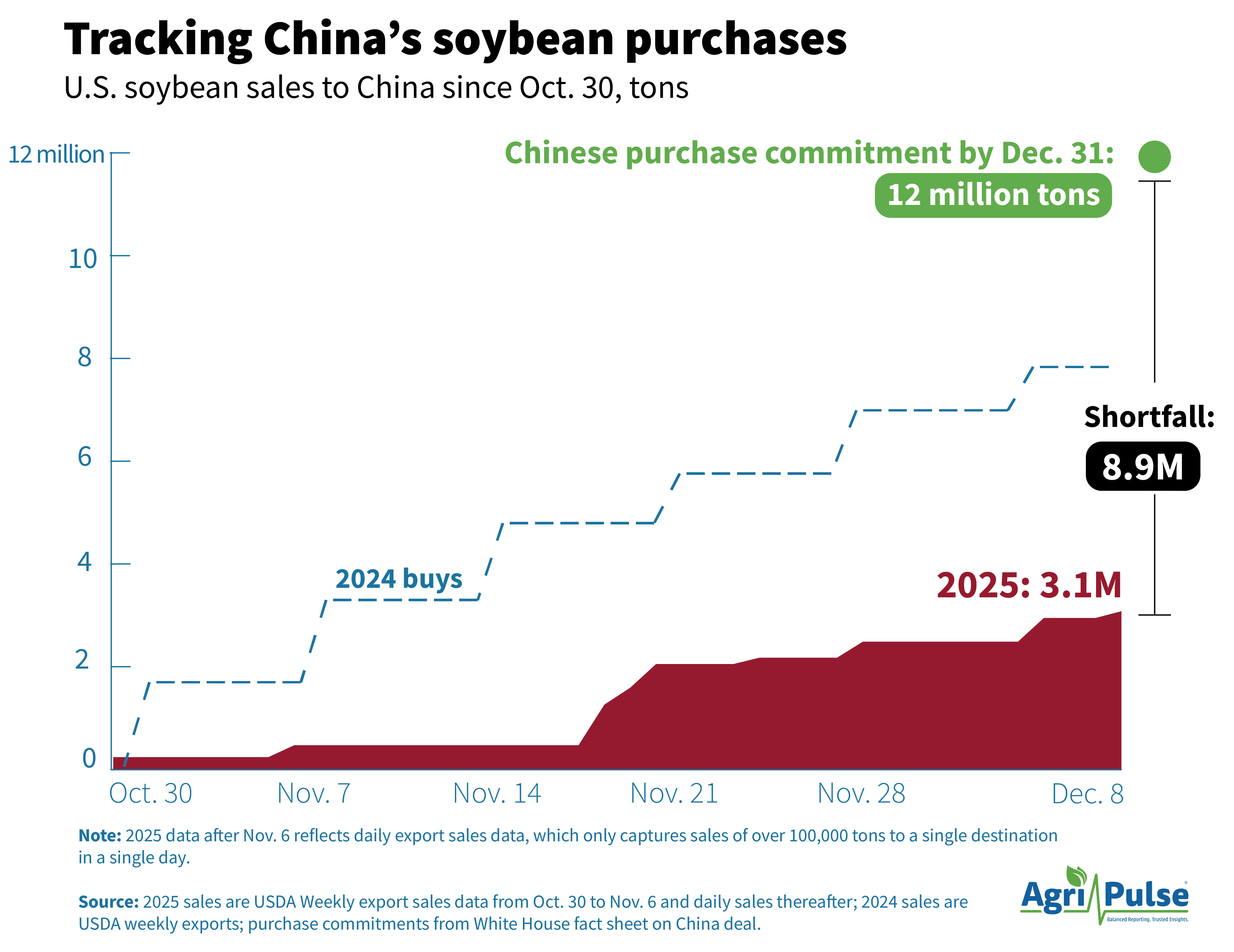
A top administration trade official on Tuesday became the latest to indicate that China wouldn’t buy 12 million tons of soybeans this year, telling senators that the deadline instead could extend through February or March.
During a hearing before the Senate Appropriations Committee's subcommittee on commerce, justice, science and related agencies, Nebraska GOP Sen. Deb Fischer asked U.S. Trade Representative Jamieson Greer to clarify the deadline for China’s purchases.
"It is for this growing season,” Greer said, which is "when we usually expect soybeans to be sold."
The “growing season,” Greer explained, extends "to the end of February or March, depending on those sales.”
A White House fact sheet on the terms of a pact between presidents Donald Trump and Xi Jinping reached in October indicates that Chinese buyers will buy 12 million tons of U.S. soybeans “during the last two months of 2025.” Beijing committed to buying 25 million tons in each of the following three calendar years, it says.
Greer’s comments echo those from Treasury Secretary Scott Bessent, who suggested last week that China’s deadline was, in fact, Feb. 28.
“They are in a perfect cadence to complete that goal,” Bessent told a financial journalist at an event Wednesday.
Agriculture Secretary Brooke Rollins has previously said that China may not have shipped all of its soybeans by the Dec. 31 deadline, but that it would have lodged their orders with U.S. sellers.
This understanding of the deal aligns with Iowa GOP Sen. Chuck Grassley's. He told reporters on Tuesday that delivering all 12 million tons to China before the end of the year, he said, is “totally impossible.” But he stressed that “we should see the commitment that they're going to purchase it.”
In comments to Agri-Pulse following the hearing on Tuesday, Sen. John Hoeven, R-N.D., downplayed the importance of the initial deadline. He said that a “discrepancy of a month or so” would not be of much concern if Beijing hits its other purchasing targets.
If China takes until February or March to reach its 12-million-ton target, Hoeven said, U.S. growers will be no worse off as long as it still buys another 25 million tons before the end of 2026.
“This is what I am going to follow up on,” he added.
Interested in more news on farm programs, trade and rural issues? Sign up for a four-week free trial to Agri-Pulse. You’ll receive our content - absolutely free - during the trial period.
China is well behind the pace it would need to lodge 12 million tons' worth of orders by the end of the year. As of Dec. 8, it had booked around 3 million tons of beans since Oct. 30, according to USDA data, more than 8 million tons short of its target.
Part of the challenge, according to recent analysis from North Dakota State University, is that U.S. prices remain around $80 per metric ton above Brazil’s in the Chinese market.
Even as China remains off the pace, Trump said this week that he anticipates purchases will ultimately exceed Beijing’s commitments.
“I think he's going to do even more than he promised to do,” Trump said of Xi, “and what he promised to do is a lot. So, we're very happy with that.”
Greer emphasized on Tuesday that the administration had also received commitments from other countries to buy soybeans, corn, wheat and other commodities, and that the administration has been busy diversifying export markets for U.S. agriculture.
Sen. Jerry Moran, R-Kan., stressed to Greer during Tuesday’s hearing, however, that China is such a major importer of U.S. soybeans and grains that it is not easy to replicate that market when it retreats from U.S. purchases.
India, he said, is potentially the only other market that could eventually compete with China for size, but “it's such a difficult country to crack,” Moran lamented.
The U.S. and India remain locked in discussions over a potential trade pact. Both U.S. and Indian officials have suggested for months that they are close to finalizing a deal, and a U.S. delegation is in the country this week for another round of negotiations.
USDA Undersecretary of Agriculture for Trade and Foreign Agricultural Affairs Luke Lindberg told Agri-Pulse in an interview last month that agriculture remained one of the sticking points in the talks.
“There's resistance in India to certain row crops,” Greer told senators on Tuesday, but he said Indian officials had been “forward-leaning" in the negotiations.
“The type of offers they've been talking to us about have been the best we've ever received as a country,” Greer said. “So, I think that's a viable alternative market.”
For more news, go to www.agri-pulse.com.