
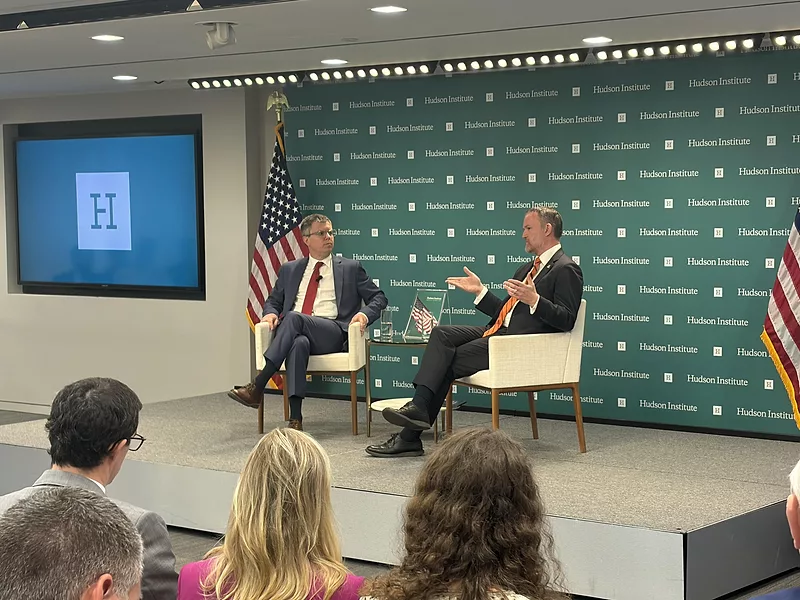
U.S. Trade Representative Jamieson Greer argued Tuesday that a North American free trade agreement can be reworked to serve as a trilateral dialogue, but also a platform for addressing bilateral issues between participants.
President Donald Trump has in recent months questioned whether the U.S.-Mexico-Canada Agreement should remain a trilateral deal, given many of the thorniest trade issues between the U.S. and its neighbors are bilateral issues.
The administration’s top trade official, however, sees opportunities to incorporate bilateral dialogues into the existing agreement.
“We do have to have some kind of a protocol or something with Mexico and one with Canada, separately I think, to deal with issues specific to those countries,” Greer said during an event hosted by the Hudson Institute. But he added that parties can “layer over” those protocols on the existing agreement.
The U.S. has a plethora of country-specific grievances it intends to raise with each country as part of a forthcoming USCMA review period, set to formally kick off July 1. In a submission to lawmakers late last year, Greer said addressing Canada’s management of dairy import quotas would be among the goals of the review.
The administration has also expressed dissatisfaction with Canadian provinces' continued boycott of U.S. alcohol products.
Meanwhile, on the Mexico side, the Trump administration is looking at how to address rising imports of fresh produce that are undercutting U.S. producers.
The trilateral free trade agreement enjoys significant support among the private sector and on Capitol Hill. A recent public comment period on the deal ahead of the review received more than 1,500 submissions, including dozens from U.S. agriculture groups.
In his comments Tuesday, Greer acknowledged the popularity of the deal, but noted that “everyone suggested changes to the agreement.”
Accordingly, he said the administration is approaching the review with the assumption that change is necessary for any extension.
Interested in more news on farm programs, trade and rural issues? Sign up for a four-week free trial to Agri-Pulse. You’ll receive our content - absolutely free - during the trial period.
Greer also stressed that Trump, who signed the USMCA in his first term, is not happy with the agreement’s impacts on the U.S. economy.
“President Trump has been clear that he is dissatisfied with a lot of the outcomes,” Greer said, noting that the agreement has not addressed yawning goods trade deficits with Canada and Mexico. “It makes it more difficult for anyone to go to him and say, ‘USMCA is working how you intended.’”
While the USTR may be optimistic that the USMCA can be adapted to suit U.S. needs and priorities, his outlook for the World Trade Organization was much less sunny. Greer was speaking a week after the end of the WTO’s 14th ministerial conference in Cameroon, where officials were unable to reach agreement on how to proceed with reform discussions and extend a moratorium on duties on digital trade.
Greer noted his disappointment that parties couldn’t make progress on even this narrow agenda.
He said the e-commerce discussions had really served as a good “litmus test” for the body. Extending the moratorium, which has been in place since the 1990s, is something “everybody should be able to agree to,” Greer said.
It “doesn't require anyone to change anything in their national law or their policies,” he added. The U.S. had been pushing for a permanent extension of the moratorium but said it was open to a four-year solution. Ultimately, Brazil and Turkey opposed even the four-year option.
“This is just a symbol of how backward the WTO is and how unable it is to respond to something normal, let alone really challenging things,” Greer said.
Working with smaller groups of like-minded countries, rather than all 166 WTO members, would be the only way forward for reforming global trade rules, Greer argued. He pointed out that when many of the rules underpinning international trade were written in the post-war period – under the General Agreement on Tariffs and Trade – just 23 countries were involved
“It was smaller, it was more lean,” he said.
The inclusion of non-market economies and big countries with what Greer called “statist” approaches to global trade have ground progress to a halt at the WTO, he argued, singling out China and India.
“A lot of this became really challenging for us and became impossible to have a lot of movement forward or progress,” he said. “We probably have to get back to smaller groups.”
For more news, go to Agri-Pulse.com.

