
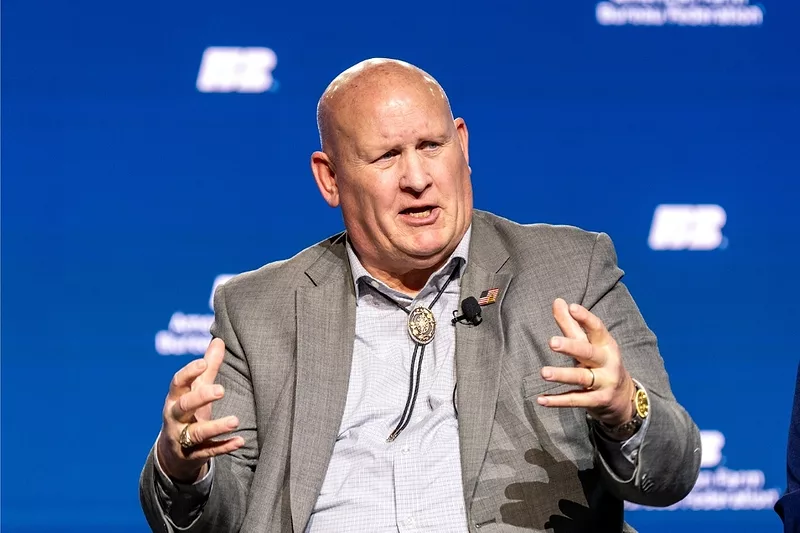
The House Ag Committee’s farm bill is a victim of the weather forecast. Ahead of a winter storm Sunday, the committee postponed a meeting that was scheduled Monday to begin debate on the legislation. The debate will now take place next week.
Proposed farm bill would cut some near-term EQIP funding
The Environmental Quality Incentives Program will lose around $1 billion in budget authority over the next four fiscal years under the farm bill draft that now will be marked up next week, according to new calculations by the Congressional Budget Office.
When adjusting for sequestration, the program would lose roughly $325 million in budget authority for fiscal 2027, $495 million in budget authority for FY28, $118 million in budget authority for FY29, and $75 million in budget authority for FY30, according to CBO estimates.
Noah Wicks has more on the issue at Agri-Pulse.com.
As administration pivots to new tariff authorities, questions abound
Hours after the Supreme Court issued a landmark ruling striking down President Donald Trump’s emergency tariffs on Friday, the administration launched its backup plan.
The plan B has, so far, involved imposing a 15% global tariff starting Tuesday, with some agriculture carveouts. The administration is also signaling future probes of countries’ unfair trade practices, which could be used to justify new tariffs.
But questions around what the trade landscape will look like in 2026 abound, and businesses may have to wait several weeks or months until the dust settles for a clearer picture.
- Refunds: The Supreme Court didn’t specify how refunds should be handled. It’s still not clear whether the administration will set up a program. Treasury Secretary Scott Bessent told CNN’S Dana Bash Sunday it would be up to the lower courts to weigh in on whether refunds are necessary and how they should be handled.
- International fallout: The new 15% global tariff represents a hike for some countries. The U.K., for example, secured a 10% rate as part of its tariff deal. U.S. Trade Representative Jamieson Greer told CBS Sunday that no countries have indicated their deals are off. But countries’ responses are still unfolding. CNBC reported Sunday that Indian negotiators are postponing a U.S. trip set for this week to firm up a recent trade deal. The European Union-U.S. deal is also set to face a key parliamentary vote on implementation Tuesday. A senior EU lawmaker is calling for a delay, citing “pure tariff chaos” and a changed “legal basis” for the deal.
- China: A 15% global tariff represents a tariff cut on Chinese exports, which were subject to a 20% emergency tariff following Trump’s late October deal. Will China adjust its tariff rates on U.S. products?
- Which countries will get a Section 301 probe: The administration said Friday it will prioritize countries adopting unfair trade practices to get an unfair leg up in rice and seafood markets. It will also go after manufacturing overcapacity, among other issues. In addition, it says “most major trading partners” will be covered by the deals. China and Brazil already have ongoing investigations, but who else will be included and who will get a reprieve is still up in the air.
- Global tariff duration: The law used to levy the new 15% tariff only allows the duty to stand for 150 days, unless Congress signs off. Whether the administration will let the tariff lapse, go to Congress, or withdraw the proclamation and draft a new one after 150 days is not clear.
Population changes may cause dairy consumption shifts, economist says
The dairy industry will likely see some shifts in consumption patterns it will need to adapt to in the years ahead, particularly as consumers age, Terrain economist Ben Laine said at USDA's Ag Outlook Forum on Friday.
Laine said that once consumers reach about 40 or 41 years old, demand for dairy begins to “level off a little bit.” He said the dairy industry should start looking beyond cheesy pizza crusts and dipping sauces toward other products like higher-protein lattes and fancier cheeses to meet shifts in demand, in addition to foreign markets.
He said that over the next several years, "it's going to be much more about balancing these things and adjusting to these realities and optimizing component production, rather than just sheer growth that we've seen over the last 20 years."
Dicamba lawsuit filed in 9th Circuit
A coalition of groups is suing the Environmental Protection Agency over its approval of dicamba, seeking a third court order to prevent the herbicide from being used “over the top” on cotton and soybeans.
EPA approved labels Feb. 6 for products from Bayer, Syngenta and BASF, authorizing use of Xtendimax, Tavium and Engenia for the 2026 and 2027 growing seasons.
The lawsuit is in the form of a petition to the 9th Circuit Court of Appeals. The groups, including the National Family Farm Coalition and Center for Biological Diversity, said they plan to ask the court to assign their case to the panel that handled previous dicamba litigation.
“This case is intimately related to the prior litigation: factually, scientifically, and legally. And some of [the] central questions presented …will be determining whether EPA complied with this court’s prior opinion and order in the new dicamba re-approval,” the petition notes.
Other plaintiffs are the Pesticide Action & Agroecology Network and Center for Food Safety.
Final word
“Our state folks are exhausted, they are just exhausted with high-path avian influenza alone, let alone if another one comes along. So that would be a place for some funding.” — Ted McKinney, CEO of the National Association of State Departments of Agriculture, calling for more funding for animal disease tracking at the Animal and Plant Health Inspection Service in the farm bill, on Agri-Pulse Open Mic with Jeff Nalley.
“We really need for them to have more funding so that we can finish out traceability programs, and they have the people that can then help the states do the work,” he said.
Listen to the whole interview here.
For more news, go to Agri-Pulse.com.


