

|
The midterm elections are still 160 days away, but it's already clear big changes are ahead in Congress. Led by Republicans, dozens of House and Senate lawmakers are leaving Capitol Hill, including some farm policy leaders.
Of the House Agriculture Committee’s 53 members, at least six Republicans and one Democrat are either retiring or running for another office. At least another four GOP members and one Democrat face highly competitive races. The seat being vacated by retiring Nebraska GOP Rep. Don Bacon, who represents part of Omaha, is widely expected to flip to a Democrat.
In the Senate, out of four members running for governor of their respective states, three sit on the Agriculture Committee, including top Democrat Amy Klobuchar of Minnesota. Lawmakers on the House and Senate Agriculture Appropriations panels also face tough re-election battles, including Sen. Jon Husted. The Ohio Republican is up against Sherrod Brown, a former Democratic senator and Ag Committee member who lost his re-election bid two years ago after 18 years in the Senate.
In addition to Klobuchar, Ag Committee members Tommy Tuberville, R-Ala., and Michael Bennet, D-Colo., are running for governor, as well as Republican Sen. Marsha Blackburn of Tennessee. Only Tuberville was up for re-election this year.
Midterm politics are clouding the outlook for a House-passed farm bill in the Senate, as some Democrats weigh whether it would be wiser to try and delay action on the legislation until next year, when they may be in power. While division on key agriculture matters like biofuel policy is largely regional, other issues have sparked bitter partisanship, such as spending on federal nutrition programs.
USDA's sweeping reorganization, Trump’s trade agenda, pesticide labeling law and livestock welfare regulations also are poised to garner more attention in the Senate and House ag committees if Democrats control the agenda.
GOP-led Senate in 'real jeopardy'
In the House, current polling indicates Democrats will gain the majority, even after taking redistricting gains for Republicans into account, political scientist Alan Abramowitz writes in Sabato’s Crystal Ball, a nonpartisan newsletter published by the University of Virginia Center f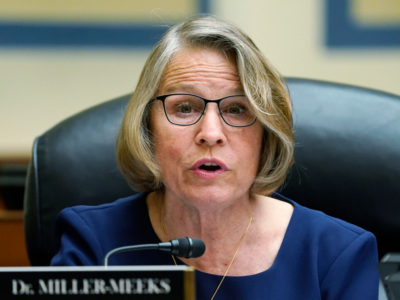 Mariannette Miller-Meeks (AP photo)or Politics.
While the Senate is a much bigger challenge for Democrats, Republicans’ grip on the chamber is “in real jeopardy,” Marc Short, who was chief of staff to former Vice President Mike Pence, said at a recent discussion hosted by the University of Chicago Institute of Politics.
Next week’s primary in Iowa will be a closely watched political barometer on whether struggling rural economies could dent Republican strongholds this November. The country's No. 1 corn, hog and biodiesel producer has two of the tightest races for GOP incumbents, Reps. Zach Nunn and Mariannette Miller-Meeks. The Hawkeye State also is holding an open gubernatorial race, with Republican Gov. Kim Reynolds stepping down, and an open contest for the Senate seat to be vacated by retiring GOP Sen. Joni Ernst.
UVA's Crystal Ball and the the nonpartisan Cook Political Report rate the Nunn and Miller-Meeks races as "toss-ups." Miller-Meeks is running again against former state Sen. Christina Bohannan, whom Miller-Meeks defeated in 2024 by one-fifth of a percentage point (0.2%).
“The place we aren’t talking enough about, honestly, is the heartland of America,” Short said. “It’s the farmers that have been hurt the most by this trade policy."
It’s easy to be “in the know” about what’s happening in Washington, D.C. Sign up for a FREE month of Agri-Pulse news! Simply click here
Crop growers also are reeling from high production costs that worsened starting in March when the U.S. war with Iran led to surging global fuel and fertilizer prices.
Democratic Iowa auditor Rob Sand is currently seen as his party's best hope of breaking the GOP's decade of dominance in Iowa, with the state voting Republican in the last three presidential elections. Rep. Randy Feenstra, R-Iowa, a House Ag Committee member, also is vying for the job of governor. Internal polls from both parties show Feenstra trailing Sand, Cook said earlier this month.
 Don Bacon (Official photo)
In the neighboring farm state of Nebraska, Bacon's retirement is seen as likely to result in his Omaha district going Democratic next year, forecasters say. Bacon has served on the House Ag Committee since 2017.
While the overall odds of Republicans keeping majority control of the House don’t look good now, there’s still a political slog to navigate until Election Day on Nov. 3.
The biggest unknown is the nation's top Republican, President Donald Trump.
Trump has been a kingmaker in key primaries, leading to the ouster of GOP incumbents, notably Kentucky's Thomas Massie and Louisiana's Bill Cassidy. But how Trump’s MAGA swagger plays in the general elections is a major wild card. Trump recently angered GOP senators when he endorsed Texas Attorney General Ken Paxton for the Senate over incumbent John Cornyn, a popular colleague who lost a runoff against Paxton on Tuesday. Republicans now might need to spend more money than planned against the Democratic contender, state Sen. James Talarico.
Cornyn, a four-term senator, serves as chairman of the Senate Finance's International Trade Subcommittee.
A record 61% of registered voters disapprove of the president’s job performance, a recent Fox News poll found. Add to that midterm losses historically endured by the party occupying the White House, and conditions should be ripe for an “absolute wipeout,” Amy Walter, editor in chief of Cook said at the University of Chicago event moderated by David Axelrod, senior adviser to former President Barack Obama.
“But what we also have to remember is that there are structural advantages that Republicans have,” Walter said. “There are just very few incumbents that sit in swing districts. Redistricting by Republicans has also helped to take that very narrow playing field and squeeze it a little bit more."
"This election really is a test of which is more powerful – structure or storm?” Walter said.
One key factor is voter enthusiasm and turnout. A poll conducted in April by ABC News/Washington Post/Ipsos showed 66% of Democrats and those who lean that way are "absolutely certain to vote." Fifty-eight percent of Republicans and Republican-leaning voters say they're definitely going to vote.
According to the same poll, those same two groups are even more widely split when asked whether these midterm elections are "much more important" than past midterms. Fifty-four percent of Democrats and those who lean Democratic said yes, while only about one third of Republicans and Republican leaners felt the same way.
Heading for the exit
Amid record-long government shutdowns and an inability to pass broad legislation, like a full five-year farm bill, one in eight U.S. lawmakers plan to vacate their current seats following this election cycle. That's the second-highest total in the last century, according to NPR's congressional retirement tracker.
As of mid-May, 71 representatives and senators either plan to retire or pursue a different office, including 57 House members, the most in records going back to 1930, NPR said.
Further, more lawmakers are opting to run for state and local office, as opposed to another federal office, as is usually the case, according to the Brookings Institution.
"It suggests a growing consensus among members that they can get more done outside of Congress, and perhaps the job’s prestige may not hold the same sway that it used to," Brookings' Abby Ward and Molly E. Reynolds write.
Iowa, California, New Mexico, South Dakota, New Jersey and Montana hold primaries next Tuesday.
.webp?t=1762183428)
