
Discussion on the potential for Senate passage of an E15 bill swirled on Capitol Hill Tuesday after the release of a draft farm bill that doesn’t include the pro-ethanol measure.
Language to allow year-round, voluntary sales of higher ethanol-gasoline blends, known as E15, wasn’t expected to be in the discussion text unveiled by the Senate Agriculture Committee Chairman John Boozman.
Still, Boozman reiterated his support for year-round E15 and told reporters he believes the Senate likely has the votes needed to pass a stand-alone bill. “The stars are aligned,” he said.
E15 is a top priority for Senate Majority Leader John Thune, and talks on the issue are ongoing, a person familiar with the matter tells Agri-Pulse. The South Dakota Republican is optimistic the Senate can reach an agreement, the person said.
But, but, but: Sen. Chuck Grassley, R-Iowa, said he’s trying to get his colleagues to “wake up” to the fact that given the upcoming midterm elections and scheduled recesses, the window for passing E15 this year is narrowing.
“There’s seven weeks between now and the election,” he said on his weekly media call. “This is something that needs to be done between now and the election.” Grassley was referring to legislative weeks.
Bill to speed up wildfire disaster relief clears House
A bill to expedite Emergency Conservation Program payments to producers whose land has been damaged by wildfires cleared the House Tuesday with a 386-19 vote. It now heads to the president’s desk for his signature.
The bill, initially introduced by Sen. Deb Fischer, R-Neb., and passed by the Senate in March, was prompted by devastating wildfires in her state earlier this spring.
It would expand eligibility for payments under ECP to cover damage from non-naturally caused wildfires where the destruction was spread by natural causes, or to cover any wildfire caused by the federal government.
Producers could also receive an advance of 75% of replacement costs and 50% of repair or restoration costs for farmland and conservation structures that need to be addressed immediately. Current law allows an advance of just 25%, which can only be used for fencing.
The bill also would update the Emergency Forest Restoration Program by letting owners of nonindustrial private forest land impacted by a natural disaster to receive an advance, something not allowed in the program, on cost-sharing payments for up to 75% of the cost of the emergency measures.
CFTC chair acknowledges 24-7 trading may not work well for commodity futures markets
While allowing 24-hour trading seven days a week may work in crypto markets, Commodity Futures Trading Commission Chair Michael Selig says he recognizes it may not be the best fit for agricultural commodity futures systems.
While the agency in the past has weighed allowing 24-7 trades, an idea largely pushed by digital assets traders, Selig said in a speech at the American Cotton Shippers Association annual convention that he doesn’t believe “that the perpetual instrument is suitable for all asset classes, especially in products like agriculture.” He said he has “strongly advocated for exchanges to limit trading hours for agricultural commodity contracts to match traditional trading hours."
"What works for newer, innovative markets, like crypto assets and prediction markets, may not be suitable for traditional asset classes, like agriculture,” Selig said.
Take note: CFTC, which regulates U.S. derivatives markets, solicited public comments on the ramifications of allowing 24-7 trades last year. However, National Grain and Feed Association President and CEO Mike Seyfert warned at the time that "spreading liquidity across a wider trading timeframe would create unnecessary volatility, potentially widen bid/ask spreads, and expand potential for market manipulation.”
USDA to accept proposals for up to $310 million in RCPP funding
The Agriculture Department on Tuesday announced it would open up proposals for up to $310 million in funding for the Regional Conservation Partnership Program.
Cut through the clutter! We deliver the news you need to stay informed about farm, food and rural issues. Sign up for a FREE month of Agri-Pulse here.
RCPP, first authorized in the 2014 farm bill, allows private sector organizations and state governments to partner with the USDA for conservation projects meant to address issues at the landscape scale. These projects can span regions or watersheds, like the Prairie Grasslands Region or the Chesapeake Bay Watershed.
According to a release, applications will be accepted through August 24.
Letlow to USDA: Issue ag emergency for Louisiana Tropical Storm Arthur impacts
Rep. Julia Letlow, R-La., is urging USDA to declare an agricultural emergency for the state of Louisiana following severe flooding tied to Tropical Storm Arthur that has impacted many farm operations.
In a letter to Agriculture Secretary Brooke Rollins, Letlow said heavy rainfall and flooding have left fields saturated, delayed planting and other fieldwork, damaged crops and disrupted farming operations during a critical point in the growing season. She said producers are facing significant economic losses as they assess the full extent of the storm's impact.
“Louisiana farmers are facing substantial economic hardship as they assess the full extent of the storm's damage,” Letlow said. “Given the severity of these impacts, I respectfully request that USDA take swift action to make available all appropriate disaster assistance to affected producers."
Letlow’s district produces about 45% of the state’s ag sales, according to USDA’s 2022 Census of Agriculture. A disaster declaration could help unlock USDA emergency assistance and loan programs for producers dealing with storm-related losses.
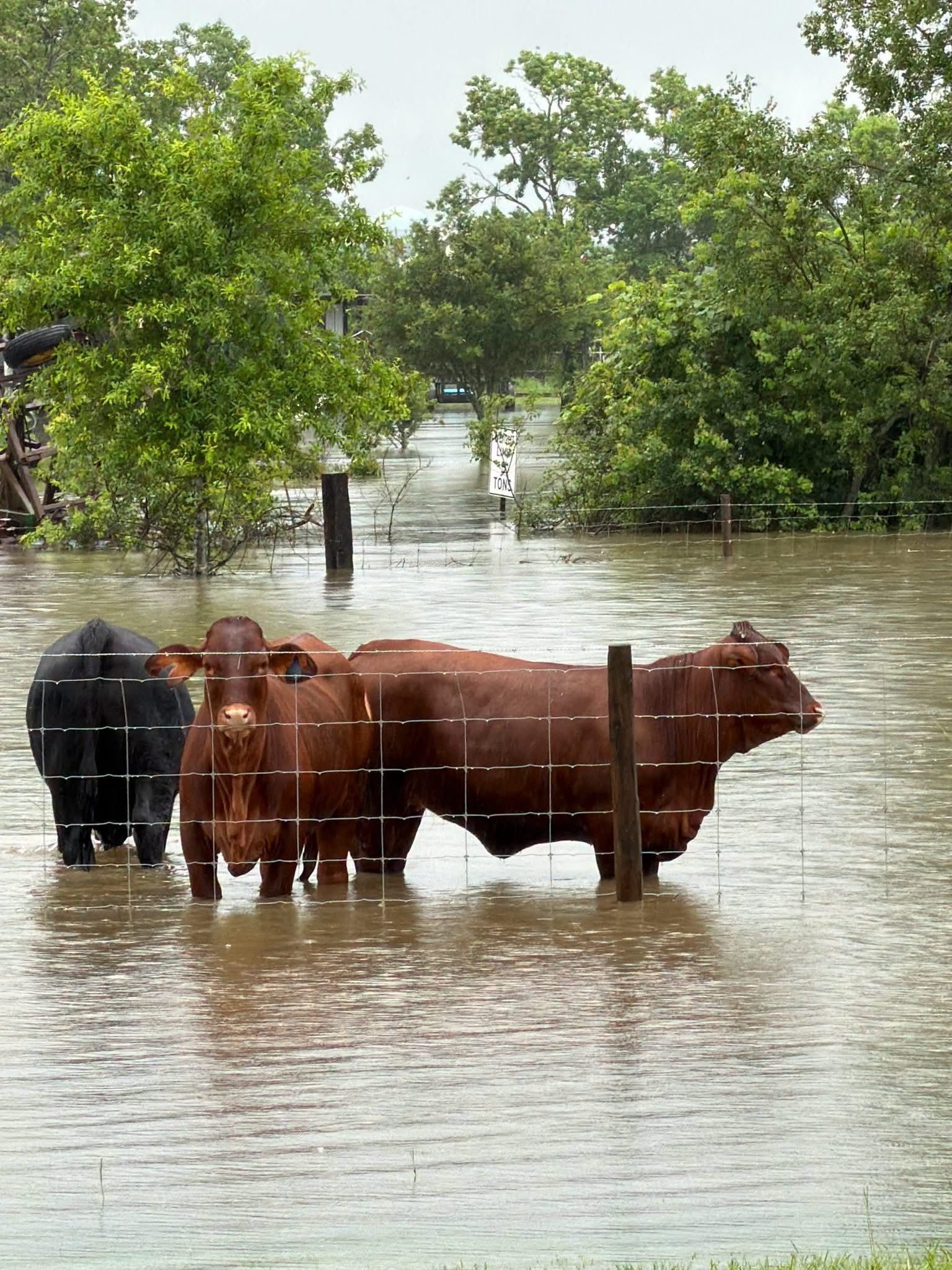 Cattle stand in a flooded field in Mansura, Louisiana, a small, rural town in the central part of the state. (Chris Dauzat photo)
Minnesota Farmers Union sounds alarm over 19,000-cow dairy
Leaders of the Minnesota Farmers Union are criticizing a decision by the Minnesota Pollution Control Agency to not prepare an environmental impact statement for a large dairy project.
“Consolidation is reshaping our dairy sector, and the trend has implications for land access, local economies and the next generation of farmers,” said MFU Vice President Anne Schwagerl. “We cannot ignore these dynamics, but neither shall we accept them without careful consideration.”
She said that an EIS “is a measured, reasonable step. It ensures that when we make decisions, we do so with eyes wide open.”
Riverview LLP has proposed expanding its West River Dairy in Stevens County from nearly 8,000 cows to 19,000 cows, which would be more than 60 times the average size of a dairy herd in Minnesota, MFU President Gary Wertish said.
Riverview’s view: The company says the project is undergoing review through the state’s formal Environmental Assessment Worksheet process — “an extensive environmental review process that ensures a protective environmental outcome for projects like this. Combined with the feedlot permit application, the project documentation totals nearly 900 pages of detailed technical analysis covering groundwater, surface water, air quality, and natural resources.”
Final word
“It’s dry as hell, grass is turning yellow, ponds are empty. It’s crazy and expensive.” — Upper Colorado River Commission Executive Director Chuck Cullom, reading a text message from a cattle rancher from the Jicarilla Apache nation aloud during a public meeting Tuesday. Cullom said the producer is just “trying to keep his herd alive” amid persistent drought and recently was forced to buy a new truck capable of hauling 2,000 gallons of water to help do so.
.webp?t=1762183428)


