
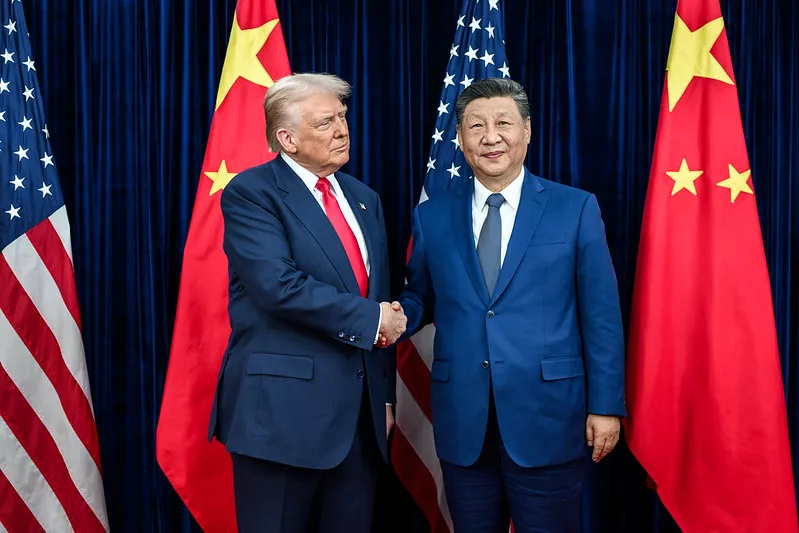
Following President Donald Trump’s meeting with Chinese President Xi Jinping last week, the U.S. said it has secured commitments from China for soybean purchases and broader tariff relief. But other commodities are hoping the final deal features targeted measures for them as well, while the administration tells industry it is still pushing for additional ag market access.
“We are encouraging the administration to finalize some minimum purchase agreements,” said Amy France, chairwoman of the National Sorghum Producers. “I believe there are talks underway,” France added, but said she had not heard any specifics from the administration early this week.
Chinese imports of a slate of U.S. ag products plummeted in 2025 as the two governments became locked in tit-for-tat tariff escalation. Officials negotiated a tariff truce in May, but Chinese buyers continued to snub U.S. ag products while negotiations on a lasting resolution to several trade issues remained underway.
Trump emerged from a meeting with Xi on Thursday touting a deal between the two countries. As part of the arrangement, U.S. officials say, China will buy at least 12 million tons of soybeans in November and December, and at least 25 million tons for the following three years. If Beijing meets these floors, it will put annual soybean exports slightly below recent years.
A White House fact sheet says China will eliminate retaliatory tariffs on a slate of agricultural products, including sorghum, pork, beef and chicken. The U.S. has said it will reduce its tariffs on China by 10% from Nov. 10. As of Wednesday, China's Ministry of Finance had announced it would only remove some retaliatory tariffs starting Nov. 10, but it left a 10% retaliatory duty in place, which will still apply to U.S. ag products, including soybeans.
Agriculture Secretary Brooke Rollins also indicated that China would resume purchases of sorghum and hardwood under the deal, but the White House has provided no further details on how this will be achieved beyond tariff reductions.
Don’t miss a beat! It’s easy to sign up for a FREE month of Agri-Pulse news! For the latest on what’s happening in Washington, D.C. and around the country in agriculture, just click here.
At a glance: The details of Trump's trade deals
France said NSP has asked the administration to secure purchase commitments of around five million tons a year – in line with historical averages. But she said even if the commitments are lower than recent trade volumes, anything would help the U.S. industry.
“We're on the verge of one of the best harvests we've had for years,” France said, with yields up 23%. “We're looking for anything” that could give U.S. farmers “some certainty and some clarifications,” France said.
U.S. sorghum exports to China through September were down 97%.
Other commodities that have seen China sales drop this year are also pressing the administration to look beyond tariff relief in any finished deal.
Dan Halstrom, president and CEO of the U.S. Meat Exporters Federation, told Agri-Pulse that while tariff reductions could help U.S. pork exports, for beef there are other trade barriers that are curbing U.S. exports to China.
Beef exports to China hit a five-year low this summer, USMEF documents, as Beijing has dragged its feet over renewing registrations for more than half of U.S. beef plants and cold storage facilities. The registrations lapsed in March and a further 11 facilities have also had their registrations suspended since then.
Halstrom said that getting those facilities cleared for export should be the next step in negotiations.
 Dan Halstrom (LinkedIn photo)
Based on his conversations with the administration, Halstrom said he's confident the issues are “top of the USTR’s list,” adding officials are “very well aware of our concerns.”
China also accounted for around a third of U.S. cotton exports last year, according to USDA data, which has also seen its sales crater this year.
Most U.S. cotton must be exported every year. In September, USDA estimated farmers would produce 13.2 million bales in 2025 and that 12 million would be exported.
Kevin Brinkley, president and CEO of the Plains Cotton Cooperative Association, told Agri-Pulse that the commodity often gets overlooked in trade negotiations. Accordingly, Brinkley said he was “thrilled” cotton was included among the commodities that are set to get relief from retaliatory tariffs, but said the industry is anxiously awaiting more details on the arrangement.
“We just kind of have to wait for it to play out,” Brinkley said.
The White House and the Office of the U.S. Trade Representative declined to respond on the record to requests for comment on some of these outstanding questions from industry.
He said, Xi said
While details of the deal’s provisions have trickled out in interviews with Trump, U.S. officials and via a White House fact sheet, Chinese officials have been quiet. China's Ministry of Commerce confirmed only that the two sides have agreed to expand agricultural trade, without providing specifics on purchase commitments or final tariff rates.
But this is in line with how Beijing approaches agreements that are still being finalized, according to Matthew Nicol, an ag market analyst at China Policy. Chinese public communications often include a “broad promise,” Nicol said, but are “light on details.”
Further, for Beijing’s audience, the lack of detail matters less than U.S.’ audience. U.S. growers are craving certainty to make planting and business decisions. For China, the goal is to help domestic crushers who were facing steep premiums on Brazilian soybeans from the ongoing purchasing freeze on U.S. soybeans, Nicol said. A return to purchasing U.S. beans, in whatever quantities, could make Brazilian bean prices slide.
“Beijing kind of gets to relieve its crushing sector without major concessions,” Nicol said.
Brazilian soybean prices slipped below U.S. prices this week for the first time in several weeks and Reuters reported Monday that Chinese buyers had responded by booking 10 cargoes of Brazilian soybeans.
 Matthew Nicol (LinkedIn photo)
Nicol said that he would expect a formalized deal with more detail in due course, but said Chinese negotiators may be reluctant to firm up too many purchase commitments. The Phase One Agreement’s purchase commitments, he said, became “a stick” with which to threaten Beijing.
“Ambiguity now makes it much more difficult to declare a target being missed further down the road,” Nichol said.
But any room for ambiguity could blunt the impacts of the deal for the U.S., said Harry Broadman, a former U.S. trade negotiator who held positions under both the George H.W. Bush and Clinton administrations.
The more specific information officials can provide in public, the more confident U.S. investors and agricultural exporters will feel. And this confidence can unlock economic benefits for farm country.
The Trump administration, which has favored an approach of announcing deals with little detail and firming up details in subsequent negotiations, has been an “aberration” from previous administration, Broadman said.
“Citing [deal provisions] with some degree of precision,” Broadman said adds “credibility to what actually took place.”
Archer-Daniels-Midland Co. during a company call on Tuesday argued it needs more details on the deal to determine the impact on U.S. grain markets, including a "joint document"
Individual farmers are also seeking more certainty. Brent Bible, an Indiana-based corn and soybean farmer told Agri-Pulse he takes a “trust but verify” approach to Trump’s trade announcements and the ag provisions within them.
“I'm anxious to see verification,” Bible, who voted for Trump in last year's election, said on the sidelines of a Farmers for Free Trade event on the National Mall in Washington.
Consult the text
Trump’s Asia trip last week, which culminated in the Xi meeting, was punctuated by a string of trade negotiation developments. Earlier in the week, the administration unveiled trade pacts with Malaysia and Cambodia and issued new details on ongoing negotiations with Vietnam and Thailand.
The Malaysia and Cambodia joint statements highlighted a litany of ag provisions, including commitments to loosen non-tariff trade barriers, maintain a “science-based” approach to sanitary and phytosanitary regulations and to preserve U.S. market access for certain cheeses and meats commonly targeted by European geographical indicators.
Two former officials granted anonymity to speak frankly about the deals said there was much to celebrate for U.S. agriculture. They singled out the commitment from both countries to accept certificates issued by U.S. regulatory agencies, as the protections from geographic indicators.
But they both also lamented that several important details hadn’t been clarified.
“We're not exactly sure when the commitments will be entered into force,” one official said. “We hope that those details come forward the next few weeks or months.”
The other former official, who worked on international trade issues, argued that some of commitments around reducing non-tariff barriers were still not clearly defined.
“Some of the language is pretty vague,” they said, but stressed that “there is a lot of new stuff there that was accomplished.”
Some industry figures, however, are hoping that the fact that the administration has made progress on multiple deals simultaneously will be enough to spur U.S. ag exports.
In addition to the southeast Asian negotiations, officials last week clarified details around the investment vehicles in the Japan and South Korean trade pacts. Taken altogether, Halstrom said that the Asia trip and all of its trade developments should foster a more stable trading environment than what's been seen in recent months.
The “further down the road we get with the macro agreements,” like Japan and South Korea, Halstrom said, the better it is for everybody.
“When there's less uncertainty in the market, things get back to a normal supply and demand type of situation,” Halstrom added. “That generally bodes well for demand, for U.S. beef and U.S. pork.”

