

The European Union’s legislative and executive bodies are at odds over how to move forward with bringing deforestation regulations into effect.
The rules were set to take effect at year’s end. The European Commission floated a one-year delay for small companies in October. But EU member states on Wednesday endorsed a proposal to pause the regulation for another year for everyone. They also called for the Commission to find ways to simplify the regulation.
But, but, but: It’s not just the Commission and member states that have competing ideas on how to proceed. The European Parliament – the EU’s second legislative body – is also divided on how to proceed.
A person familiar with internal discussions told Agri-Pulse Wednesday that the two potent voting blocs that make up more than a third of lawmakers want a two-year delay.
The Progressive Alliance of Socialists and Democrats, which makes up around 20% of the lawmakers, is against stopping the clock on the regulations or reopening them for simplification, the person said.
The Parliament will try to reach a unified position during a plenary meeting slated for Tuesday, the person said. After that it will have to work with the Commission and member states to reconcile their positions.
MAHA’s evolution to focus on science-backed policies is positive, experts say
The Make America Healthy Again movement remains a concern for the ag industry, but experts told National Association of Farm Broadcasting convention attendees that the movement’s “aggressive assault” on agriculture has faded over the past year.
“I think there is a greater focus on the importance of science and risk-based policies, and now there is a greater focus on the economic consequences of departing from science and risk-based policies,” explained John Bode, president and CEO of the Corn Refiners Association.
MAHA will likely always be tied to Health and Human Services Secretary Robert F. Kennedy Jr., said Mollie Van Lieu, vice president of nutrition and health policy at the International Fresh Produce Association. However, she expects the movement’s principles – which are largely bipartisan – to continue beyond the Trump administration.
“I think we are in a very kind of unique moment where the President recognized [MAHA] as a populist movement prior to the election,” Van Lieu said. “So, I think we won't see it as it is today forever, but these issues, the fundamental issues, will be around as long as people care about them.”
New Dems unveil rural revitalization agenda
The New Democrat Coalition, a group of 115 House Democrats, has released a broad rural revitalization agenda focusing on healthcare, hunger, economic development and the digital divide.
The agenda was prepared by the coalition’s Rural Revitalization Working Group, chaired by Rep. Kim Schrier of Washington. Other members include Rep. Jim Costa of California, April McClain Delaney of Maryland and Josh Riley of New York.
The ambitious agenda seeks to “fight rural hunger by supporting federal nutrition programs, including by undoing harmful cuts to the Supplemental Nutrition Assistance Program.” Other goals include “undoing disastrous cuts to Medicaid” and investing in programs to provide local foods to schools.
The coalition’s website says it aims to “bridge the partisan divide with a solutions-oriented approach to politics.”
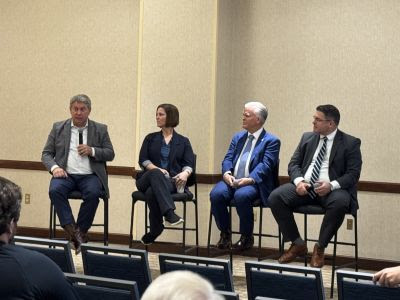 “Trade in Trump 2.0” panel at the National Association of Farm Broadcasting annual convention in Kansas City. From left to right: Gregg Doud, National Milk Producers Federation; Janna Fritz, United Soybean Board; Joe Schuele, U.S. Meat Export Federation; and Andrew Brandt, U.S. Grains and Bioproducts Council. (Agri-Pulse photo)
Doud: Ag needs to look beyond China
U.S. ag trade strategy is entering a new reality, with or without tariffs. That was one of the messages from a session called “Trade in Trump 2.0” at the National Association of Farm Broadcasting convention in Kansas City, Missouri.
National Milk Producers Federation President and CEO Gregg Doud says all the “easy stuff” on ag trade was done a long time ago. “We have lived off of Chinese demand for U.S. agriculture products for about 25 years,” says Doud, who served as chief agricultural negotiator in the Office of the United States Trade Representative during the first Trump administration.
Now, he says it’s time to move up the value chain and expand international markets for pork, poultry and dairy.
Meanwhile, U.S. Soybean Export Council Chairperson Janna Fritz says there is still a great deal of opportunity for soybeans in China, but also a lot of uncertainty. “Farmers are struggling, and we’re at a point where some of these things need to be finalized,” Fritz says.
The Trump administration says China has pledged to buy 12 million tons of soybeans by the end of the year. Since the week that President Donald Trump met with Chinese President Xi Jinping, confirmed purchases total about 1.4 million tons.
Egg producers get greenhouse gas reporting tool
The American Egg Board is releasing a first-of-its-kind tool for reporting greenhouse gas emissions from egg production.
It’s easy to be “in the know” about what’s happening in Washington, D.C. Sign up for a FREE month of Agri-Pulse news! Simply click here
The tool, announced in conjunction with this year’s Sustainable Agriculture Summit, includes a survey based on the 40 most-asked questions of producers when it comes to their practices and emissions. The tool also has a calculator for determining a producer’s Scope 1 and Scope 2 emissions.
“The tool gives egg farmers a streamlined way to communicate their sustainability practices and demonstrate leadership in a changing marketplace. Just as importantly, it shows customers that America’s egg farmers are committed to providing the information they need most,” said Emily Metz, president and CEO of the American Egg Board.
WOTUS proposal published, kicking off comment period
The public will have until Jan. 5 to submit comments on the latest proposal to define “waters of the U.S.” under the Clean Water Act, which was published in today’s Federal Register.
One of the issues EPA and the Army Corps of Engineers are seeking comment on is whether “relatively permanent” waters should be those “that typically have standing or flowing water year-round or that have standing or continuously flowing water at least seasonally (e.g., typically three months).”
Means formally joins administration
Make America Healthy Again advocate Calley Means has officially joined the Trump administration as a senior adviser to Health and Human Services Secretary Robert F. Kennedy Jr.
The HHS directory lists Means’ position, which was first reported in the New York Times. Means co-founded a company called TrueMed that sells products including fitness equipment and supplements.
Before becoming a senior adviser to Kennedy, Means was a special government employee and thus limited to 130 days of employment.
Final Word
"I would say that [the Renewable Fuel Standard] is the single greatest ag policy ever passed in D.C. in my lifetime. It's not the farm bill, it's the RFS. And I'm a corn and soybean farmer from about an hour from here on Missouri side." – Andrew Brandt, U.S. Grains and Bioproducts Council, speaking at the National Association of Farm Broadcasting’s annual convention in Kansas City, Missouri, Wednesday.
Lydia Johnson, Oliver Ward and Noah Wicks contributed to today’s Daybreak.


