
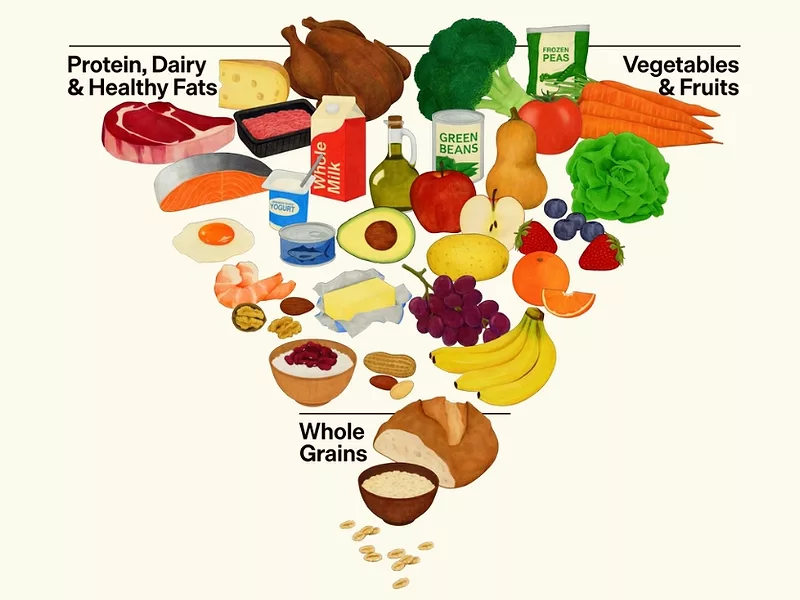
The Trump administration’s push to eat “real food” in line with the Dietary Guidelines for Americans got a boost from a Super Bowl halftime ad featuring legendary boxer Mike Tyson.
“We're the most powerful country in the world, and we have the most obese, fudgy people. Something has to be done about processed food in this country,” Tyson said as the screen told viewers, “Processed Food Kills” and advertised the administration’s new website, realfood.gov.
In the 30-second ad paid for by the MAHA Center, Tyson recounted his sister’s death “of obesity” at age 25 and how he at one time “would eat anything” and reached 345 pounds. He also took a few bites from an apple.
“While the MAHA Center is an independent nonprofit, the Tyson ad launches a national campaign in support of the Trump administration's efforts to evangelize whole food, reform SNAP to prioritize real food instead of soda and candy, and ensure our military and school lunch procurement features nutrient-dense food instead of poison,” the group said of the ad.
By the way: Frito-Lay, a unit of processed food giant PepsiCo, had a message of its own for the Super Bowl: A Lay’s ad featured a father and daughter passing down potato farming as a way of life. “This ad, inspired by a real family farm in Illinois who has worked with PepsiCo for decades, is a recognition of how critical farmers are to our business and the world,” PepsiCo Chief Sustainability Officer Jim Andrew says in a LinkedIn post.
E15’s moment of truth
Farm-state lawmakers return to Capitol Hill today with only a handful of days left to forge an E15 proposal that has a chance of moving through Congress later this month. President Donald Trump assured Iowa farmers in late January that he wants the House and Senate to move quickly in delivering an ethanol bill for him to sign into law that would allow year-round, nationwide sales of E15.
But the E15 effort has turned into a battle between large and small refiners, with biofuel stakeholders caught in the middle. A provision in recently proposed legislation, backed by the American Petroleum Institute, would slash the number of small and mid-sized oil refiners eligible for exemptions from federal biofuel-blending requirements. Independent energy firms loudly voiced their objection to lawmakers who have affected refineries in their districts and states. The opposition last month scuttled a plan to attach the E15 bill to a funding package that was set to clear Congress.
What’s next: House GOP leaders last month formed an E15 Rural Domestic Energy Council that’s tasked with recommending a plan by the end of this week, so the House can consider the bill by Feb. 25.
But, but, but: The week starts with many questions, including:
- How will lawmakers deal with small refinery exemptions, a major cause of contention in biofuel policy negotiations for years, including during Trump's first term?
- If a plan comes together, does it have enough support to pass Congress? The various factions include lawmakers from refining states and some Democrats who previously haven't backed ethanol expansion due to environmental concerns.
- With both the House and Senate out next week, and other big issues to deal with this week, is there even enough time for E15?
By the way: Pro-ethanol Democrats say the council isn't including them in the talks, underscoring the difficulty of moving bills through Congress in a midterm election year. But cutting Democrats out of the discussions will enable GOP take credit for any E15 deal that emerges.
"Federal legislation to allow the year-round sale of E15 has long been a bipartisan priority," Rep. Nikki Budzinski, D-Ill., told Agri-Pulse in a statement. "My Democratic colleagues and I have been clear about the need for Democratic voices on this council — a concern leadership has so far failed to address. I will continue to press for real, bipartisan action that our growers deserve.”
For more on this week’s agenda in D.C., read our Washington Week Ahead.
Dicamba announcement prompts predictably mixed reactions
Major farm groups are welcoming EPA’s decision to re-register dicamba. But the Friday announcement, which will allow the herbicide to be used this growing season, was not a surprise. Nor would it be surprising to see environmental groups sue again over what the Center for Food Safety and Center for Biological Diversity called the “drift-prone herbicide.”
The American Soybean Association, Agricultural Retailers Association and American Farm Bureau Federation were among the organizations that complimented EPA for approving what ASA called “a clear, practical, and science-based label.”
The two prominent environmental groups, however, said “experts have found dicamba drift damage to be the worst of any herbicide in the history of U.S. agriculture. Yet the current approval provides even fewer protections from dicamba drift and damage than past approvals.”
EPA says the new restrictions, including temperature-based prohibitions on spraying, are the strongest ever approved.
Read more in our article here.
Ag trade Friday
The Trump administration rounded out last week with a burst of ag trade announcements, providing new details on the recently agreed U.S.-India pact and opening the door to more Argentinian beef.
President Donald Trump signed an executive order to allow an additional 80,000 metric tons of lean beef trimmings from Argentina to enter the U.S. duty-free in 2026.
U.S. Cattlemen’s Association President Justin Tupper stressed in a statement that the measure should be limited to a “one‑time, measure of exception – not a template for routine quota expansions.”
Take note: The administration also has provided a few new details of a new U.S.-India trade deal. A joint statement says dried distillers’ grains, red sorghum, tree nuts, fruit, soybean oil, wine and spirits and other agricultural products will see tariff reductions.
PHOTOS GO HERE
Farmland abuts protected forests around a river in Mato Grosso. Middle: A visit from Agri-Pulse’s Oliver Ward and other international media outlets to Mato Grosso generates local media coverage. Bottom: Col. Flávio Glêdson Vieira Bezerra.
Reporter’s Notebook: For Brazilian farmers, fighting fires is part of the job
Trade Editor Oliver Ward files this report, where he has been reporting.
Firefighters in Brazil’s Mato Grosso region are getting assistance from local soybean growers. The Brazilian state that is the size of France and Germany combined has just 1,600 firefighters responsible for protecting a land area that spans rainforest, savannah grass and marshland biomes.
Col. Flávio Glêdson Vieira Bezerra, general commander of Mato Grosso’s firefighters, told reporters on Saturday that the fire service realized it needed to boost its operational power.
After severe fires in recent years, the group now recruits ag producers as “fire responders.” If a fire starts near their farm, the fire service contacts nearby responders, and they will use their farm equipment to help battle the fire until the fire service arrives.
The farmers are not paid for providing firefighting assistance but do so voluntarily.
In 2025, Bezerra said, there were 146 incidents where they contacted local farmers. The farmers mobilized 232 pieces of ag machinery to support the state’s firefighting efforts, including private planes.
Bezerra says the initiative is partly behind the significant fall in Mato Grosso’s annual burnt area in recent years. Even as the climate has grown hotter, Mato Grosso reduced its total area lost to fires in 2025 by more than 70%.
Final word
Fox News’ Maria Bartiromo: Do you have any estimate for us as far as when we’re going to see that China trade deal in writing?
Treasury Secretary Scott Bessent’s response: “No. But I can tell you that the Chinese have lived up to their end of the bargain. They’ve completed their soybean purchases.”
Check out Oliver Ward’s China purchase tracker, which he updates as buys are reported. So far, nearly 10 million tons of purchases have been reported, along with another 3 million tons bound for unknown destinations.
For more news, go to Agri-Pulse.com.
.webp?t=1762183428)

