
|
Gov. Gavin Newsom used an appearance before the Association of California Water Agencies to urge the state’s water leaders to “finish the job” on major infrastructure projects, framing Sites Reservoir, the Delta tunnel and groundwater recharge as core tests of whether California can adapt to climate whiplash after decades of conflict, delay and litigation.
The governor’s keynote last week sharpened the message running through ACWA’s spring conference: California has made significant progress in moving long-stalled water projects, but the hardest decisions are still ahead. Water leaders said Sites Reservoir has become a model for how California can overcome the odds on large projects, while business and conservation leaders warned that permitting, financing and affordability pressures are making it harder to build the infrastructure the state needs.
 Jennifer Barrera, CalChamber (Brad Hooker/Agri-Pulse)
Newsom cast the past eight years as a period of forced adaptation after a series of droughts, atmospheric rivers, floods and water quality crises exposed the limits of 20th century infrastructure and 19th century water laws.
“We all share one thing in common,” Newsom told ACWA members. “We’ve chosen a profession with forever problems. Water is the forever problem.”
He pointed to the Water Resilience Portfolio, released in 2020, as the foundation for his administration’s strategy. The portfolio included 142 actions across groundwater, recycling, storage, conveyance, safe drinking water, permitting and ecosystem restoration, serving as a roadmap for state agencies to support local efforts to diversify supplies, protect natural systems, build connections and prepare for climate risks.
But Newsom said the state had to become more aggressive as the 2020-2022 drought deepened and California confronted “weather whiplash.” He said the administration’s 2022 water supply strategy moved beyond planning and set numeric goals to offset an expected 10% loss in water supplies by 2040.
That target was later codified through SB 72, which calls for California to plan for 9 million acre-feet of additional water supply by 2040 through a mix of storage, conservation, groundwater recharge, recycling and other strategies.
Newsom said the state cannot meet that challenge without completing projects that have been debated for decades.
“We have to finish the job,” he said. “We’ve got to maintain the vigilance on these voluntary agreements [for the Bay-Delta Plan] at peril — or we go back to our old ways. We've got to do the groundbreaking at Sites. … We've got to get [the Delta tunnel project] done.”
Sites emerges as the test case
Sites Reservoir was the clearest example at the conference of a project moving from aspiration toward execution. During a separate ACWA panel, Sites Project Authority Executive Director Jerry Brown said the project is on the precipice of construction after clearing major state and federal milestones, with construction targeted to start next year and completion by the end of 2033.
It’s easy to be “in the know” about what’s happening in Washington, D.C. Sign up for a FREE month of Agri-Pulse news! Simply click here
Brown said the immediate test is the State Water Resources Control Board’s pending water right decision. The board’s administrative hearings office released a draft decision in March conditionally approving Sites’ water right application, with public comments due May 22.
Brown called the draft order “a good start,” but said the authority is preparing comments on provisions that raise concerns for the project and the broader water community. He said the authority expects a draft water right by July 15, which would begin a four-month push for participating agencies to seek board approvals for final investor commitments.
“This is the largest water right the state of California has issued since the ‘60s,” said Brown. “It says we can still do this.”
Newsom made the same point more bluntly, calling Sites an obvious climate adaptation investment.
“If you can't agree to an off-stream investment in this world, with the weather whiplash, we're as dumb as we want to be,” he said.
The governor also highlighted permitting reform as one of the administration’s major achievements. In 2023 lawmakers approved SB 149, allowing the governor to certify certain infrastructure projects for streamlined litigation under the California Environmental Quality Act. Newsom certified Sites under the law later that year, making it the first project to qualify. The law requires courts to resolve CEQA challenges to certified projects within 270 days to the extent feasible while preserving judicial review.
Brown said SB 149 was a turning point for Sites, helping the authority move through both trial court and appellate review within 270 days. “That was pretty amazing,” he said.
Jeff Sutton, general manager of Glenn-Colusa Irrigation District, said the law showed California can accelerate decisions without short-circuiting review.
“It did not short-circuit any analysis or review,” said Sutton. “All it did is streamline a process to get an answer, to keep projects on track.”
Sutton said that matters because delays can become fatal for major projects. Brown estimated Sites now costs about $6.5 billion, with each month of delay adding about $20 million in escalation costs.
That cost pressure reinforced broader concerns raised in another ACWA discussion over whether California can build needed infrastructure while keeping water affordable. Chelsea Haines, ACWA’s director of state regulatory relations, said water is largely absent from the governor race even though it underpins housing, affordability, wildfire resilience, ecosystems and economic growth.
Affordability, partnerships and the next governor
Metropolitan Water District of Southern California General Manager Shivaji Deshmukh said the industry’s success has made its challenges harder to explain.
“This industry is our own worst enemy,” he said. “We do a great job in terms of the reliability of water, but because of that high level of service, I don't think the general public really recognizes the challenges we face with the changing climate.”
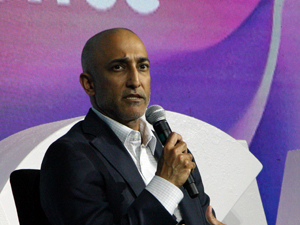 Shivaji Deshmukh, MWD (Brad Hooker/Agri-Pulse)
Jennifer Barrera, president and CEO of the California Chamber of Commerce, said California’s ambitious policy goals are running into cost constraints.
“We are facing an affordability crisis,” she said. “We have made policy decisions in the past — still well intentioned — but they're reaching a point of friction where the cost of implementing some of those policies are really pushing up against everyday costs of living.”
Barrera pointed to CalChamber’s Building an Affordable California Act, a proposed 2026 ballot initiative that would set firm timelines for environmental review and litigation for certain essential projects, including water, housing, transportation, clean energy, broadband, healthcare and public safety facilities. The proposal would not require agencies to approve projects, but would require decisions within defined timelines, similar to SB 149.
Chuck Bonham, executive director of The Nature Conservancy’s California branch and former director of the California Department of Fish and Wildlife, warned that permitting reform should not be framed as weakening environmental protections. He said the administration’s cutting the green tape effort for restoration projects shows that faster permitting can produce environmental benefits. But he said project sponsors also need to rethink how they approach regulators.
“Some people are hardwired to make regulatory permitting a fight,” said Bonham. “Other people are hardwired to figure it out.”
Sites supporters see the storage project as reflecting that shift. Brown said the authority revised earlier plans after receiving feedback from local communities, tribes and environmental groups. He acknowledged that some opponents remain, but said the process required the authority to understand concerns and show how they were considered.
“Everybody in this room is going to sacrifice something for a project like this,” said Brown.
Lance Eckhart, general manager of San Gorgonio Pass Water Agency, said Sites has advanced partly because it is locally led rather than run as a traditional state or federal project. He described the authority as a “lean startup,” with water agencies and investors making decisions directly.
“Sites is a paradigm shift for California,” said Eckhart. “Partnerships is the new water in California.”
Newsom echoed that argument in broader terms, crediting ACWA members as the “last mile” of state water policy.

